

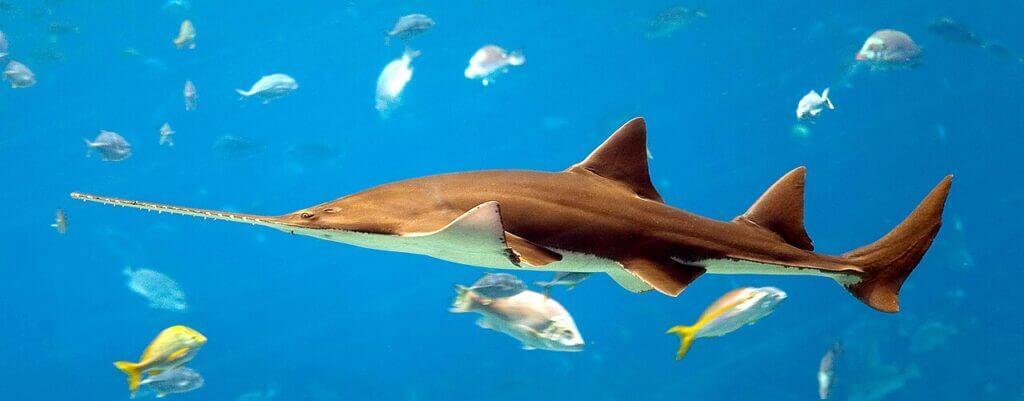
The Sawfish is an intriguing ray species that lives in a broad range of coastal and freshwater environments around the globe. The sawfish is a member of the Pristidae family and is distinguished by its characteristic saw-like rostrum. It has a distinct look that separates it from other marine organisms, with a long, flat body and a serrated snout.
Unfortunately, several species are threatened by habitat loss and exploitation, making them a conservation priority.
Species
Sawfish species share an elongated, toothed rostrum in common, but there are several species that are part of this family:
- Smalltooth Sawfish (Pristis pectinata)
- Largetooth Sawfish (Pristis pristis)
- Green Sawfish (Pristis zijsron)
- Dwarf Sawfish (Pristis clavata)
- Narrow Sawfish (Anoxypristis cuspidata)
Appearance
Sawfish are part of the Elasmobranch group, which also includes sharks, rays, and skates. Their skeletons are made of cartilage, not bone, which provides more flexibility. Although they resemble sharks, sawfishes are classified as rays due to the placement of their gills and mouths on the underside of their bodies.
The following are the essential characteristics that characterize their appearance in detail:
- Body Shape: Sawfish have long, flat bodies suitable for coastal and freshwater environments. Their bodies are streamlined, allowing them to glide through the water quickly.
- Rostrum (Saw): The most distinguishing characteristic is its large, flattened snout, known as the rostrum. The rostrum is bordered on both sides with sharp, serrated denticles that resemble a saw blade. Depending on the species, their rostrum can have between 14 and 37 denticles. The rostrum varies in size and form, with some reaching lengths of up to one-third of the entire body length.

- Eyes and Spiracles: Sawfish have small, bead-like eyes on the top of their heads, which allows them to see when partially buried in sandy bottoms. They also have spiracles behind their eyes that enable them to take in oxygen from the water during periods of inactivity.
- Dorsal Fins: They have two dorsal fins positioned on their back. These fins provide stability during swimming and help control their movements.
- Pectoral Fins: They have two pectoral fins on either side of their body just behind their head. These fins help Sawfish with lift and steering as they glide through the water.
- Pelvic Fins: They have two pelvic fins for added stability. Males boast an extra feature – claspers. These specialized appendages at the base of the pelvic fins are actually the Sawfish’s male reproductive organs.
- Coloration: Their color varies by species and region, with brown, gray, or olive upper bodies providing camouflage in waterways.
Diet
Sawfish have thousands of small organs called electroreceptors packed into their rostrum which helps them to detect the tiny electrical currents created by live animals. They use this sixth sense to grab their victim from up to 40 cm away, swiping their lethal saw through the water with deadly accuracy.
Sawfish eat various fish including bony fish like mullet, herring, and catfish; rays; small sharks; invertebrates and crustaceans like crabs, lobsters, and shrimp.
Habitat
Sawfish primarily inhabit shallow coastal waters, estuaries, and rivers in tropical and subtropical regions, with a significant presence in Florida, USA.
They are adapted to a variety of habitats but are commonly found in areas close to red mangroves and can venture into waters as deep as 100 meters.
They are incredibly adaptable organisms and can be found in a wide range of coastal and freshwater habitats, preferring shallow coastal waterways such as estuaries, mangrove swamps, lagoons, and tidal flats, where they find food, shelter, and nursery grounds for their young.
Although they prefer shallow water, they can also venture into waters as deep as 100 meters. They may also be found in freshwater rivers, lakes, and brackish bodies of water.
They are more common in tropical and subtropical areas, with certain species migrating into temperature zones during the warmer months. They favor sandy or muddy bottoms and protected locations that offer shelter.
Some species are capable of long-distance migrations in search of food, ideal breeding sites, or varied habitats with changing climatic circumstances.
Reproduction
The reproduction of sawfish is a fascinating process, with some unique characteristics that set them apart from other fish species. They reach sexual maturity relatively late compared to other fish. The precise age of reproductive maturity varies depending on the species and can range from 7 to 15 years of age – or even longer for some larger species.
Sawfish are ovoviviparous, meaning their embryos grow inside the female’s body. Males transport sperm into the female’s body during mating using claspers, which are modified pelvic fins. The eggs are fertilized internally, and the gestation period, or the time between conception and birth, varies by species. It usually lasts many months, with some species having reproductive spans of nine months or longer.
When the female’s gestation cycle is complete, she gives birth to live, fully-formed pups. The number of pups in a litter varies depending on the species, ranging from one to a few.

After giving birth, females may use shallow, protected areas such as mangroves, lagoons, and estuaries for their young. Sawfish show little parental care beyond the delivery of live young. Pups are left alone to fend for themselves in their nursery environments after birth.
Threats
Global sawfish populations have declined significantly due to a variety of stressors. The Smalltooth sawfish populations concentrated around the Florida Keys, for example, have declined significantly for the past century and the NOAA Fisheries and the Endangered Species Act list them as an endangered species.
Several human actions and environmental factors contribute to these dangers. The following is the critical information concerning the main threats to them:
- Overfishing: They are often caught incidentally as bycatch in fishing gear, such as trawls, gillnets, and longlines. They can become entangled and drown in fishing gear intended for other species.
- Climate Change: Climate change affects the marine environment in multiple ways, including rising sea temperatures and changes in ocean currents. These factors can impact the distribution of their prey and disrupt their habitats, affecting their overall survival and reproductive success.
- Pollution: Pollution from various sources, including industrial runoff, agricultural chemicals, coastal development, and plastic waste, can contaminate the waters where they live. This pollution can harm their health, disrupt their feeding patterns and affect their reproductive success.
- Illegal Fishing and Trade: Despite international protection through CITES (Convention on International Trade in Endangered Species of Wild Fauna and Flora), illegal fishing and trade of sawfish and their body parts continue to be a problem, fueling the decline of populations.

Conservation
Key conservation strategies include the establishment of protected areas, anti-finning laws, and regulations against the trade of sawfish parts. Community-based conservation efforts are also critical, involving education and outreach to encourage the reporting of sawfish sightings and the safe release of accidentally caught sawfish.
Globally, the Save Our Seas Foundation supports research teams in remote locations to document sawfish populations and their habitats, which can help in creating targeted recovery plans. These teams engage local communities, particularly in regions like the Gulf of Mexico, West Africa, and Southeast Asia, to increase awareness and gather crucial data about sawfish presence and threats.
5 Curious Facts About Sawfish
- Sawfish are euryhaline, meaning they are able to navigate across different levels of salinity.
- Denticles are modified scales for sensing, while their real teeth are hidden in their underside mouth.
- Female Smalltooth Sawfish can occasionally reproduce asexually (facultative parthenogenesis), birthing male clones to maintain populations when males are scarce.
- Sawfish rely on electroreception in their rostrums to find prey by sensing their electrical fields.
- Sawfish have few natural predators, facing occasional attacks from sharks, dolphins and crocodiles.
FAQs
Are Sawfish dangerous to humans?
Sawfish are generally docile towards humans, however, their impressive saw is a powerful tool for defense.
Why are Sawfish listed as endangered?
Sawfish face a serious conservation crisis and are likely the most imperiled group of marine fishes on Earth. All five Sawfish species have suffered population declines exceeding 90%. This dramatic drop is due to two threats: overfishing and critical habitat loss.
How do Sawfish use their rostrum for hunting?
Sawfish hunt using their rostrum, endowed with delicate electrosensory organs known as ampullae of Lorenzini that can detect weak electric fields created by concealed or buried prey.
Do Sawfish have bones?
Sawfish, like all sharks and rays, are cartilaginous fish. They don’t have skeletons made of true bone. Instead, they have a lighter and more flexible internal framework made of cartilage. This makes it uncommon to find complete fossil records.
How many species of Sawfish are there?
There are five species of Sawfish still alive today: Largetooth sawfish, Dwarf sawfish, Smalltooth sawfish, Green sawfish and Narrow sawfish.


