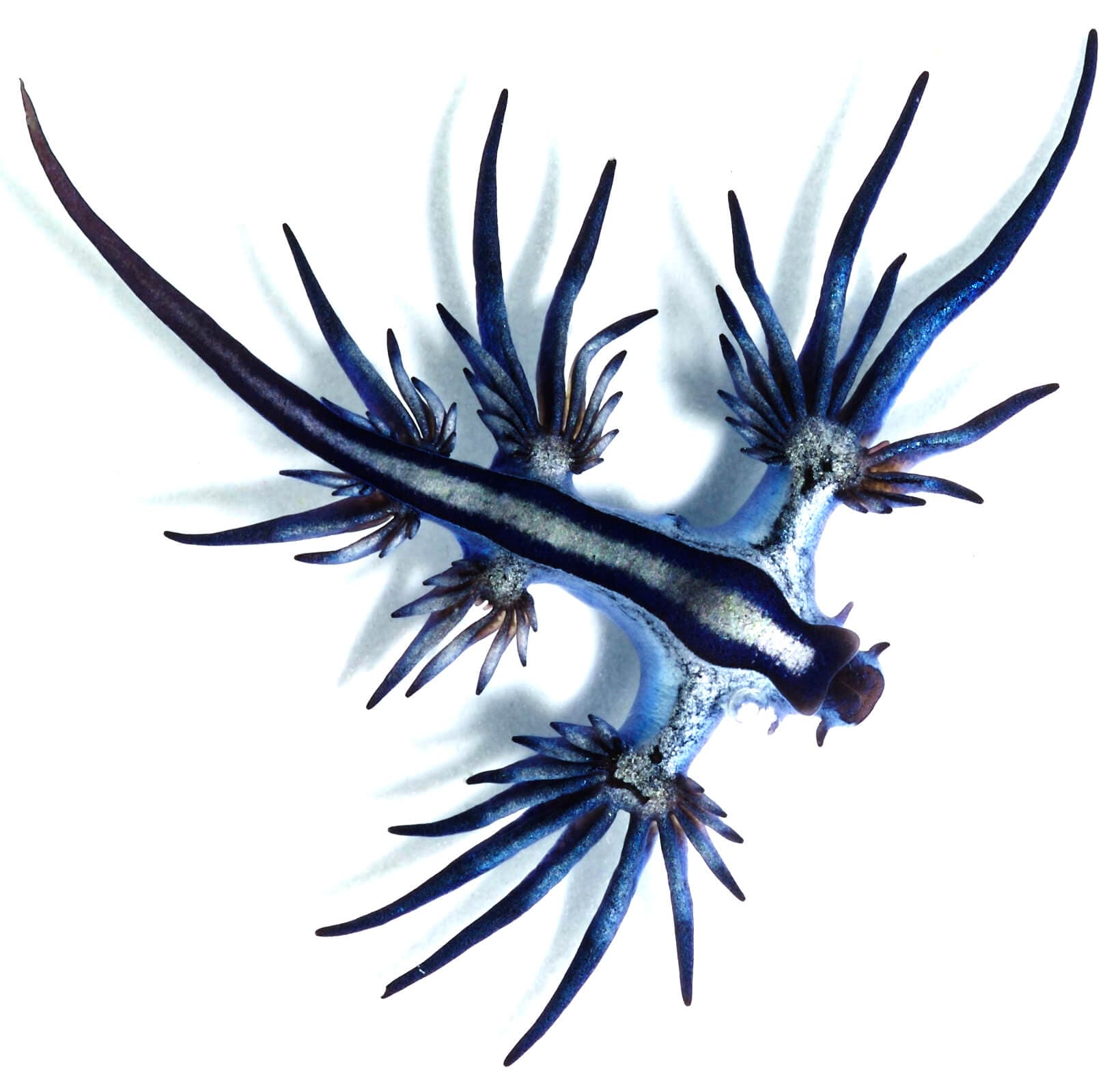

The blue glaucus, also known as the blue dragon or blue angel, is a type of nudibranch, a soft-bodied mollusk belonging to the sea slug family. Its vibrant blue hues and wing-like appendages allow it to gracefully glide through the open ocean, making it a striking and unique marine creature.
As majestic as it looks, it hardly grows more than 3 centimeters (1.5 inches) because, despite its small size, it can prey on sea animals larger than their size, such as jellyfish. Join us as we uncover the secrets of this extraordinary sea creature.
Appearance
The bodies of blue glaucus are soft, shell-less, and consist of 6 appendages that give rise to “Cerata” (tentacles-like projection- usually ranging from 6-12 on each side). They have a unique buoyancy system in which their stomach contains a sac that fills with gas, allowing them to float to the water’s surface upside down.
The Blue Glaucus has some great methods of preventing itself from any surrounding dangers. Glaucus’ bodies make them more concentrated and venomous. Toxic chemicals are released when a predator tries to hunt them, giving them a powerful sting.
Their skin itself comes in handy to protect them. The blue upper body faces upward, blending with the ocean color and camouflaging it from airborne predators, and the lower pearlized silver part faces downward, merging with the sun’s reflection on the ocean when looked down below by predators. This countershading provides them with valuable camouflage beneath the bright sea surface.

Did you know…
The Glaucidae family includes only two species: Glaucus atlanticus (commonly called the blue glaucus) and Glaucus marginatus. While they share the same striking blue coloration, they differ in size and tentacle arrangement. Glaucus marginatus is smaller than Glaucus atlanticus. Additionally, in Glaucus atlanticus, the tentacles (known as cerata) are arranged in a single row, whereas in Glaucus marginatus, they are arranged in multiple rows.
Habitat
Blue Glaucus are ocean creatures mainly found in the Pacific, Atlantic, and Indian Oceans. A large population is found in Australia, South Africa, Europe and in the Portuguese islands of the Azores. However, there is a possibility that their habitat is very vast, some specimens have also been found in Brazil. Since they are so small, they are hard to quantify.
Unlike other nudibranchs that live on the deep surface, these blue dragons float on the ocean’s surface. This is made possible by air bubbles in the stomach. Although their skin color helps them camouflage on the surface, this position also gives them a disadvantage as they are more prone to being brushed onto land due to ocean currents. Even with this, the stings on their periphery are still active and protect them from harm.

Diet
Blue Dragons are considered carnivores, and their favorite meal is jellyfish: including blue button (Porpita porpita), the violet snail (Janthina janthina), the by-the-wind-sailor (Velella velella), and, most importantly, Portuguese man o’ war.
Jellyfish are known to have a great defense mechanism against their predator through their deadly stings, though this little fella of an ocean creature has a solution. As soon as they approach their preferred prey (aka the jellyfish), they release an inhibitory mucus that neutralizes the effect of a stinging capsule, helping the blue glaucus to feed on their tentacles. The glaucus also has radular teeth resembling a knife’s serrated edge, making it easy to tear into the jellyfish flesh.
If the mucus doesn’t work, the hard disc on their skin releases spindles when encountered with stinging cells, that are then absorbed in the body. Once absorbed, some of these cells are digested, whereas most of them are migrated from the gut to the periphery, where they are stored in the body for days to weeks.

Reproduction
Blue glaucus are hermaphrodites, meaning they possess the ability to be both male and female, along with male and female reproductive organs. Their mating lasts for several minutes to an hour, and since their whole body is loaded with stinging cells, they avoid touching each other as much as they can.
The organisms intertwine their penises during mating until the eggs residing in each of them are fertilized. Once this is established, they both separate from each other and lay their eggs. Within hours, several eggs are hatched into baby glaucus without needing much gestational care.
Threats
The blue glaucus faces challenges in its ocean home. Predators like fish, turtles, and birds find them an easy target. Pollution, climate change and habitat loss from human activities, and rough seas further threaten their survival. Their reliance on specific prey also makes them vulnerable to changes in the marine ecosystem.
A lot of people try to keep them as pets, and since their diet and mating habits are not suitable for a closed space, they usually die. A decline in jelly fish populations also directly impacts blue glaucus survival.
6 Other Facts about Blue Glaucus
- A group of glaucus is called blue fleet. They are often seen as groups that are ideal for attacking prey, as well as mating.
- Despite many tries, it has not proven to be good pet primarily due to their venomous stings but also due to their dietary requirements.
- Their life span is generally quite short as they only survive for a few months or a year.
- They have several other names, including sea lizard, sea swallow, and blue ocean slug.
- More and more of these blue glaucus have been spotted on the beach recently, which can be attributed to increasing oceanic currents.
- Picking one up results in a painful sting and symptoms similar to those of its prey.
FAQs
Why are blue dragons dangerous?
Blue dragons store nematocysts, which are stinging cells, from their prey (Portuguese Man O war) and concentrates it in their bodies, which means their poison is more dangerous than that of a jellyfish. This adaption is made to protect themselves from predators. So if you find them onshore, it is better to just look at them from afar and don’t try to pick them.
How endangered is the Blue Glaucus?
Blue dragons have been classified as endangered species on the IUCN Red List. The exact number of remaining blue dragons is difficult to calculate since they are spread throughout the world. However, it is clear that ever since their internet popularity, this species has faced tremendous losses.
Can the Blue Glaucus kill you?
Unfortunately, the answer is yes. Their venom is concentrated and, therefore, more poisonous than a jellyfish. The good thing is they are rarely seen on the shore. In 2015, there were reports of Glaucus seen on Australian shores. Last year, in 2020, they were spotted on the shores of Texas. People were advised to keep their distance from this small but harmful creature which helped to protect them from unfortunate events.
What do you put on a Blue dragon sting?
If you have been stung by a Blue dragon, it is better to seek emergency help and go to a nearby hospital rather than trying to treat it at home. Their sting can produce various symptoms, including nausea, vomiting, severe pain, redness, papules and fluid-filled blisters. Due to the wide range of systemic symptoms, proper medical help should be taken.
Can you have Blue Glaucus as a pet?
Glaucus is an ocean animal, and they usually don’t survive in captivity. Apart from having a fiery sting, which can be deadly, they also have specific dietary requirements, which include another stingy animal i.e., Jellyfish. Additionally, their mating habits are also not suitable for closed environments. Therefore, they usually die when kept as pets.
Is Blue Glaucus cold-blooded?
Yes, blue dragons are cold-blooded nudibranchs (organisms that lose their shells after completing the larval stage). They belong to the phylum Mollusca and class Gastropod (Slugs or snails). Hence their other name is Blue Slug.