
A key player in the biological carbon pump, sequestering over 11 gigatonnes of carbon each year, the ocean has long borne the brunt of the increase in greenhouse gases (GHG) and carbon dioxide (CO2) emissions.
Human activities have gradually driven this climate change, resulting in ocean acidification, temperature fluctuations, sea level rise, and deoxygenation. These changes impact the diversity and richness of ocean species, alter oceanic circulation, and amplify storm intensity.
A cascade of consequences follows: marine resources, marine fisheries, and coastal communities are all disrupted. Consequently, global businesses, food resources, physical environments, and economic structures are impacted.
In this article, we dive into the details of those impacts and discuss how the health of our oceans can be improved through careful practices.
How the Ocean Influences Climate
Oceans cover over 70 percent of the Earth’s surface and contain 97 percent of its water, playing a crucial role in balancing the climate system. As the largest carbon sink, the ocean plays a central role in regulating the Earth’s climate.
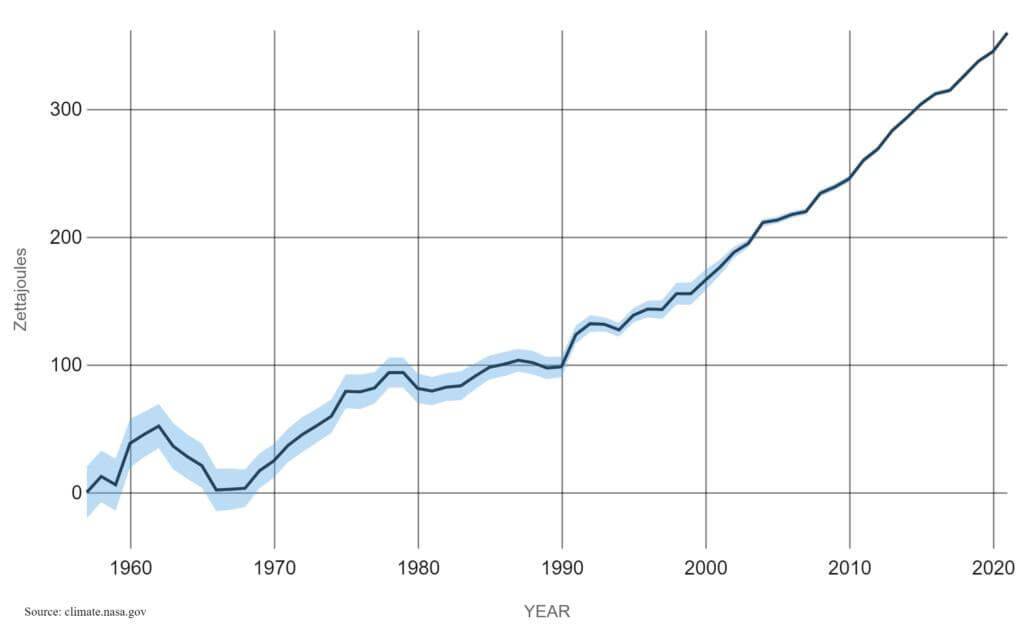
The Fifth Assessment Report by the Intergovernmental Panel on Climate Change (IPCC), published in 2013, indicated that the ocean has absorbed 93% of the excess energy from the enhanced greenhouse effect, with warming now detectable at depths of up to 1,000 meters.
We explore the various ways in which the ocean contributes in an in-depth article, you can find out more about it below.
9 Effects of Climate Change on Our Oceans
Destructive human activities have put the Earth’s climate at significant risk, leading to potentially long-term, irreparable changes. Here are some ways through which oceans are getting affected due to the high rise in temperatures:
Rising Sea Levels
Over the past 50 years, climate change has intensified extreme events and increased their frequency, resulting in a surge of natural disasters. Sea-level rise exacerbates deadly storm surges and coastal hazards like flooding, erosion, and landslides, which now occur at least once a year in many areas—previously a once-per-century phenomenon.
Predictions by Kulp & Strauss indicate that high emission rates could cause sea levels to rise drastically, affecting over 1 billion people annually by 2100, with 230 million potentially losing their homes to floods as tide levels rise by up to 1 meter.
Only in Alaska and a few places in the Pacific Northwest are sea levels falling, though that trend will reverse under high greenhouse gas and carbon dioxide emissions.
Several regions, such as the western Tropical Pacific, the South-west Pacific, the North Pacific, the South-west Indian Ocean and the South Atlantic, face substantially faster sea-level rise.
— Intergovernmental Panel on Climate Change (IPCC)
Stronger Storms and Destruction
Stronger storms and rising sea levels are major concerns due to the noticeable climatic changes. These result in widespread destruction, loss of property, and infrastructure failures. Preventative measures, including strict laws, policies, long-term programs, adaptation actions, and increased capacity, are crucial to mitigate these effects.

Communities in Florida, Louisiana, Rhode Island, California, and New York have experienced the devastating effects of hurricanes, extreme weather, and rising tides due to climate change. Recent research in Bangladesh estimates that during a powerful cyclone, mangroves could reduce seawater rise by 4 to 16.5 centimeters and decrease water inflow speed by 29% to 92%. Thus, protecting mangroves offers significant benefits to communities.
Impact on Coastal and Marine Ecosystems
Climate change also threatens entire coastal and marine ecosystems, making many species vulnerable to extinction. Coastal erosion is a significant concern, and the oceans’ ability to absorb CO2 underscores the urgency of protecting these resources. Oceans absorb CO2 even below 200 meters, and 90% of heat generated by rising emissions is absorbed by the oceans, which act as efficient carbon sink, absorbing 23% of human-caused CO2 emissions.
Glacier Melting and Ice Collapse
The shart temperature rise in the last decade has accelerated glacier melting at an alarming rate. Ice collapse in the cryosphere and the Amundsen Sea in West Antarctica has already passed tipping points.
NOAA reports that Annual average Arctic sea ice extent has decreased between 3.5 percent and 4.1 percent per decade. As a result, NASA satellites are keeping a close eye on the melting ice, the ocean currents, and the ocean life to better understand this phenomenon.
Coral Bleaching
Excessive increases and decreases in the temperature of the water, decline in nutrient rate, and lack of light energy lead to coral bleaching. In any of these conditions, the corals eject the algae (zooxanthellae) existing in their tissues, causing the coral to turn white. Corals can survive the bleaching event, but they undergo more stress and are highly vulnerable to mortality.

Between 1979 and 1990, mass bleaching of corals took place, affecting the rest of the areas of the world. In 2016, almost 29 to 50 percent of the reef’s coral was killed due to bleaching on the Great Barrier Reef, resulting in the longest coral bleaching event.
This was not it; the bleaching stretched into the central area of the reef around 2017 due to El Nino (infrequent warming of surface water in the eastern tropical Pacific Ocean), resulting in damage to over 70 percent of the coral reefs. As of 2019, it is stated that large-scale restoration of corals won’t be effective. Refurbishment on an individual level is being carried out realistically and operatively to overcome the destruction of corals on a mass scale.
Migration of Fish
Tropical countries rely greatly on fish resources for their economic stability. Due to the constant rise in the temperature of ocean water because of climate change, fish have started to migrate to cooler regions to maintain their thermal environment. Therefore, the economies of tropical countries are at risk as ocean warming has eventually led to the loss of their resources.
For instance, as local ocean temperatures increase, pollock and cod are migrating north to colder waters. These shifts disrupt the ecosystems they enter and create uncertainty regarding applicable fishing regulations.

Unfortunately, there are absolutely no policy measures to mitigate the loss when a fish leaves a country’s Exclusive Economic Zone (EEZ). It is estimated there will be a loss of 6-25 percent of fish species from EEZ of Northwest Africa by 2050, which is jaw-dropping. By 2100, a drastic dip in fish stock of 30-58 percent has been estimated. However, there are no laws or policies to compensate for this huge loss.
Damaging Impact on Wetlands
Wetlands prevent greenhouse gases from entering the atmosphere. It also helps in the inhibition of water pollution, recharges the groundwater level, supports habitat and species diversity, protects from the extinction of many exotic species, and prevents phenomena like strong floodwater flow and melting of snow.

The amount, timing of rainfall, and temperature changes lead to a rise in sea level, causes changes in the components and constituents of water, changes in habitat, flooding, and quality of the environment. The tree’s mortality rate goes higher, lack of moisture availability occurs, and vegetation for the communities gets disturbed on a major scale.
Ocean Acidification
Ocean acidification is the phenomenon in which a high amount of CO2 is absorbed by seawater, resulting in a series of chemical reactions and leading to a decrease in pH levels, and carbonate ion concentrations. It is a process that greatly affects the saturation state of calcium carbonate minerals, which is an essential component (known as the building block of skeletons and shells) of marine species.
Changes in water pH have led to ocean acidification, disrupting carbon sequestration by other species including mollusks and crustaceans. The supersaturation and undersaturation of these minerals vastly impact the coastal organisms to produce and maintain their shells.

For example, Pteropods, which are tiny pea-sized organisms, serving as food source for many other marine species, undergo drastic changes which lead to the dissolving of their shells due to the low pH of seawater.
Shellfish also undergo similar changes, which result in total failure of their reproductive organs. This is because the pathogen level increases and the amount of dissolved oxygen decreases on a major scale.
Scientists and researchers are still working on measures to inhibit the acidification of ocean water, and strict laws and policies are to be implemented to prevent this hazard from continuing.
Alteration in Water Currents
The variation in oceanic currents can have a great impact on the migratory patterns and reproductive habits of many coastal species, threatening fish stocks and exerting a direct impact on the coastal communities that depend on these resources.
For example, coral reefs and other reef fish species directly depend on the dispersion of larvae by currents.
Impact on Coastal Communities
The number of changes listed above ultimately impact the lives and livelihoods of coastal communities and beyond. The degradation of marine resources and ecosystems due to climate change diminishes the ocean’s capacity to provide food, ecosystem services, generate oxygen, regulate carbon dioxide, and adapt to climate changes.
Mitigation Strategies
Luckily, all is not lost. Improving ocean health requires careful practices, including reducing pollutants, conserving water, preserving environmental quality, and developing sustainable resource management. Addressing the climate crisis is essential to maintaining the integrity and value of ocean resources before they become entirely nonexistent.
Aquaculture, or seafood farming, strengthens resilience against climate change. Reducing energy consumption is another key step everyone can take to lower carbon emissions, which helps mitigate ocean warming and acidification. Additionally, shopping sustainably and planning meals with sustainably harvested seafood contribute to maintaining healthy ocean ecosystems

Government Policies and Laws
According to the 2014 COP21 and the 2015 Paris Agreement, steps are taken to prevent damage to marine species and to protect the climate. These include:
- Limiting the rise in temperature to 1.5 degrees Celsius
- End subventions to fossil fuel creation
- Renewal of energies
- Adapting measures
- Sustainable management of biodiversity
Intergovernmental Panel on Climate Change
The Intergovernmental Panel on Climate Change conveyed a special report in which over 100 scientists from 36 different countries pledged to alter the changes in the ocean and cryosphere part of our planet. Priorities include:
- Preventing glacier and ice sheets from melting
- Regulating greenhouse gases
- Averting ocean warming
- Preventing acidification of ocean water
UN SDGs
Goal 14 of the United Nations Sustainable Development Goals (UN SDGs) highlights the need for the conservation of the ocean and sustainable use of marine resources
Goal 13 of the United Nations Sustainable Development Goals (UN SDGs) highlights the need to address the increasing effects of greenhouse gas emissions.
Proposed Climate Change Solutions
The truth is that careful handling of human activities can save us from a handful of global impacts of climate change and oceans. We need to make sure that each one of us are playing our individual and collective role-for a better future!
- Renewable energies – Switching to safer energy sources like wind, water, and biomass.
- Reduction of carbon footprints – Adapting eco-friendly ways for transportation.
- Preventing Air pollution – The quality of air should be maintained by reducing the number of industrial effluents being directly channeled into the atmosphere.
- Recycling – to limit the waste going into the ocean, as well as the energy required to make new materials.
- Sea and ocean conservation, including protecting marine life, corals, and irreversible damage to ocean properties.
Ocean Insights: Hear From Our Experts

By Rida Nasir
Researcher and Conservationist, with an MSc in Environmental Science
Oceans cover an immense area of 139 million square miles (361 million km²) and hold about 1.37 billion km³ of water, which can sequester carbon from the atmosphere. However, as climate change worsens with increasing greenhouse gas emissions, the oceans have been drastically affected over the past decade. The oceans, accounting for about 70% of Earth's surface, have absorbed 20% to 30% of anthropogenic carbon dioxide emissions in recent decades (7.2 to 10.8 billion metric tons per year), leading to increased acidity and declining oxygen levels. Significant changes in ocean current patterns are also occurring, impacting marine health and species. In my expert opinion, to preserve our oceans, we must strictly adhere to the Paris Agreement's goal of keeping the global temperature rise "well below 2°C" and striving to limit warming to 1.5°C. With the world emitting 41 billion tonnes of CO2 in 2022, we only have six years of current emissions left to have a 50% chance of staying below 1.5°C.
FAQs
How does the ocean affect climate change?
The ocean influences weather and climate by storing solar radiation, distributing heat and moisture around the globe, and driving weather systems.
Can ocean currents affect climate?
Yes, ocean currents regulate global climate, helping to counteract the uneven distribution of solar radiation reaching Earth’s surface. Without currents in the ocean, regional temperatures would be more extreme — super hot at the equator and frigid toward the poles — and much less of Earth’s land would be habitable.
Where does 90% of global warming occur?
More than 90 percent of the warming that has happened on Earth over the past 50 years has occurred in the ocean.


