
Dakosaurus (Dakosaurus andiniensis), were fearsome predators that lived during the Late Jurassic period, around 152 to 157 million years ago. This prehistoric crocodile was a member of the family Crocodylomorpha. This family consists of marine crocodylomorphs that evolved to live almost exclusively in the ocean.
While it was not as well-known as some marine reptiles of the time, like Plesiosaurs and Ichthyosaurs, Dakosaurus (meaning biter lizard) was a formidable predator in its own right. It could easily swim through the water with a streamlined body and powerful flippers.
Read on for more about the evolution and ecology of this super rare aquatic creature.
Appearance
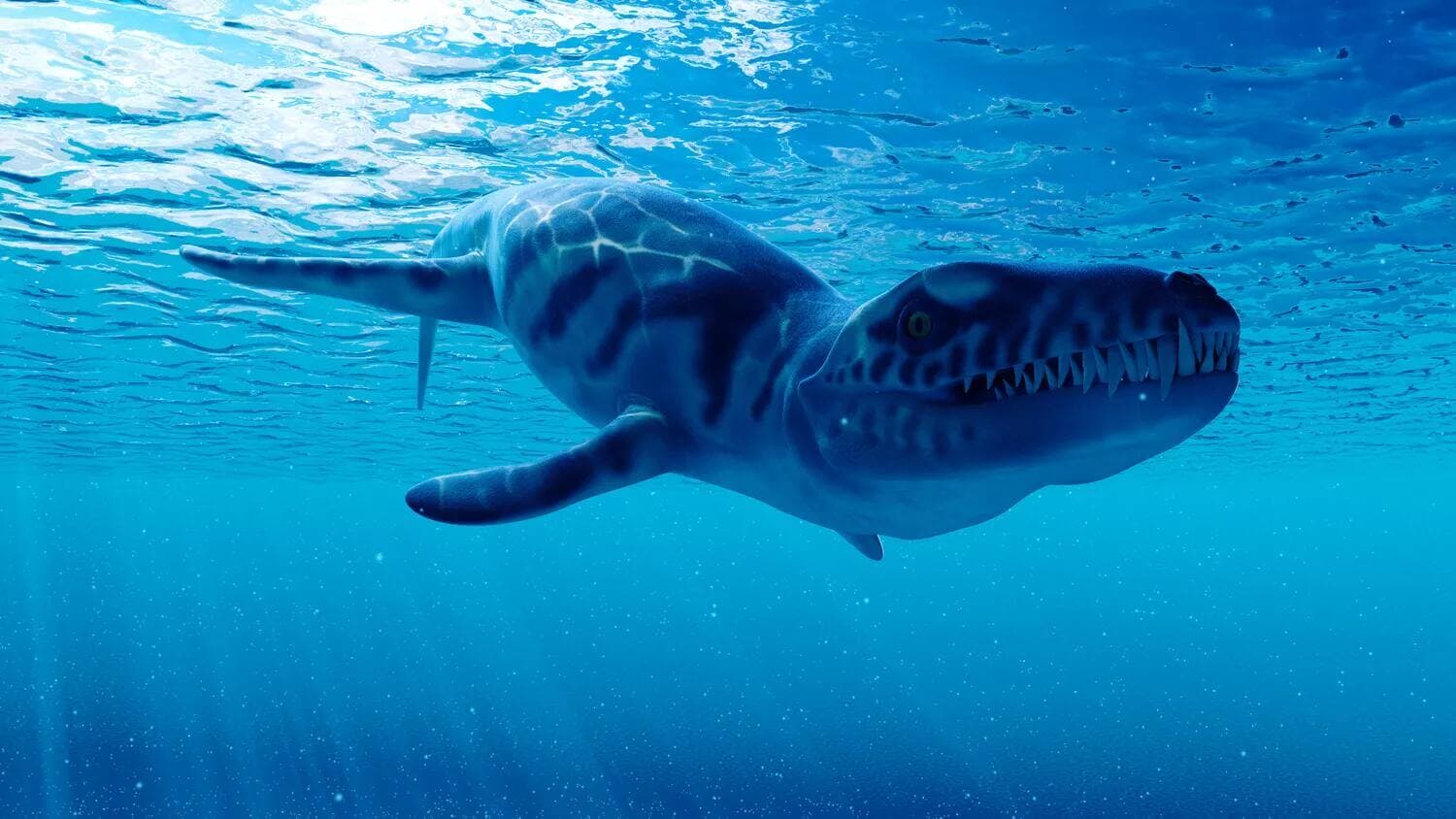
Dakosaurus was a large and long reptile, measuring up to approximately 4.5 meters. The long, narrow tall snout filled with sharp teeth shows that Dakosaurus was well-suited for catching and eating fish and other marine animals. At the same, it had a streamlined body with four flippers that allowed it to move quickly through the water.

They had a similar body shape to modern-day dolphins. That means it also had a tall dorsal fin and a fluke tail that provided propulsion. Its eyes were also high on its head, allowing it to see above the water’s surface.
Their skulls are triangular, with deeply rooted large, serrated teeth deeply rooted in the jaws and a bulbous, deep mandibular symphysis.
Habitat
Fossils have been found from Late Jurassic deposits from England, France, Switzerland, Germany, Poland, Russia, Argentina, and Mexico. They were typically found in marine environments such as shallow seas and coastal regions.
Based on the fossils, it is believed that Dakosaurus preferred warm, shallow waters with abundant marine life. They lived in the same areas as ichthyosaurs, plesiosaurs, and other marine reptiles.

It probably roamed the warm waters and coastal beds of Argentina in search of prey and gave birth in shallow waters where the safety of young might’ve been more guaranteed. In short, they had a wide distribution and inhabited warm waters during the Late Jurassic or early Cretaceous period.
Diet
There is no direct evidence of a dakosaurus feeding. The fossil records also indicate that they were a powerful predator that fed on various marine animals. The presence of sharp Dakosaurus teeth confirms that they were carnivores. It had a long, narrow snout filled with sharp teeth. Without a doubt, this implies these reptiles had a relatively easy time catching and eating fish, squid, and other marine reptiles.

The Dakosaurus probably fed on all sorts of marine animals, primitive whales, and other predators, and maybe even attacked members of its kind.
Some fossils were found with the remains of other marine reptiles. This discovery suggests that it may have been an opportunistic predator that hunted whatever it could catch.
Reproduction
The extent of its adaptation to a marine lifestyle means that it is most likely that it mated at sea, but since no eggs or nests have been discovered that have been referred to Dakosaurus, whether it gave birth to live young at sea like dolphins and ichthyosaurs or came ashore like turtles is not known. They can be compared with modern-day sea turtles to see how the extinct animals reproduced.
After laying, these extinct animals likely buried the eggs in the sand to offer protection from predators and weather elements.

Threats
They are an extinct genus. Researchers are working hard to find the exact reason for the extinction of Dinosaurs. However, analysis suggests that changes in sea levels, climate variations, and competition among marine predators could be the main culprits.
History and archeology indicate the prevalence of significant sea-level fluctuations during the Late Jurassic period. These changes often led to unhealthy alterations in the marine ecosystem. These changes may have reduced the availability of prey and made it difficult for them to survive.
Additionally, the climate during the Late Jurassic was changing. Many parts of the earth began experiencing cooler and drier conditions towards the end of this troubled period. Climate change may have adversely affected the distribution and its ability to adapt.
Competition with other marine predators, such as plesiosaurs and mosasaurs, may have also contributed to their decline. These animals were also apex predators.
6 Astonishing Facts About Dakosaurus
- Dakosaurus likely had a unique respiratory system adapted for prolonged underwater activity.
- The name Dakosaurus means “biter lizard”, and is derived from the Greek dakos (“biter”) and sauros (“lizard”).
- Some scientists believe Dakosaurus and other metriorhynchids may have been warm-blooded, giving them an advantage in colder waters.
- It was a fully marine reptile, spending its entire life in the ocean.
- Unlike modern crocodiles, they had paddle-like limbs for efficient swimming.
- Some scientists call them primitive whales.
FAQs
What is the difference between Dakosaurus and other marine reptiles?
Dakosaurus evolved to live almost entirely in the ocean. Other marine reptiles, such as plesiosaurs and ichthyosaurs, were adapted to life in the water but still needed to breathe. They lived during the Late Jurassic period, while other marine reptile groups like ichthyosaurs, plesiosaurs, and mosasaurs appeared and flourished during different periods of the Mesozoic era.
How do scientists know when Dakosaurus lived?
Scientists use radiometric dating and other methods to examine the rock layers where the fossils were found. By analyzing the age of the rock layers where their fossils were found, scientists have determined that they lived during the Late Jurassic world, around 152 to 157 million years ago.
Is a Dakosaurus a Dinosaur?
No, a Dakosaurus is not a dinosaur. Although it lived during the same period as well-known dinosaurs like Stegosaurus and Allosaurus. They were a member of a group of marine crocodylomorphs called metriorhynchids. These were not dinosaurs but reptiles that evolved to live almost entirely in the ocean. While some dinosaurs lived in aquatic environments, they were less adapted to underwater hunting.
Are there living relatives of Dakosaurus?
No, there are no living relatives of Dakosaurus. Today, the closest living relatives of thalattosaurs are lizards, snakes, and tuatara, collectively grouped as the order Squamata. However, thalattosaurs and Squamata are not closely related. The last common ancestor of these groups lived around 250 million years ago, long before the evolution of thalattosaurs.