

Hogfish, Lachnolaimus maximus, commonly known as hog snapper, is a species from the Wrasse family. It is a vibrant-colored fish that inhabits the Atlantic Ocean. It is especially plentiful in the Gulf of Mexico, Florida, and the Caribbean Sea.
The hogfish is easily distinguishable by its elongated snout resembling a pig’s, hence its name. It is also known for its ability to change its color according to its surroundings. An interesting feature about this species is that it is a protogynous hermaphrodite. All juvenile hogfish are born as females and later transform into males as they mature.
Over the years, the value of hogfish has greatly increased in both recreational and commercial fishing industries.
Appearance
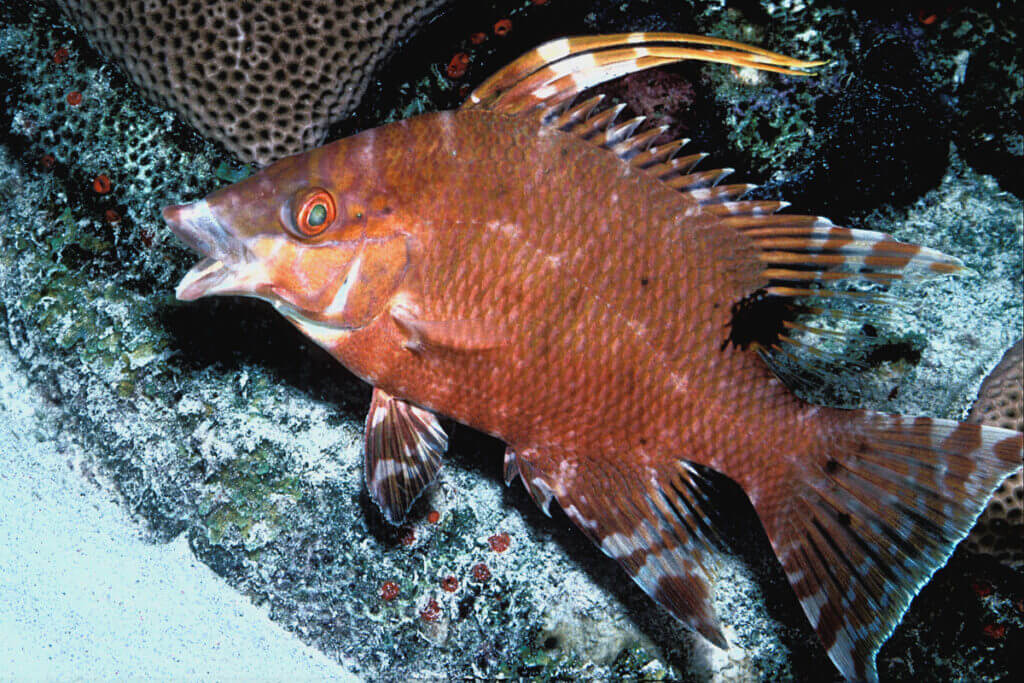
Hogfish are easily recognizable and visually striking. Typically, their color ranges from unique shades of reds, oranges, yellows, pinks, and light gray. Males are usually more brightly colored compared to females. In addition, at the back base of their dorsal fin, they possess a black spot that fades with age.
When the male is removed from the population, the largest female begins her transition to male and develops a more dramatic sloping snout as well as darker pigmentation around the face, almost resembling a mask. It is believed the female-to-male sex change can take up to two months, internally, while the external characteristics continue to become more pronounced over time.
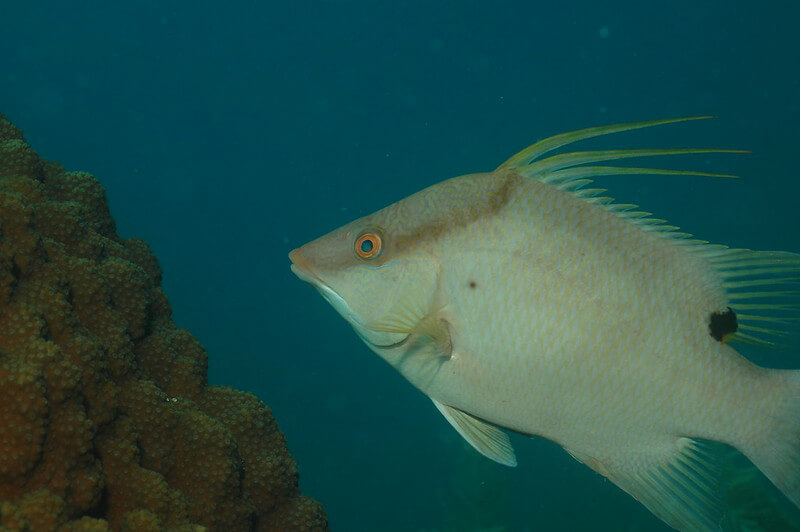
Scientists are still unraveling the mysteries of the light-sensitive opsins found in hogfish skin, exploring their role in camouflage and beyond.
Adult hogfish often reach an impressive length of 3 feet and a weight of about 24 pounds. They have an elongated, spindle-shaped body resembling that of a snapper. Their most distinguishing feature is their protruding snouts. Also, their first three dorsal fin spines are thick and elongated into long filaments. The caudal tail is slightly crescent in shape, and the tips of the anal and dorsal fins are pointed.
Due to their vibrant color, hogfish make a beautiful addition to saltwater aquariums. Their juveniles are often caught for the aquarium trade.

Did you know…
Hogfish are known for their beautiful and variable coloration. They can rapidly change their color and pattern to blend in with their surroundings, making them masters of camouflage. This helps them both to ambush prey and avoid predators.
Habitat
Hogfish mainly occur in warm waters of the western Atlantic Ocean although its entire distribution is from North Carolina to Bermuda and Brazil, They live in depths of up to 200 feet. However, they are more abundant in the Florida Keys and the Caribbean.
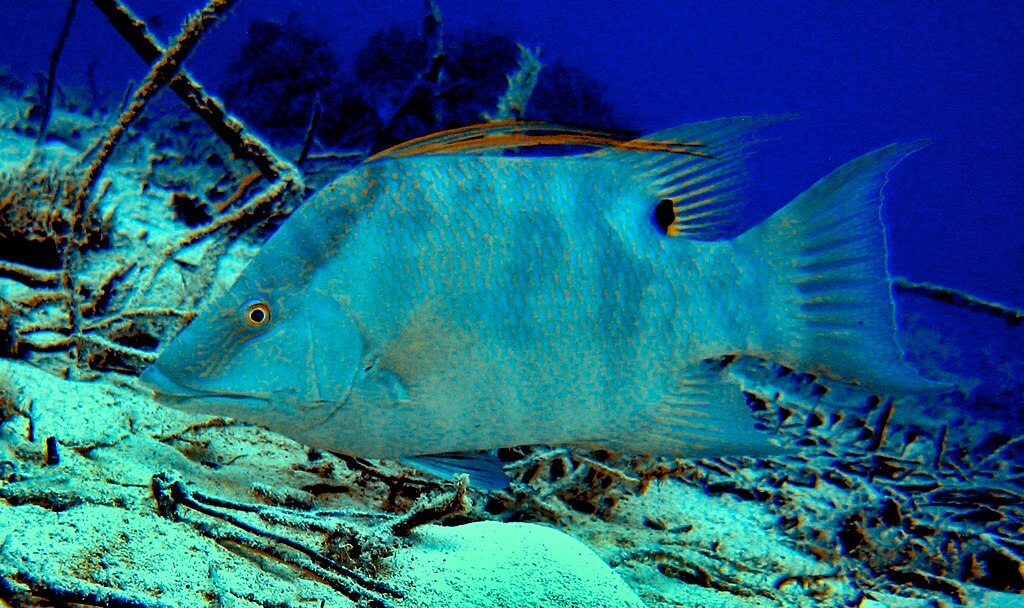
Hogfish are benthic dwellers. They prefer shallow coastal waters where coral reefs, seaweeds, and seagrass beds dominate the bottom. Although these fish can be found in depths of up to 200 feet, they are more common in depths of 100 feet or less.
Hogfish are highly social and form small groups called harems. These harems consist of one male and about 15 females. Notably, hogfish are not migratory and remain in the same area for the rest of their lives.
Diet
Hogfish are primarily carnivorous. They thrive on a diet of benthic invertebrates. Their diet mainly consists of mollusks like snails and clams and crustaceans like shrimp, hermit crabs. Besides these, they occasionally consume sea urchins and small reef fish species. Hogfish forage during the day and rest at night. They can easily crack open the shells of their prey.
They use their elongated snouts to dig out prey from the sandy bottoms or coral crevices. Their snouts are lined with protruding teeth, which crush and grind their hard-shelled prey.
Hogfish also fall prey to other larger fish. They are preyed upon by groupers, barracuda, dolphins, and seals. Unfortunately, their juveniles are more vulnerable as they have a wider range of predators.
Reproduction
As a member of the wrasse family (Labridae), hogfish are protogynous hermaphrodites. The transition from female to male mainly depends on social factors and the size of an individual.
It spawns from September to April off the coast of Florida. The time of spawning in other areas is unknown. The smallest size at which female hogfish are capable of reproducing is about 8 inches, although most mature at a larger size.
The males perform interesting behaviors of quivering and raising fins before rushing a few feet off the bottom with the female while expelling their eggs and sperm to be externally fertilized.
Hogfish form harems of 5-15 females, guarded by one male. The male protects his harem and mates with all the females in it. Once the single male is removed from the harem, the largest female starts to transition into a male. The transition occurs when an individual is 3 years of age and about 14 inches long.
Hogfish are broadcast spawners. The breeding period takes place between November and June. Upon successful fertilization, the eggs hatch into larvae within 24 hours. The larval form floats freely for 26 days and then settles on the bottom as juveniles, initially in seagrass beds.
Further, hogfish have been known to have an average lifespan of about 11 years, with records of some living up to 23 years.
Threats
The sustainability of hogfish has become a significant concern. Over the last few years, the hogfish population has declined by 60%. This has majorly been due to overfishing. As a result, the IUCN lists hogfish as declining.
Fortunately, to safeguard this species, the National Marine Fisheries Service (NMFS) closed the in-season recreational fisheries of hogfish in 2015. According to reports, hogfish’s yearly recreational catch limit had surpassed by 267%.
Today, management measures have been implemented to protect this species. Some of the measures include the use of proper hook and fishing gear, seasonal closures and catch and size limits. Also, marine protected areas have been established to provide safe habitats where they can feed and breed undisturbed.

9 More Interesting Facts About Hogfish
- These fishes are also known for changing their color according to their surroundings.
- Their common name is a result of their pronounced snout and hog-like rooting behavior that they use while searching for prey in the sand.
- They use photosynthetic organisms like sea fans as cover in the depths.
- This species has a set of crushing plates located in its throat that help break down the shells of its prey.
- Their foraging activities also help to oxygenate the seabed.
- Their vibrant colors and crucial role in the ecosystem make them essential members of the underwater paradise.
- If the dominant male in a group disappears, the largest female will typically transform into a male to take its place.
- They are often used in saltwater aquariums.
- There have been documented females as old as 12 years of age and around 25 inches fork length with the oldest hogfish found to be a male at 23 years of age.
FAQs
What is the difference between hogfish and hog snapper?
There is no difference between hogfish and hog snapper. Both are names of the same species of fish, Lachnolaimus maximus, a type of wrasse. This species is known for its elongated pig-like snout, where the names come from. It is a popular game fish native to the western Atlantic Ocean.
What is the legal size of hogfish?
The legal size for hogfish varies depending on the location, as fishing regulations differ by state or country. In Gulf waters, the minimum size limit for hogfish is 14 inches fork length. In federal waters, the minimum size is 17 inches.
What is the best bait for hogfish?
Hogfish are known for their preference for crustaceans. Therefore, the best bait for hogfish is live shrimps, fiddler crabs, and mollusks. In some regions, sand fleas are also commonly used. They respond to baits with a strong scent, making these options highly effective.
Which is the best place to catch hogfish?
Hogfish thrive in warm, tropical waters of the western Atlantic Ocean. The best place to catch them is in the waters of the Gulf of Mexico, especially off the coast of Florida. These areas have extensive coral reef systems, seaweed, and seagrass beds, providing the perfect habitat for hogfish.
Is hogfish a bottom feeder?
Hogfish mainly feed on worms, small crustaceans, and mollusks. These organisms occur at the bottom of their marine habitats. They use their long, pig-like snouts to root around the seafloor for their favorite prey, making them bottom-feeding predators.


