
The world’s oceans, rivers and wetlands are home to an incredible variety of aquatic life, ranging from tiny plankton to gigantic whales. Fish, in particular, are a diverse group of animals that come in all shapes and sizes. Among this incredible array of creatures are some of the smallest fish in the world, which often go unnoticed due to their size.
In this article, we will explore the world of the smallest fish, from where they are found to their conservation status.
Forktail Blue-Eye (Pseudomugil furcatus)
Length: Up to 4 centimeters (1.6 inches).
Fun Fact: The Forktail Blue-Eye is known for its ability to change colors.

The Forktail Blue-Eye is a diminutive species of rainbow fish that is found only in two locations in eastern Papua New Guinea. It typically thrives in clear, rocky pools found within slow-flowing rainforest streams, where abundant aquatic vegetation provides both shelter and food. Its population faces potential threats from logging, habitat conversion, and possibly invasive species.
While the Forktail Blue-Eye is known to be present in the international aquarium trade, it is important to note that the majority of specimens available in the market are commercially bred. It is currently listed as Data Deficient as the precise level of extraction from wild stocks remains unknown.
Midget Dwarf Goby (Trimmatom nanus)
Length: Up to 3 centimeters (0.8 to 1.2 inches).
Fun Fact: It has a unique mating behavior where males build and guards nests made of sand.

The Midget Dwarf Goby is one of the world’s smallest fish species and was first described in 1981 in the Chagos Archipelago. This tiny fish inhabits depths of 5-35 meters in tropical ocean waters of the Indian and western Pacific Oceans. It is typically associated with typically in oceanic drop-offs, lagoons, and outer reefs.
The Midget Dwarf Goby is identified by a semi-translucent pale grey body with internal red bars and a red head. It is currently listed as “Least Concern” due to no known major threats and its presence in marine protected areas within its range such as the Great Barrier Reef Marine Park in Australia and Dongsha Atoll National Park in Taiwan.
Malabar Pufferfish (Carinotetraodon travancoricus)
Length: Up to 2.5 centimeters (1 inch).
Fun Fact: Malabar Pufferfish are one of the world’s smallest pufferfish and are known for their social nature, forming large groups in their natural habitat.

The Malabar Pufferfish is endemic to the Western Ghats of India and is is commonly found in freshwater rivers in Kerala and southern Karnataka. Its population has declined significantly, and this trend is expected to continue. Threats to its survival include damming, deforestation, and conversion of forests into agricultural land.
While it has no fisheries value, it is a highly sought-after aquarium fish. The shoaling nature of the Malabar Pufferfish makes it particularly vulnerable to over-harvesting by the aquarium trade. The lack of precise information on its trade and the ongoing threats to its habitat highlights the need for conservation efforts to protect this species.
Carolina Pygmy Sunfish (Elassoma boehlkei)
Length: Up to 2.5 centimeters (1 inch).
Fun Fact: Male Carolina Pygmy Sunfish display striking blue and red patterns during the breeding season.
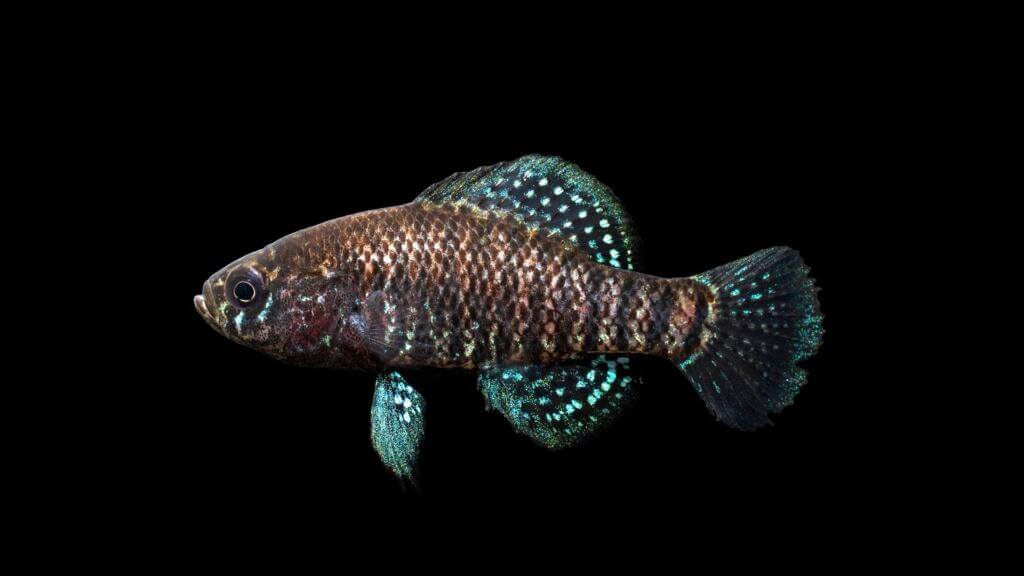
The Carolina Pygmy Sunfish is a tiny freshwater fish that is native to North Carolina and South Carolina in the United States. It inhabits shallow, quiet waters with soft substrates and abundant vegetation, often in human-disturbed areas. Sadly, local extirpations of this species have been linked to urbanization, highlighting the detrimental impact of human encroachment on its natural habitat.
It is classified as Vulnerable due to its limited range, fragmented distribution, and declining populations. Fortunately, conservation efforts are underway to safeguard the future of the Carolina Pygmy Sunfish. These efforts include captive breeding programs, spearheaded by institutions like Riverbanks Aquarium and Conservation Fisheries Inc., aimed at establishing backup populations and reintroducing individuals into suitable habitats.
Celestial Pearl Danio (Danio margaritatus)
Length: Up to 2.1 centimeters (0.8 inches).
Fun Fact: It gets its name from the shimmering pearl spots on its body, resembling stars in the night sky.

The Celestial Pearl Danio was initially discovered in Myanmar but has since been found in other locations in the Salween River basin and Thailand. It has a strong preference for heavily vegetated pools no deeper than 30 cm, which are sustained by seepage or springs. The small size of this fish makes it difficult to study, contributing to its Data Deficient classification on the IUCN Red List of Threatened Species due to the scarcity of information on its distribution and population status.
Sadly, the Celestial Pearl Danio faces threats from over-collection for the aquarium trade, but also from the degradation and loss of its unique habitat. It is highly sought after in the aquarium trade due to its unique appearacnce, resembling a miniature galaxy. Therefore, despite a ban on exports by the Myanmar government, the trade continues, providing income for locals.
Dwarf Pygmy Goby (Pandaka pygmaea)
Length: Up to 1.5 centimeters (0.6 inches).
Fun Fact: It has two rows of teeth along each jaw.
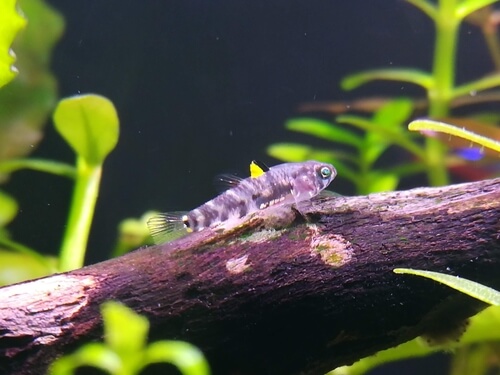
The Dwarf Pygmy Goby, also known as the Philippine Goby, is one of the smallest fish globally, inhabiting brackish waters and mangroves in Southeast Asia. The Dwarf Pygmy Goby is near-transparent with dark cross bands along its sides. Originally found in the Philippines, its type locality is now polluted and the species is considered extinct in Malabon River.
Although facing threats like pollution and deforestation, its wide distribution and abundance in certain areas suggest a stable population. It is found in other regions like Indonesia, with collections in Bali, Sulawesi, Singapore, Thailand and Malaysia. It had previously been introducted into the German aquarium trade in 1958.
Paedocypris progenetica
Length: Up to 7.9 millimeters (0.3 inches).
Fun Fact: This tiny fish has unusual pelvic fins adapted for grasping.

Paedocypris progenetica, the world’s smallest vertebrate, is a member of the carp family. It is found in the blackwater habitats of peat swamp forests in Indonesia. Its see-through body and reduced head skeleton contribute to its larval appearance. This fish has unusual pelvic fins adapted for grasping and thrives in the highly acidic, tea-colored waters of its environment.
Unfortunately, the species faces a Near Threatened status due to ongoing habitat loss caused by deforestation, conversion to plantations and farms, and water extraction. Despite some protected areas within its range, further conservation actions are crucial to protect the remaining peat swamp forests and restore degraded habitats.
Ocean Insights: Hear From Our Experts

By Dr. Rabiah Ryklief
Principal Scientist and Lecturer of Marine Science, with a PhD in Zoology
Scientists have discovered a tiny fish in Myanmar that makes an incredibly loud noise for its size. This fish, called Danionella cerebrum, is smaller than your pinky nail, but it can make a sound as loud as a gunshot! They do this by using a special muscle to drum their ribcage against an organ called a swim bladder, which helps them float. This discovery has scientists wondering why such a tiny fish needs to be so loud and how it manages to make such a big noise. They're also curious about what other secrets this tiny fish, with its incredibly small brain, might hold.
FAQs
What are little fish called?
Little fish have different names depending on their age: larvae are newly hatched and still have their yolk sac for food, alevins are the next stage, fry are bigger and starting to grow fins, and fingerlings look like miniature versions of the adults.
What is the shortest living fish?
The shortest living fish is the Sign Eviota, a tiny coral reef fish, which completes its entire life cycle within an astonishing eight weeks.
What is the smallest fish in the Philippines?
The smallest fish in the Philippines is the Pandaka pygmaea, also known as the Philippine freshwater goby or dwarf pygmy goby. It grows to an average size of about 1.2 centimeters, making it one of the tiniest fish in the world.


