
Sea pens (Pennatulacea), often called sea feathers, are colonial marine invertebrates, that belong to the order Pennatulacea, and captivate with their resemblance to delicate, feathery quills. Each sea pen is a thriving colony of polyps, tiny anemone-like creatures that collaborate to ensure the survival of the whole.
These colonial wonders, related to sea anemones, corals, and jellyfish, play a significant role in the marine ecosystem. Join us as we dive into their fascinating world and uncover their unique adaptations, ecological importance, and the secrets they hold within their feathery forms.
Appearance
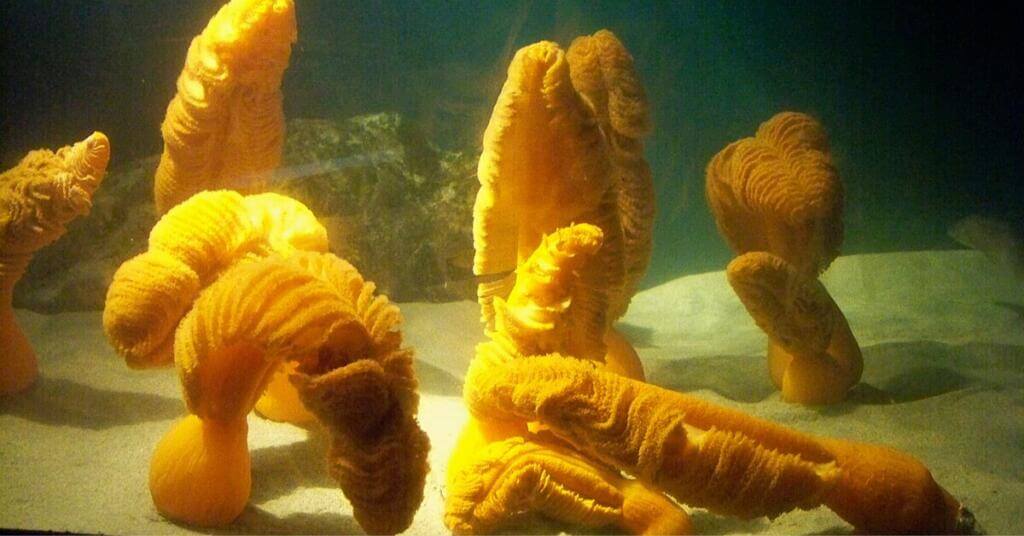
Sea pens resemble delicate quills and are colonies of interconnected polyps. Each colony, regardless of its specific shape, size, or color, relies on a central stem called the rachis for support and anchorage. This rachis arises from a specialized polyp that transforms into an upright stalk. Losing its tentacles, it develops a bulbous base, known as the peduncle, which secures the colony to the seafloor.
In some species, the rachis can extend over a meter in length, providing a sturdy foundation for the colony. The other polyps branch off this central stalk, and are responsible for essential functions like feeding, water circulation, and reproduction. Each polyp possesses eight tentacles to capture food particles and ensure the colony’s well-being.
Sea pens exhibit a range of colors, including yellow, orange, red, brown, and even white, adding vibrancy to the marine environment. Their heights can reach up to 40 cm. While the classic “feather-like” structure is common, some species deviate from this form, resembling clubs, umbrellas, or pinwheels, demonstrating the diversity of life beneath the waves.

Many species exhibit bioluminescence and emit light ranging from blue to green. This light, often triggered by touch or predators, serves for communication, prey attraction, or defense. The sea pen’s surface features small, raised bumps or ridges, known as calyces, which serve as protective cups for individual polyps.

Mud substrate, minimum salinity, depth, and gravel content were identified as key environmental factors influencing the presence of all three sea pen species.
Habitat
Sea pens primarily inhabit areas with soft, sand, or mud on the ocean floor. These substrates allow their peduncle to anchor securely, providing stability for the colony.
They are found at various depths, from shallow coastal waters to the deep sea. Some species can exist at depths exceeding 6,000 meters! They prefer areas with moderate water movement.
They are found in all major oceans around the world, from tropical to polar regions. Certain areas have a higher abundance and diversity. These include the North Atlantic, the Indo-Pacific, and the waters around Antarctica.

The discovery of a novel rock-dwelling sea pen species, Anthoptilum gnome sp. nov., with a specialized sucker-like peduncle, expands the understanding of sea pen habitat diversity.
Diet
They are suspension feeders, which means they need water circulation to move their meal into their grip. Their primary food source is tiny animals (zooplankton) and algae (phytoplankton), which are picked up by the tentacles at the ends of each polyp.
The feeding polyps, called autozooids, wave their tentacles in the water column to catch drifting plankton. Siphonozooids, a different kind of polyp, are responsible for distributing food throughout the colony using a complicated water circulation system.
Once ingested, the food is broken down within the polyp’s digestive cavity, providing nutrients for its survival. Nutrients absorbed by individual polyps are shared throughout the colony, ensuring the well-being of all members.
They also supplement their diet with detritus, which is organic matter like decaying plant and animal particles that settle on the seafloor.
Reproduction
Sea pens reproduce sexually, with most colonies being hermaphroditic, containing both male and female reproductive organs within their polyps. They typically exhibit a defined spawning season, often influenced by factors like water temperature and lunar cycles.
Broadcast spawning is the predominant reproductive strategy, where colonies release eggs and sperm into the water column for external fertilization. This synchronized release increases the chances of successful fertilization. Fertilized eggs develop into planktonic larvae that drift in the water for several days to a few weeks before seeking suitable sandy or muddy substrates to settle and begin forming new colonies.
Threats
Sea pens, like many marine organisms, face a range of threats that affect their survival and the health of their ecosystems. Habitat destruction emerges as a primary concern, with bottom trawling and excavation activities directly damaging or displacing colonies. These practices involve dragging heavy nets or machinery across the seafloor, disrupting the soft substrates that sea pens rely on for anchorage.
Climate change poses multifaceted risks: ocean acidification alters seawater chemistry, potentially weakening the calcium carbonate skeletons of some species while rising sea temperatures can disrupt spawning patterns and larval development.
Predation, particularly by young nudibranchs (sea slugs) and adult sea stars, adds natural pressure to sea pen populations. Additionally, pollution from various sources, including land-based runoff and maritime activities, can introduce harmful chemicals or debris into their environments, impacting their health and reproductive success.
5 More Quick Facts About Sea Pens
- Certain species exhibit increased feeding activity at night when plankton is more abundant near the surface.
- They can inflate or deflate by absorbing or releasing water through the polyps’ hollow tubes.
- They drive water from the colony when disrupted, to withdraw into their bulbous foot.
- Some sea pen species have glide reflection symmetry, which combines reflection and translation symmetry.
- Some species form upright, feathery colonies with polyps arranged in rows or whorls along the rachis.
FAQs
Are sea pens poisonous?
While some sea pen species contain toxins that deter predators, they are generally not considered poisonous or harmful to humans through casual contact. At night, their colony sparkles in dark orange, yellow, white, bright brown, and red.
Can sea pens move?
Sea pens possess limited mobility. While anchored to the seafloor by their peduncle, they can exhibit slight swaying or bending movements in response to water currents. Some species can retract their polyps or even the entire colony into the sediment for protection.
Are they edible?
Sea pens are generally not eaten due to potential toxins, unpalatable textures, and their ecological importance. Some Indigenous communities with specific knowledge and preparation methods may consume certain species, but responsible harvesting is crucial.
What is the lifespan of a sea pen?
Sea pen lifespans vary widely, from years to decades, with some deep-sea species known to live for centuries. Factors like species, environmental stability, and predation influence their longevity.
How do sea pens defend themselves?
They employ a combination of chemical, physical, and behavioral defenses: toxins to deter predators, retraction into the sediment for concealment, spicules for physical protection, and bioluminescence to startle or attract counter-predators.


