
Alligators first appeared in the late Eocene epoch around 37 million years ago. The name comes from “el lagarto,” meaning “the lizard” in Spanish, a name that was given to the creature after it was first seen in Florida by Spanish explorers.
The word “crocodile” comes from the Ancient Greek κροκόδιλος or crocodilos, meaning “lizard.” A total of sixteen extant species of crocodile have been recognized around the world, stretching from Australia to Africa and the Americas.
Main Differences: Alligator vs Crocodile
Here are the top five main differences between Alligators and Crocodiles:
- Color: Alligators are usually gray or black, and Crocodiles are olive or tan.
- Habitat: Alligators prefer freshwater and Crocodiles prefer brackish and saltwater.
- Behavior: Alligators are less aggressive than Crocodiles.
- Size: Crocodiles are several feet longer than Alligators when fully grown.
- Snout shape: Crocodiles have a pointed, V-shaped snout, and Alligators have a wider, U-shaped snout.
We’ll explore these differences and interesting facts about each species more below.


Alligator vs Crocodile: Who Would Win?
Bite Strength: Crocodile wins
Crocodiles have one of the strongest bite forces of any animal on Earth, capable of crushing bones and tearing flesh with ease. While Alligators also have incredibly strong bites, they are not as powerful as a Crocodile’s.
Skin Toughness: Crocodile wins
Both Crocodiles and Alligators have tough, scaly skin that offers protection against attacks. However, Crocodiles have thicker, bony scales reinforced with osteoderms, bony deposits that further enhance their armor. This gives them an edge in defense compared to Alligators.
Aggressiveness: Crocodile wins
Alligators, while capable of aggression, are typically less confrontational and rely on stealth and ambush tactics. In contrast, Crocodiles are known for their aggressive nature and territorial behavior, making them more likely to initiate attacks and are generally considered more dangerous than Alligators.
Adaptability: Crocodile wins
Crocodiles also have an advantage in terms of habitat and adaptability. They thrive in a variety of environments, including freshwater and saltwater, while Alligators primarily inhabit freshwater habitats. This versatility gives Crocodiles an edge in terms of encountering and engaging with potential prey.
Overall Winner: Crocodile
In conclusion, while both Crocodiles and Alligators are apex predators in their respective habitats, the Crocodile’s superior size, strength, bite force, armor, aggression, and adaptability would likely give it the upper hand in a direct confrontation.
Appearance
Although similar at first glance, Alligators and Crocodiles differ in their appearance when it comes to their snout shape, color, body shape, and size.
Difference in Jaw and Snout Shape
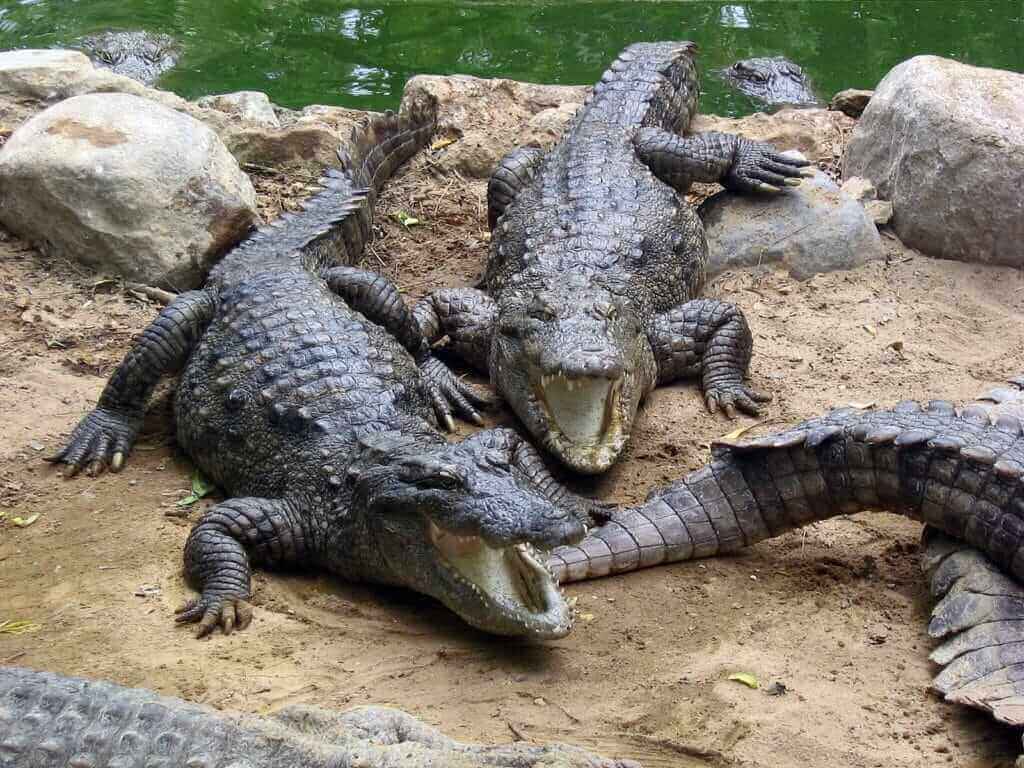
A key distinction between Alligators and Crocodiles lies in the shape of their snouts. Alligators possess a broader, U-shaped snout, while crocodiles sport a longer, narrower, V-shaped snout. This morphological difference is thought to be linked to their dietary preferences.
The Alligator’s robust snout is better suited for crushing hard-shelled prey like turtles. In contrast, the Crocodile’s elongated snout is more efficient for catching fish, reptiles and mammals.

Another distinction between Alligators and Crocodiles lies in their jaw structure. Alligators possess a wider upper jaw, which conceals most of their teeth when their mouths are closed.
In contrast, Crocodiles have upper and lower jaws of similar width, causing the lower teeth to interlock with the upper jaw’s margin when their mouths are shut. This interlocking pattern results in the prominent fourth tooth on each side of a Crocodile’s lower jaw protruding visibly outside the snout when closed.
Difference in Color
Crocodiles have an olive or tan coloration, while Alligators are predominantly gray or black.
While both Alligators and Crocodiles possess lighter coloration on their undersides, there is a subtle difference in the hue. Alligators typically exhibit a white underside, which aids in camouflage when they are floating at the water’s surface. In contrast, Crocodiles tend to have a yellowish underside, which may be attributed to their preference for brackish or saltwater habitats, where the yellowish hue blends more effectively with the surrounding environment.
Juvenile Alligators also boast vibrant yellow or white stripes, creating a stark contrast that helps them camouflage during their early development.
Body Shape
Crocodiles are perfectly adapted for their aquatic and predatory lifestyle. Their streamlined bodies, webbed feet, and specialized traits enable them to swim swiftly and efficiently, even minimizing water intake while submerged. Their smooth underbellies and sides contrast with thick, armored skin on their backs, providing protection while still allowing for heat absorption through capillaries, an essential adaptation for these ectothermic reptiles.
Alligators possess a robust and sturdy body shape, well-suited for their semi-aquatic lifestyle. Their broad, muscular tails serve as both a powerful propeller for swimming and a formidable weapon for defense. Their short, stocky legs, while not built for speed on land, are efficient for navigating through dense vegetation and ambushing prey. The Alligator’s overall body plan prioritizes strength and resilience, making them apex predators in their wetland habitats.
Size
The size of Crocodiles varies from species to species, with the smallest West African Dwarf Crocodile ranging from 4.9 to 6.2 feet (1.5 to 1.9 meters). At the same time, the larger saltwater Crocodiles can grow to 23 feet (7 meters) and weigh 2,200 pounds (1,000 kilograms).
Several species of crocodile can grow to around 17 feet (5.2 meters) in length. The largest crocodile ever recorded was 20.24 feet (6.17 meters) in length and weighed 2,370 pounds (1,075 kilograms).
The average Alligator, on the other hand, weighs around 790 to 990 pounds (360 to 450 kilograms) with a maximum length of between thirteen feet and fourteen feet (4 to 4.4 meters). The largest Alligator ever recorded stretched to a massive 19.2 feet (5.84 meters).
Habitat
Crocodiles can be found in Sub-Saharan Africa, Southeast Asia, and Australia. Alligators are native only to the United States, Central America, and China.
In the United States, the American Alligator is particularly prevalent in south Florida Everglades and Louisiana. They can also be found in some parts of North Carolina, Mississippi, Alabama and Texas. They live in freshwater habitats such as marshes, ponds, rivers, lakes and swamps. Brackish water, which is a combination of fresh and salt water, is also suitable for them.

Crocodiles have a much broader geographic distribution and prefer tropical regions within their range. Their ideal habitat includes access to bodies of water with varying salinity levels, and secure nesting sites for their eggs. Primarily nocturnal hunters, Crocodiles spend most of their time submerged in water, lying in wait for prey.
Both Crocodiles and Alligators are considered important species for the ecosystems they inhabit. As apex predators, they regulate prey populations, preventing overgrazing of vegetation and maintaining the health of fish stocks. Their feeding behavior also creates nutrient-rich environments, as they often drag prey into the water, where the carcasses decompose and provide sustenance for scavengers and other wildlife.
Their presence is an indicator of a healthy ecosystem, and their conservation is essential for the well-being of the entire food web.
Diet
Both Alligators and Crocodiles are ambush predators, meaning they lie in wait for their prey to approach before launching a surprise attack.
Young Alligators primarily consume fish, snails, worms, and other small creatures. Whereas the diet of adult Alligators expands to include larger fish, turtles, birds, small mammals, and even larger animals like bears, panthers and dogs.
Young Crocodiles mostly feed on invertebrates and small fish. As they mature, their diet varies depending on their size and habitat. Adult Crocodiles commonly feed on fish, birds, mammals, mollusks, reptiles, amphibians, crustaceans and even smaller crocodiles.
Contrary to their reputation as strict carnivores, both Alligators and Crocodiles have been observed consuming fruit, suggesting a more omnivorous diet than previously thought.
Interesting Facts About Alligators
- Alligators first appeared in the late Eocene epoch around 37 million years ago.
- Larger Alligators have been known to attack bears, panthers and dogs.
- The Chinese Alligator is critically endangered, found only in the Yangtze River.
- Alligators help improve biodiversity in their habitats.
- Male Alligators grow larger in size than females.
Interesting Facts About Crocodiles
- Some species like the Nile Crocodile can lay up to 80 eggs at one time.
- Crocodiles go dormant during droughts and cold weather.
- Crocodiles have powerful senses that make them skilled predators.
- Crocodiles are able to replace their 80 teeth up to 50 times during their lifetime.
- The largest Crocodile species is the Saltwater Crocodile.
Ocean Insights: Hear From Our Experts

By Dr. Rabiah Ryklief
Principal Scientist and Lecturer of Marine Science, with a PhD in Zoology
The presence of lingual salt glands in crocodiles is a fascinating adaptation that significantly influences their ecological niche and distribution. These specialized glands, located on the tongue, allow crocodiles to effectively excrete excess salt, enabling them to thrive in both brackish and freshwater environments. This adaptability is a key factor in their ability to colonize diverse habitats, from coastal estuaries to inland rivers.
In contrast, alligators, lacking these lingual salt glands, are predominantly restricted to freshwater habitats. This physiological difference has implications for the management of captive animals in zoos, where maintaining separate enclosures for alligators and crocodiles is crucial to ensure optimal environmental conditions for each species.
Furthermore, the evolution of lingual salt glands in crocodiles has broader ecological implications. It highlights the importance of osmoregulation in adapting to varying salinity levels, a critical factor in the diversification and success of crocodilian species across the globe. Understanding the role of these glands in crocodile physiology provides valuable insights into their evolutionary history and ecological niche.
FAQs
Which has a stronger bite force: an Alligator or a Crocodile?
Alligators have a recorded bite force of 2500 to 2900 psi, while Crocodiles have a bite force of 3700 to 5000 psi.
Are Crocodiles faster than Alligators?
Alligators are generally faster than Crocodiles on both land and water. Alligators can reach speeds of up to 30 miles per hour, while Crocodiles can only reach speeds of around 20 miles per hour, but only for short distances. This speed advantage is attributed to the body shape and limb proportions of alligators, which are better adapted for quick bursts of speed and agility. So, in summary, alligators are faster than crocodiles.
Can Alligators and Crocodiles interbreed?
Alligators and Crocodiles cannot mate or interbreed with each other. Although they may appear similar, they are genetically different, belong to different families (Alligatoridae and Crocodylidae), and have distinct reproductive behaviors. They have evolved separately for millions of years, resulting in incompatible mating schedules and rituals.
Which one lives longer, Alligator or Crocodile?
The lifespan for Crocodiles is betwen 70 to 100 years, while Alligators typically live for around 30 to 60 years. It’s important to note that these are general averages and can vary based on factors such as the species, habitat and individual health. Additionally, there may be variations within different species of Alligators and Crocodiles.
Which one is more dangerous, an Alligator or a Crocodile?
Crocodiles are generally considered to be more aggressive and pose a higher risk of attacks on humans compared to Alligators. Additionally, crocodiles are larger in size and have a stronger bite force, making them potentially more dangerous in certain situations.


