
The world of fish is rich with color, movement, and mystery, and species beginning with the letter D capture this perfectly. From the brilliantly colored Dolphin Fish, a swift predator of the open ocean, to the elegant Discus, a jewel of the Amazon, these fish show just how varied aquatic life can be.
The tiny, lively Danio brightens aquariums worldwide, while the eerie Dragonfish lurks in the dark depths of the sea. Together, they reveal the remarkable diversity of the fish kingdom, each playing a unique role in its environment and in our imagination. In this section, we’ll explore some of the most distinctive fishes that start with D.
Common Fish Names That Start With D
This section features fish recognized by their common names, often inspired by their distinctive looks or special traits.
Dolphin Fish (Coryphaena hippurus)
Habitat: Open waters in tropical and subtropical oceans worldwide.
Size: Typically 2 to 4 feet long, weighing 15 to 30 pounds.
Conservation Status: Least Concern (LC) by the IUCN.

Famously known by its Hawaiian name, Mahi-mahi, the Dolphin Fish is renowned for its stunning, iridescent colors that can flash and change rapidly. Its common English name comes from its habit of swimming ahead of sailing ships, similar to dolphins.
This species is also one of the fastest-growing fish in the ocean, capable of reaching its full size in just over a year, and the males, called “bulls,” are easily distinguished by their prominent, high, and almost vertical foreheads.
Discus (Symphysodon genus)
Habitat: Slow-moving, warm, and acidic blackwater rivers within the Amazon River Basin.
Size: 6 to 9 inches in diameter.
Conservation Status: Listed as Least Concern (LC) by IUCN.
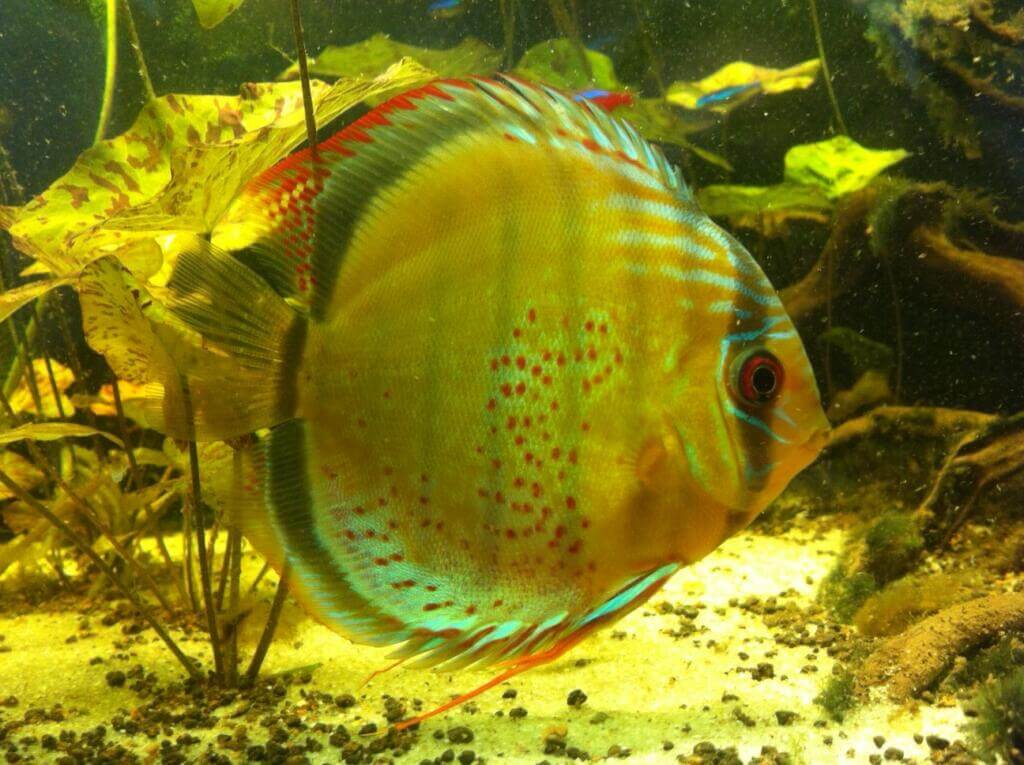
Often called the “King of the Aquarium,” the Discus has a majestic, compressed, disc-shaped body with vibrant, intricate patterns, and it moves with a slow, graceful, gliding motion that adds to its regal appearance. This flat shape is a natural adaptation for navigating the tangled roots and vegetation of its native floodplain habitat.
As highly social cichlids, they form strong pair bonds and exhibit complex parental care; most remarkably, Discus parents produce a nutritious, mucus-like secretion on their skin for their newly hatched fry to feed on. However, their royal status comes with a challenge, as Discus are notoriously sensitive fish that require pristine water conditions with specific temperature and pH levels to truly thrive.
Dogfish (Order Squaliformes)
Habitat: Found in temperate and subarctic waters worldwide, from shallow coastal areas to the deep sea.
Size: Most species are small, typically ranging from 2 to 4 feet in length.
Conservation Status: The Spiny Dogfish is listed as Vulnerable (VU) due to overfishing, while other species are of Least Concern.
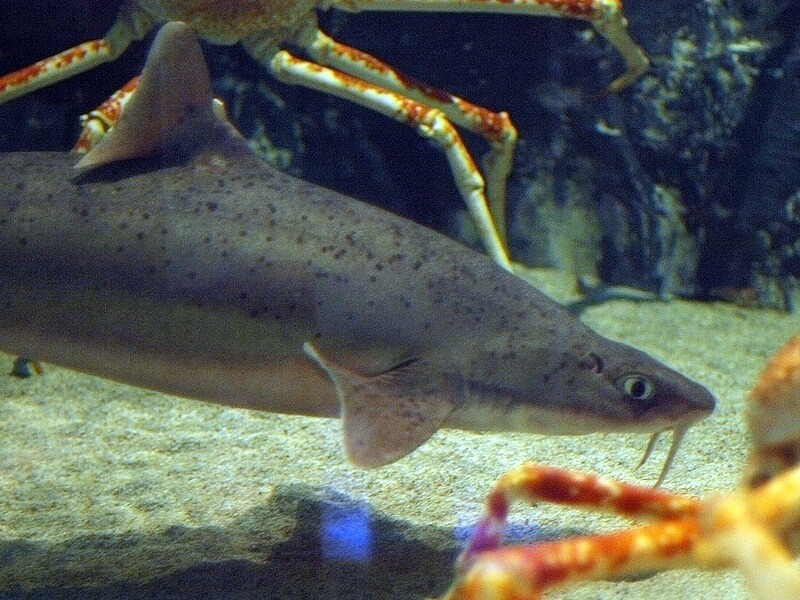
Dogfish are a type of small shark known for their slender bodies and pointed snouts. For defense, many species like the Spiny Dogfish have sharp, mildly venomous spines in front of their dorsal fins.
Unlike many larger sharks, they are also social hunters, often forming large packs that can number in the hundreds. The Spiny Dogfish is particularly notable for having one of the longest gestation periods of any vertebrate, with its pregnancy lasting nearly two years.
Scientific Fish Names That Start With D
Here we focus on species or genera where the scientific name is particularly well-known or descriptive.
Danio (Danios)
Habitat: Freshwater streams, rivers, and rice paddies throughout South and Southeast Asia.
Size: Most species are small, typically 1 to 3 inches long.
Conservation Status: Most species are Least Concern (LC), though some are threatened by habitat loss.

The genus Danio includes many of the most popular, active, and hardy fish in the aquarium hobby. These schooling fish, many of which have distinctive horizontal stripes, are constantly on the move and typically occupy the upper levels of the water column. Beyond their appeal to hobbyists, they hold immense scientific value.
The Zebrafish (Danio rerio) is a crucial model organism, being one of the first vertebrates to have its entire genome sequenced. Their small size, rapid development as prolific egg-scatterers, and transparent embryos make them ideal subjects for research in genetics and developmental biology.
Diodon (Porcupinefish)
Habitat: Shallow tropical and subtropical reefs and seagrass beds worldwide.
Size: Ranges from 10 inches to 3 feet, depending on the species.
Conservation Status: Most species are listed as Least Concern (LC) by the IUCN.
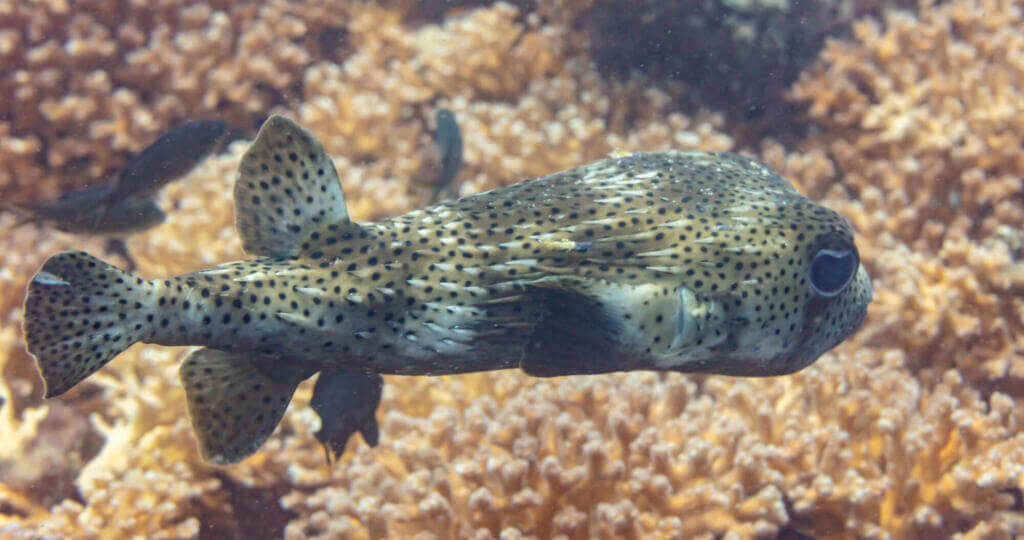
As a primary defense mechanism, the Porcupinefish can rapidly inflate its body with water, dramatically increasing its size to deter predators. This inflation causes its spines, which are actually modified scales that normally lie flat against the body, to stand erect. Beyond this physical deterrent, they are also highly poisonous if eaten, as their internal organs contain a potent neurotoxin called tetrodotoxin.
For feeding, their teeth are fused into a powerful, beak-like structure used for crushing hard-shelled prey, a feature reflected in their genus name, Diodon, which means “two teeth.” Complementing these unique traits are their large, expressive eyes that can move independently, giving them a curious and personable appearance.
Other Fish Species That Start with D
- Dab (Limanda limanda)
- Dace (Leuciscus leuciscus)
- Daggernose Shark (Isogomphodon oxyrhynchus)
- Daggertooth Pike Conger (Muraenesox cinereus)
- Damselfish (Family Pomacentridae)
- Darter (Subfamily Etheostomatinae; Etheostoma spp.)
- Dartfish (Nemateleotris magnifica)
- Datnioides pulcher (Datnoid Fish)
- Datnioides undecimradiatus (Banded Datnoid)
- Death Valley Pupfish (Cyprinodon salinus)
- Debowy Cat (uncertain; needs verification)
- Deep Sea Eel (various families)
- Deep Sea Smelt (Family Bathylagidae)
- Deep-sea Anglerfish (Suborder Ceratioidei)
- Deepwater Flathead (Platycephalidae family)
- Deepwater Hap (Placidochromis electra)
- Delta Smelt (Hypomesus transpacificus)
- Demasoni Cichlid (Pseudotropheus demasoni)
- Dempsey Cichlid (Rocio octofasciata)
- Demoiselle (Chrysiptera spp.)
- Denison Barb (Sahyadria denisonii)
- Denison’s Flying Fox (Crossocheilus denisonii)
- Denticle Herring (Denticeps clupeoides)
- Desert Pupfish (Cyprinodon macularius)
- Devil Ray (Genus Mobula)
- Diamond Tetra (Moenkhausia pittieri)
- Dickfeld’s Julie (Julidochromis dickfeldi)
- Disco Fish (common aquarium fish name)
- Doctorfish (Acanthurus chirurgus)
- Dogfish Shark (Squalus acanthias)
- Dogtooth Tetra (Hydrocynus spp.)
- Dolly Varden Trout (Salvelinus malma)
- Dorado (Mahi-Mahi) (Coryphaena hippurus)
- Dorub Wolf Herring (Chirocentrus dorab)
- Dory (Paracanthurus hepatus, also refers to Zeidae)
- Dory Snapper (Pristipomoides spp.)
- Doryrhamphus excisus (Ribboned Pipefish)
- Doryrhamphus pessuliferus (Yellow-banded Pipefish)
- Dottyback (Family Pseudochromidae)
- Dotted Line Barb (Puntius lineatus)
- Double Lipspot Mouthbrooder (Pseudocrenilabrus multicolor)
- Dragon Goby (Gobioides broussonnetii)
- Dragonet (Family Callionymidae)
- Dragonfish (Family Stomiidae)
- Driftfish (Psenes cyanophrys)
- Drombus drombus (Giant Sea Bass)
- Drum Fish (Family Sciaenidae)
- Duckbill Catfish (Asterophysus batrachus)
- Dojo Loach (Misgurnus anguillicaudatus)
- Dunckerocampus baldwini (Baldwin’s Pipefish)
- Dunckerocampus boylei (Boyle’s Pipefish)
- Dunckerocampus dactyliophorus (Banded Pipefish)
- Dusky Black Striped Barb (Puntius johorensis)
- Dusky Doradid (Doradidae family)
- Dusky Grouper (Epinephelus marginatus)
- Dusky Pimelodid Catfish (Pimelodus species)
- Dusky Piranha (Serrasalmus marginatus)
- Dusky Shark (Carcharhinus obscurus)
- Dwarf Corydoras (Corydoras hastatus)
- Dwarf Driftwood Catfish (Auchenipteridae family)
- Dwarf Giraffe Catfish (Anaspidoglanis macrostoma)
- Dwarf Gourami (Trichogaster lalius)
- Dwarf Livebearer (Heterandria formosa)
- Dwarf Loach (Yasuhikotakia sidthimunki)
- Dwarf Ornate Bagrid (Bagridae family)
- Dwarf Snakehead (Channa gachua)
- Dwarf Spotted Danio (Danio margaritatus)
- Dwarf Wrasse (Halichoeres melanurus)
- Dyanema urostriatum (Whiptail Catfish)
- Dimidiochromis compressiceps (Malawi Eye-biter)
- Diplodus cervinus (Zebra Sea Bream)
- Diplodus sargus (White Sea Bream)
- Dorosoma cepedianum (Gizzard Shad)
FAQs
Why are so many “D” fish important to science?
Fish like the Danio (specifically the Zebrafish, Danio rerio) are ideal “model organisms.” Their rapid development, transparent embryos, and simple genetic makeup allow scientists to easily study vertebrate biology, genetic diseases, and the effects of new drugs in a way that can be applied to human health.
What does it mean for a fish to be “demersal”?
A demersal fish is one that lives and feeds on or near the bottom of a sea or lake. Many important commercial fish that start with ‘D’, like the Dab, are demersal. They are distinct from pelagic fish, which live in the open water column.
Is the Dolphin Fish related to a dolphin?
No, not at all. The Dolphin Fish (Coryphaena hippurus), also known as Mahi-mahi, is a true bony fish. The name likely comes from an old term for its dolphin-like shape or its habit of swimming ahead of ships. Marine mammals like dolphins are air-breathing mammals and are completely unrelated to fish.
What are some of the smallest fish that start with ‘D’?
The letter ‘D’ is home to some tiny fish perfect for small aquariums. The Dwarf Rasbora (Boraras maculatus) is a brilliantly colored fish that often measures less than an inch long. Similarly, the Dwarf Pufferfish (Carinotetraodon travancoricus), also known as the pea puffer, is one of the smallest pufferfish in the world, reaching only about one inch in length.


