Carp and goldfish are two popular and widely recognized freshwater fish that have been domesticated and cherished by fishkeepers for centuries. Both Carp and Goldfish are members of the Cyprinidae family – a vast group of primarily freshwater fish. This family is the most extensive in both diversity and size among fish families and is generally the largest vertebrate family, boasting approximately 3,160 species. Cyprinids are found in Africa, Eurasia, and North America, ranging from northern Canada down to southern Mexico.
However, despite their similar body shapes, shared origins in Asia, and belonging to the Cyprinidae family, the carp and the goldfish exhibit distinct characteristics that set them apart. We’ll explore these in this article.


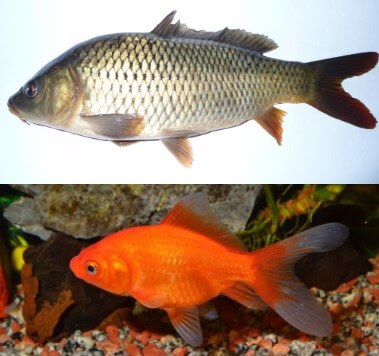
Image Credits: Patagon (left) JuanCarlosPalauDiaz_Shutterstock (right)
Carp vs Goldfish: Main Differences
Appearance: Carp have a robust and torpedo-shaped body, with scales that vary in color. They also have barbels near their mouths, which aid in locating food. Goldfish are renowned for their bright golden coloration, They have an elongated and laterally compressed body, with a pair of prominent eyes.
Size: Carp are significantly larger than Goldfish. Common carp can grow to substantial sizes, reaching lengths of 40 to 80 centimeters (16 to 31 inches). On the other hand, Goldfish are generally smaller, with most individuals reaching lengths of 10 to 25 centimeters (4 to 10 inches) in home aquariums.
Habitat: Carp are highly adaptable and can be found in a wide range of aquatic habitats. They are native to Asia but have been introduced to various regions worldwide. Goldfish are also native to Asia and have been domesticated for centuries.
Diet: Carp and goldfish are primarily herbivorous, feeding on algae, plant matter, and occasionally insects.
Let’s dive into the subtle but significant distinctions between carp and goldfish, uncovering fascinating facts about these two popular pond dwellers.
Carp vs Goldfish: Who Would Win?
In an exploration of a hypothetical encounter between a carp and a goldfish, the carp’s inherent size and strength advantages would likely lead to its dominance. Carp, particularly larger species, exhibit a significant size disparity compared to goldfish. This translates to a weight and power advantage that would be difficult for a goldfish to overcome.
Additionally, carp possess streamlined bodies and strong swimming capabilities, making them more adept in open-water confrontations.
Goldfish, while often possessing elaborate fin structures that enhance maneuverability in confined spaces, would likely struggle against the carp’s sheer size and strength in a direct encounter.
In reality, however, carp and goldfish coexist peacefully within similar freshwater ecosystems, occupying similar dietary niches and posing no threat to one another.
Carp
Carp (Cyprinus carpio) are majestic freshwater fish with a long history of association with humans. Originating from Asia, they have become one of the most widely introduced and adaptable fish species globally.
Carp are renowned for their impressive size, reaching lengths of up to 80 centimeters (31 inches) or more. As masters of survival, they thrive in various water conditions, from tranquil lakes to bustling rivers and even brackish waters.

It typically reaches lengths of 40 to 80 centimeters (16 to 31 inches) and weighs up to 40 pounds or more in some cases. Carp come in various colors, including shades of gold, brown, orange, and green, with some individuals exhibiting striking metallic scales. The scales of carp are relatively large and have a rough texture.
They are one of the largest freshwater fish. In the wild, they can exceed 40 pounds, although in most home ponds or lakes, they usually reach lengths of 40 to 80 centimeters (16 to 31 inches). Some carp varieties, such as koi carp, have been selectively bred for their impressive size and color patterns.
Carp Species
Carp is the common name used to denote a number of varieties of this fish. For example:
- Common Carp (Cyprinus carpio): This is the species most frequently referred to simply as “carp.” It’s a large freshwater fish native to Europe and Asia, known for its adaptability to various water conditions and its significance in aquaculture.

- Koi Carp (Cyprinus rubrofuscus): Often mistaken for a type of common carp, Koi are domesticated descendants of the Amur carp. They are prized for their bright colors and patterns and are commonly found in decorative ponds.

- Grass Carp (Ctenopharyngodon idella): Introduced globally for aquatic weed control, grass carp are distinct from common carp but are often grouped under the broader “carp” category due to their similar environmental adaptability.

- Crucian Carp (Carassius carassius): Related to the goldfish, this type is smaller and less commonly kept. It is notable for its ability to survive in low-oxygen environments.

Diet
Carp are omnivorous bottom-feeders with a diverse diet that includes plant matter, insects, snails, crustaceans, and small fish.
They use their sensitive barbels to locate food on the lake or riverbed, and their feeding behavior involves rooting around in the substrate for edible items. Carp are known for their voracious appetite, which can lead to overpopulation and environmental issues if not managed properly.
Habitat
Carp are highly adaptable and can be found in a wide range of aquatic habitats. They are native to Europe and Asia but have been introduced to various regions worldwide. In their native range, they inhabit freshwater lakes, rivers, and ponds.
However, due to their resilience and adaptability, they can also survive in brackish water environments and even some polluted waters. Carp are known for their ability to thrive in various conditions, making them suitable for different climates and water types.
Reproduction
At maturity, carp are known for their prolific reproductive capabilities. As oviparous fish, females release adhesive eggs during spawning events, which adhere to the substrate and protect the developing embryos.
Carp can spawn multiple times during the breeding season, typically in spring or early summer when the water temperature rises. The fry, or young carp, hatch from the eggs after a few days and grow rapidly.

Threats
In their native range, carp are essential components of freshwater ecosystems and play a crucial role in nutrient cycling. However, in some regions where carp have been introduced as invasive species, they can pose significant threats to local aquatic ecosystems.
Due to their prolific reproduction and feeding behavior, carp can outcompete native fish species for food and resources, leading to declines in biodiversity and potential habitat destruction.
Goldfish
Goldfish (Carassius auratus) are among the most adored and cherished freshwater fish, captivating the hearts of fish enthusiasts and beginners alike. They are ideal for smaller ponds and are commonly kept as ornamental fish in tanks and aquariums.
Goldfish have a variety of body shapes depending on the type of goldfish, but they are usually wider and egg-shaped.

Originally hailing from Asia, these elegant creatures have a rich history of domestication that spans centuries. Known for their vibrant golden coloration and striking dorsal fins, goldfish usually undergo selective breeding to exhibit a wide array of captivating colors and patterns, making them living works of art in aquariums around the world.
One of the defining traits of goldfish is their bright golden coloration, although various other colors and patterns have been bred through the years. They have a long dorsal fin (with 15-21 fin rays), and a forked tail fin.
In most home aquariums, goldfish typically grow to lengths of 10 to 25 centimeters (4 to 10 inches), depending on the specific species and the quality of care provided. In larger outdoor ponds or favorable environments, goldfish can grow even larger, reaching lengths of over 30 centimeters (12 inches) or more.
Habitat
Goldfish are also native to Asia and have been domesticated for centuries. They are often kept in home aquariums or outdoor ponds, where they can be observed and appreciated for their beauty and playful behavior.
Goldfish are highly tolerant of turbid waters, temperature fluctuations, and low levels of dissolved oxygen.
They inhabit slow-moving or still waters in the wild, such as ponds, lakes, and marshes. They prefer freshwater environments with ample vegetation and suitable hiding places.

Diet
Goldfish are omnivores, and their diet primarily consists of a combination of commercially available fish flakes, pellets, and live or frozen foods such as brine shrimp, bloodworms, and daphnia.
They are omnivorous bottom-feeding foragers and crush food such as insects with their pharyngeal teeth.
Their feeding behavior is characterized by their tendency to constantly search for food at the water’s surface and bottom, which can lead to overfeeding if not regulated, impacting water quality and the fish’s health.
Reproduction
Goldfish also follow a similar reproductive pattern. They engage in courtship behaviors during the breeding season, which usually coincides with warmer temperatures in spring or early summer.

The female releases eggs into the water on aquatic plants, and the male fertilizes them externally. The eggs are adhesive and stick to aquatic vegetation or other surfaces. After hatching, the fry is tiny and requires proper care and nutrition to ensure healthy development.
Threats
While goldfish are generally considered peaceful and non-threatening, they, too, can become invasive in certain environments. When released into natural waters by well-meaning individuals, goldfish can reproduce rapidly and outcompete native species.
In some regions, goldfish have become problematic invasive species, disrupting the balance of local ecosystems and threatening the survival of native aquatic life.
Ocean Insights: Hear From Our Experts

By Hamna Faizan
Marine Life Researcher and Lecturer, with an MSc in Zoology
The escalating impacts of climate change have not left the members of the Cyprinidae family, including carp and goldfish, untouched. I believe that these species present a spectrum of conservation concerns due to their contrasting ecological roles and interactions with humans. Countries worldwide have implemented unique strategies to manage these challenges. For instance, Australia has implemented the National Carp Control Plan, which employs trapping, a carp-specific virus, and habitat manipulation. Similarly, the US Fish and Wildlife Service collaborates with state agencies to monitor and manage invasive carp populations using physical barriers, chemical treatments, and public education campaigns. In Europe, where carp are native, efforts focus on maintaining healthy wild carp populations through sustainable fishing practices and habitat restoration projects. Despite being perceived as low-maintenance pets, I think it's important to understand that goldfish require a carefully controlled environment to thrive. They can be sensitive to changes in water quality and temperature, and require a balanced diet and plenty of space to swim. While they are social creatures that do well in groups, releasing them into the wild can lead to ecological issues as they can outcompete native species. Although not currently threatened, I believe they could be impacted by environmental changes such as pollution and climate change. Thus, I see public education about responsible ownership and ongoing research as crucial.
FAQs
Are carp and goldfish related?
Both carp and goldfish belong to the Cyprinidae family, the largest family of fish in the world. This means the two fish are distantly related, with several shared characteristics, including their preference for freshwater habitats and omnivorous diets.
Can you put carp with goldfish?
Carp and goldfish can typically be housed together in the same pond or aquarium, but it’s important to consider factors such as size, compatibility, and water conditions to ensure their well-being and prevent potential issues.
Is carp a good fish to eat?
Carp is consumed as a food source in many cultures around the world, but its taste and culinary qualities can vary widely depending on preparation methods and regional preferences.
Are carp and goldfish intelligent?
While fish intelligence is a complex topic, both carp and goldfish demonstrate impressive cognitive abilities. They can learn to recognize patterns, navigate mazes, and even exhibit social behaviors. Research suggests that they possess a capacity for memory and problem-solving.
Can carp and goldfish crossbreed?
While closely related, carp and goldfish typically do not breed in the wild. However, under controlled conditions and with human intervention, it is possible to create hybrids. These hybrids often exhibit a blend of traits from both parent species.


