

The letter ‘E’ introduces us to an exceptional and eclectic group of fish, showcasing some of nature’s most extreme adaptations. This category is defined by the truly Electric Eel, a fish that can generate a stunning electrical charge, and the Elephantnose Fish, which navigates its world with a weak electrical field.
It also includes the elegant Emperor Angelfish, a living jewel of the coral reef, and the enigmatic Eelpout of the deep sea. Join us as we explore the extraordinary lives of these and many other fish that start with E.
Common Fish Names That Start With E
This section highlights fish best known by their common names, which often hint at their remarkable characteristics.
Electric Eel (Electrophorus electricus)
Habitat: Slow-moving, muddy bottoms of rivers and swamps in the Amazon and Orinoco basins of South America.
Size: Can grow up to 8 feet in length.
Conservation Status: Least Concern (LC) by the IUCN.

Despite its name, the Electric Eel is not a true eel but is actually a type of knifefish, more closely related to catfish. It is famous for its ability to generate a powerful shock of up to 860 volts (more than five times the voltage of a standard US wall socket), which it uses for both hunting and self-defense.
This incredible power comes from three pairs of specialized abdominal organs that make up nearly 80% of its long, cylindrical body. Because its eyesight is very poor, it also navigates and finds prey by emitting a low-voltage electrical field and sensing disturbances within it. Lacking most typical fins, it swims primarily by undulating its long anal fin.
Eel (Order Anguilliformes)
Habitat: Found globally in both saltwater and freshwater, from shallow coastal reefs and deep-sea trenches to inland rivers and lakes.
Size: Shows extreme variation, from the tiny one-jawed eel at 2 inches to the slender giant moray, which can exceed 13 feet in length.
Conservation Status: Many moray eels are of Least Concern (LC).

The most defining characteristic of an eel is its long, serpentine, snake-like body, which allows it to navigate tight crevices. Most eels lack scales, instead having thick, leathery skin protected by a layer of mucus that makes them notoriously slippery and resistant to parasites.
This unique form is the result of a remarkable metamorphosis, as they start life as a transparent, leaf-shaped larva called a leptocephalus that drifts in the ocean currents for months or even years. For many freshwater species, this life cycle culminates in one of the most mysterious migrations on Earth, as they travel thousands of miles from rivers back to the Sargasso Sea in the middle of the Atlantic Ocean to spawn and then die.
European Bass (Dicentrarchus labrax)
Habitat: Coastal waters, estuaries, and lagoons of the eastern Atlantic Ocean (from Norway to Senegal), the Mediterranean Sea, and the Black Sea.
Size: Can grow up to 3.3 feet (1 meter) in length and weigh over 25 pounds.
Conservation Status: Near Threatened (NT) by the IUCN, as it is widespread and heavily supported by a large aquaculture industry.
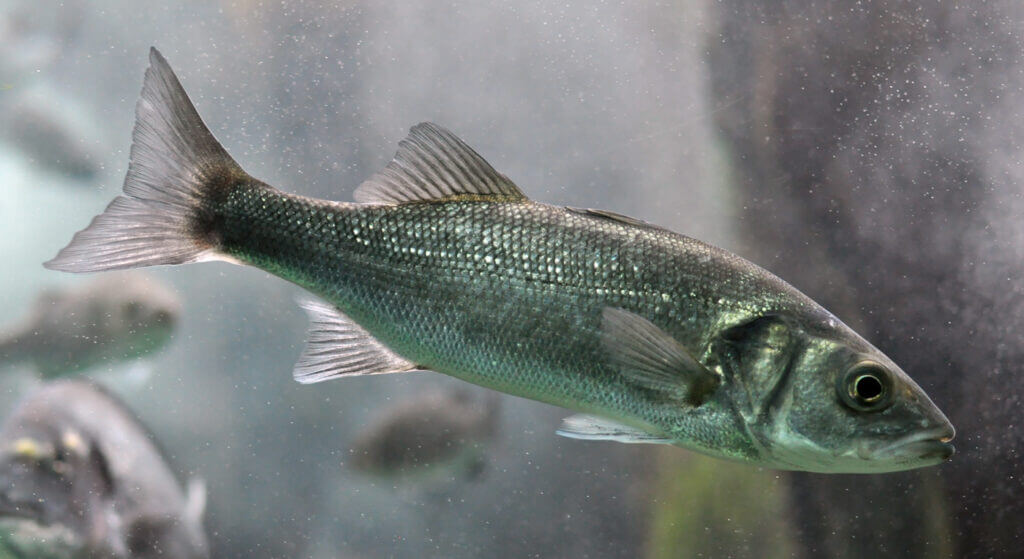
Known by many prestigious culinary names, including “Branzino” in Italy and “Loup de Mer” (Wolf of the Sea) in France, the European Bass is a prized gourmet fish and one of the most important commercial species in Europe, supported by a massive aquaculture industry. Its scientific name, Dicentrarchus, means “two spines,” referring to its two distinct dorsal fins, and it also possesses two sharp spines on its gill cover for defense.
As a highly adaptable euryhaline species, it can thrive in a wide range of salinities, from full saltwater to freshwater rivers. There, it acts as a voracious nocturnal predator, using its excellent low-light vision to hunt for smaller fish like sardines and sand smelt.
Elephantnose Fish (Gnathonemus petersii)
Habitat: Murky, slow-moving rivers in West and Central Africa.
Size: Up to 9 inches in length.
Conservation Status: Least Concern (LC) by the IUCN.

The “nose” of the Elephantnose Fish is not a nose at all, but a highly sensitive, trunk-like chin extension called a Schnauzenorgan, which is covered in thousands of electroreceptor cells. This nocturnal fish spends its days hiding and becomes active at night, using this unique organ to probe the mud for insect larvae and worms.
To navigate and hunt in total darkness, it generates a weak electric field from its tail and uses the Schnauzenorgan to sense disturbances in that field. Beyond these incredible adaptations, they are also known for their high intelligence and have even been observed “playing” with objects in their environment.
Scientific Fish Names That Start With E
Here, we focus on species or genera where the scientific name is particularly significant.
Epinephelus (Groupers)
Habitat: Found worldwide in tropical and subtropical waters, typically around reefs, wrecks, and rocky bottoms.
Size: Varies immensely, from one foot to over 8 feet long for the Giant Grouper (Epinephelus lanceolatus).
Conservation Status: Varies greatly. Many species, like the Goliath Grouper (Epinephelus itajara), are listed as Vulnerable (VU) due to overfishing.

The genus Epinephelus represents one of the largest and most widespread groups of predatory reef fish, playing a crucial role as a keystone species in maintaining the health and balance of coral reef ecosystems. They are classic ambush predators, using coloration that provides excellent camouflage to blend in with their rocky environments before using their huge mouths to create a powerful suction that inhales prey whole.
Their life cycle is equally fascinating, as many species are slow-growing, long-lived protogynous hermaphrodites, starting life as females and later changing sex to become males. This slow life cycle, with some living for 50 years or more, unfortunately, makes them very susceptible to fishing pressure.
Ecsenius (Combtooth Blennies)
Habitat: Shallow coral reefs and lagoons throughout the Indo-Pacific.
Size: Small, typically ranging from 1.5 to 4 inches in length.
Conservation Status: Most species are listed as Least Concern (LC) by the IUCN.

Many Ecsenius blennies are famous for their comical behavior of perching on their pelvic fins, using their expressive, independently moving eyes to survey their surroundings. As scaleless fish with a slimy skin that protects them from abrasions, they are perfectly suited to navigate the tight crevices they call home.
Their genus name refers to their comb-like teeth, which they use to scrape algae and detritus off these rocky surfaces. While often shy and quick to dart into a hole at the first sign of danger, some species employ a more clever defense, mimicking other, more venomous blennies to deter predators.
Other Fish Species That Start with E
- Eagle Ray (Myliobatis aquila)
- Earspot Cichlid (Cichlasoma synspilum)
- Earth Eater / Eartheater Cichlid (Genus Geophagus)
- Eastern Cod (Maccullochella ikei)
- Eastern Mudminnow (Umbra pygmaea)
- Echeneis naucrates (Remora / Suckerfish)
- Edible Gourami (Osphronemus goramy)
- Edward’s Mbuna (Pseudotropheus socolofi)
- Egyptian Mouthbrooder (Tilapia spp.)
- Eel Catfish (Family Plotosidae)
- Eel Loach (Pangio spp.)
- Eelpout (Family Zoarcidae)
- Electric Catfish (Family Malapteruridae / Malapterurus electricus)
- Electric Eel (Electrophorus electricus)
- Electric Knifefish (Order Gymnotiformes)
- Electric Ray (Order Torpediniformes)
- Electric Yellow Hap (Labidochromis caeruleus)
- Elagatis (Elagatis bipinnulata) (Rainbow Runner)
- Elagatis bipinnulata (Rainbow Runner)
- Elegant Rasbora (Rasbora elegans)
- Elephant Fish (Callorhinchus milii)
- Elephant-Nose Cichlid (Nimbochromis linni)
- Elephantnose Fish (Gnathonemus petersii)
- Elongated Lepidiolamprologus (Lepidiolamprologus elongatus)
- Elver (juvenile eel)
- Ember Tetra (Hyphessobrycon amandae)
- Emerald Catfish (Corydoras splendens)
- Emerald Dwarf Rasbora (Celestichthys erythromicron)
- Emerald Shiner (Notropis atherinoides)
- Emperor Angelfish (Pomacanthus imperator)
- Emperor Bream (Genus Lethrinus)
- Emperor Tetra (Nematobrycon palmeri)
- Empire Gudgeon (Hypseleotris compressa)
- Enoplosus armatus (Old Wife)
- Entsuyui (Myxocyprinus asiaticus)
- Escolar (Lepidocybium flavobrunneum)
- Estuary Cod (Epinephelus coioides)
- Epinephelus itajara (Goliath Grouper)
- Epinephelus marginatus (Dusky Grouper)
- Etelis carbunculus (Ruby Snapper)
- Etrumeus teres (Round Herring)
- Ethiopian Lungfish (Protopterus aethiopicus aethiopicus)
- Everglades Pigmy Sunfish (Elassoma evergladei)
- Everglades Pygmy Sunfish (Elassoma evergladei)
- European Anchovy (Engraulis encrasicolus)
- European Chub (Squalius cephalus)
- European Eel (Anguilla anguilla)
- European Flounder (Platichthys flesus)
- European Minnow (Phoxinus phoxinus)
- European Perch (Perca fluviatilis)
- European Plaice (Pleuronectes platessa)
- European Smelt (Osmerus eperlanus)
- European Sprat (Sprattus sprattus)
- European Trout (Salmo trutta)
- European Whale’s Eye-spot Loach
- Eye-Lined Pyrrhulina (Pyrrhulina rachoviana)
- Eye Spot Sleeper (Tateurndina ocellicauda)
- Eye-Spot Flipper (Lefua costata)
FAQs
What is the difference between a true “Eel” and other “eel-like” fish?
A true Eel belongs to the scientific order Anguilliformes. They share a specific life cycle that includes a transparent, leaf-shaped larval stage called a leptocephalus. Many other fish have developed a similar long, serpentine body shape to navigate tight spaces, but are unrelated. For example, the Electric Eel is actually a type of knifefish, and Eelpouts are in a completely different family of fish that thrive in cold, deep water.
How does an Electric Eel produce electricity?
The Electric Eel has three specialized organs made of modified muscle cells called electrocytes. When the eel’s brain sends a signal, thousands of these cells discharge simultaneously, like tiny batteries wired in series. This generates a powerful external shock that can stun prey or deter predators.
What is an “Elver”?
An Elver is a specific life stage of a freshwater eel. After hatching in the ocean as larvae and drifting for months or years, they metamorphose into tiny, transparent “glass eels.” As they enter freshwater estuaries to begin their upstream migration, they develop pigmentation and are then called Elvers.
Do “Eartheater” Cichlids actually eat earth?
Not exactly. Eartheaters (genus Geophagus) get their name from their unique feeding method. They take large mouthfuls of sand or substrate (“earth”) and sift it through their gills. They swallow the small edible invertebrates and plant matter they find and expel the clean sand through their gills and mouth.


