Corals are soft-bodied organisms with a strong protective base and a limestone skeleton.
The latter is known as a calicle, and it attaches to the ground, forming the structure of the reef with which corals are usually associated. They can live on their own, as coral polyps, or form large communities.
According to Science Focus, corals are related to sea anemones and jellyfish. Despite the vast diversity in colors, shapes, and sizes among Cnidarians, they share common characteristics: a simple stomach with a single mouth opening surrounded by stinging tentacles. Each coral organism is called a polyp, and most live in colonies comprising hundreds to thousands of genetically identical polyps formed through a process called budding, where the original polyp reproduces itself.
They also provide homes for up to 25% of the world’s species. However, they don’t take up even 1% of the earth’s surface area. The oldest coral is dated to 240 million years ago, but most of what we see today on the ocean’s floor is between 5,000 and 10,000 years old.

Where Are Coral Reefs?
Corals can be found in tropical ocean waters around the world. They usually live together in groups called coral reefs. These reefs are colorful and diverse in shape and size, reflective of the various kinds of corals that exist throughout the world. Sometimes the size of the reef is reflective of how old the corals are, but this isn’t always the case due to the different paces they grow at. They’re usually found fairly close to the surface, where they can easily reach the sun’s rays. But this isn’t always the case. According to Science Focus, scientists have discovered corals living in what is known as the “twilight zone,” reaching down to 160 meters.
Coral reefs are found in 100+ countries around the world. Most are in the Pacific and Indian Oceans and the Red Sea, and the Persian Gulf. They are less common in places like Florida and the south of Japan.
Types of Corals
They are broadly categorized into “hard corals” and “soft corals.”
1. Hard Corals
Hard corals build reefs by producing a rigid calcium carbonate (CaCO3) skeleton that protects their soft tissues. These are the primary reef builders, forming colonies of hundreds to thousands of polyps that bind together through the calcium carbonate they secrete. There are approximately 800 known species of hard coral, also referred to as “reef-building” corals.
2. Soft Corals
Soft corals lack the rock-like calcareous skeleton of hard corals. Instead, they develop wood-like cores for support and fleshy coverings for protection. They also live in colonies, often resembling brightly colored plants or trees. They can be distinguished from hard ones by their polyps, which have eight tentacles with a feathery appearance. Soft corals are found in oceans worldwide, from the equator to the poles, typically inhabiting caves or ledges where they hang down to capture food carried by ocean currents.
They include sea fans, sea feathers, and sea whips.
3. Black Corals
Black corals, or antipatharians, are colonial animals related to sea anemones and stony corals, known for their rigid, black or brown skeletons often used in jewelry. With over 150 species, they grow in various forms, from spiral coils to fan-shaped branches, and are found in deep tropical and subtropical waters, from shallow depths to nearly 20,000 feet. Unlike shallow-water corals, they lack symbiotic algae, allowing them to thrive in low-light environments such as caves and ledges. They are carnivorous, feeding on plankton carried by currents, and reproduce both asexually and sexually. These long-living corals play a vital role in creating habitats for various marine species.
How Does a Reef Begin?
Reefs begin with a polyp, an individual coral that attaches to the ocean floor. It divides, cloning itself. This is a process also known as budding. The clones connect to one another and create a larger colony that acts as one organism. These colonies start off small, but over hundreds of years, they grow larger, connecting with other colonies and forming what we know today as reefs. Their development doesn’t stop there. The oldest coral reeds on the planet have been developing and changing for 50 million years, according to National Geographic.

Growth and Shapes of Reef-Building Corals
They grow slowly, even in ideal conditions, and display a variety of shapes. Branching corals have primary and secondary branches, while sub-massive ones resemble fingers or cigars without secondary branches. Table corals form flat, fused structures, and elkhorn corals have large, flattened branches.
Foliose corals rise in whorl-like plate patterns, and encrusting corals grow as thin layer against surfaces. Massive corals can be ball-shaped or boulder-like, ranging from the size of an egg to as large as a house, while mushroom corals resemble mushroom tops. Massive corals typically grow 0.5 to 2 cm per year, with some species reaching up to 4.5 cm annually under ideal conditions. Branching corals, however, grow faster, reaching up to 10 cm per year vertically.
Types of Coral Reefs
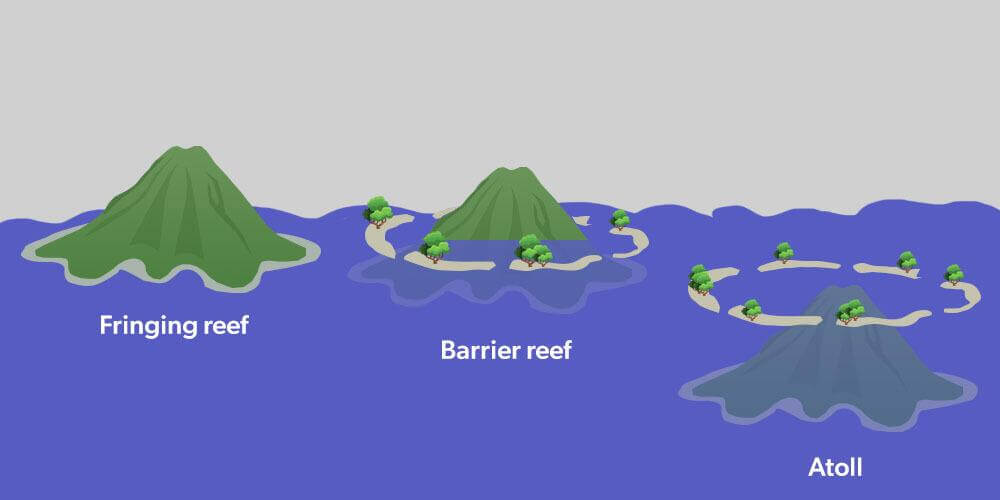
As they grow and expand, reefs develop into one of three main structural types: fringing reefs, barrier reefs, or atolls.
Fringing Reefs
Fringing reefs, the most common type, extend seaward directly from the shoreline, creating borders along the coast and around nearby islands.
Barrier Reefs
Barrier reefs also border shorelines but are situated farther from land. They are separated from the landmass by a lagoon of open, often deep water.
Atolls
Atolls form when a fringing reef grows around a volcanic island that eventually subsides beneath sea level. As the coral continues to grow upward, a circular or oval reef with a central lagoon forms. In some cases, parts of the reef platform rise above the water to form islands, while breaks in the reef allow access to the central lagoon.
Darwin’s Theory of Reef Formation
In the 1830s, Charles Darwin proposed that fringing reefs, barrier reefs, and atolls represent different stages in the development of atoll reefs, suggesting a sequential relationship between the three types.
Common Characteristics of Reefs
All three reef types share similarities in their biogeographic features. Factors such as bottom topography, water depth, wave and current strength, light availability, temperature, and suspended sediments influence the formation of characteristic horizontal and vertical zones. While these zones vary depending on the reef’s location and type, the major divisions typically include the reef flat, reef crest (or algal ridge), buttress zone, and seaward slope, moving outward from the shore.
What Does Coral Eat?
In their location close to the surface, they are capable of reaching the algae that grow as an effect of this sunlight. The algae’s process of photosynthesis helps to fuel corals. They also catch tiny floating zooplankton. They are pulled into the polyps’ mouths and then digested. The majority of corals also contain zooxanthellae, a symbiotic organism, and can take in nutrients through its process of photosynthesis. Corals that live deeper in the ocean, those in the “twilight zone,” would have to live without the process of photosynthesis.

Coral grows at different rates depending on external factors like water temperature and salinity. Warmer waters are usually better for coral growth, but too warm, and the water will have the opposite effect. The clearer the water is, the better as well. This means that more sunlight makes its way down to them when they need it. Saltwater is also crucial. They can’t live successfully near freshwater sources.
The amount of food in one particular area is also crucial for determining how quickly and expansively a coral will grow. They use a great deal of energy in the process of growing their skeletons and therefore depend on the algae in their tissues to supply them with nutrients. The slowest species grow between 5 and 25 millimeters (0.2–1 inch) per year, and the fastest add as much as 20 centimeters (8 inches) a year, according to Coral.
How Do Corals Reproduce?
Just as with any other animal, their reproductive methods vary depending on species. They either do sexual reproduction or asexual reproduction. Some use sperm and eggs, while others are single-sex. The coral larvae are either fertilized inside or outside the polyps’ bodies. Inside means that the sperm is released through another polyp’s mouth, and the sperm and egg merge together.
In other species, those that eject eggs and sperm into the water, the eggs and sperm fertilize outside the polyp after being ejected in the trillia. This is a process known as coral spawning. After fertilization, they swim to the surface, where the larvae remain for weeks. Then, they float back down and attach to the ocean floor and continue the cycle of reproduction, as described by Coral.

Role in Ecosystem
Coral reefs are immensely valuable to hundreds of millions of people globally, offering crucial ecosystem services such as nutrition, economic stability, and protection from natural disasters. They also hold significant ecological and cultural importance.
Home for 25% of Species on Earth
This region is home to over 7,000 species of fish, invertebrates, plants, sea turtles, birds, and marine mammals. While less familiar, deep-water reefs or mounds also sustain a diverse range of marine life in an otherwise sparse environment.
Provides Shelter and Food
Corals offer a habitat for zooxanthellae, which, in turn, supply the corals with oxygen through photosynthesis, as well as organic matter like carbohydrates and proteins that the corals use for nourishment.
Threats to Coral Reefs
Unfortunately, there are almost endless threats to corals’ survival. These include pollution, the climate crisis, species invasion and sedimentation. The latter is a primary stressor for coral reefs, according to the EPA. Sediment deposited onto them can smother them and decrease their ability to feed themselves, grow, and reproduce. It is just one of the many facts that lead to coral bleaching.
Pollution is another major factor that affects coral reefs. This includes runoff, deforestation, and spills (oil and chemical). They can impede their ability to grow and also lead to coral bleaching. Some of the worst affected areas in the world are on islands in the Pacific and Caribbean.
Climate change is by far the most important threat to the survival of coral reefs. The ocean warming creates widespread coral bleaching and disease outbreak. The addition of carbon dioxide absorbed by the ocean also has negative effects. It has reduced calcification rates meaning that the coral is less stable and less able to build reefs.
Invasive fish species pose a threat to coral reefs as well. The lionfish, originally from Indo-Pacific waters, has rapidly expanded its population in the Atlantic Ocean. In large numbers, lionfish can significantly disrupt coral reef ecosystems by preying on and competing with native reef species.
Coral bleaching occurs when coral becomes stressed. This might bed to any of the factors mentioned above or others. Bleached coral that turns bright white is not dead. They can survive a bleaching event but it puts them in an even more vulnerable state.
Are Corals animals or plants?
They are animals and plants. Although they appear different than most animals, we are familiar with them. They are still firmly in this category. They are sessile, meaning that they attach themselves to the ocean floor. There, like a plant, they root and wait. Each polyp, protected by its hard skeleton of limestone, needs to eat just like every other animal.
What exactly are Corals?
Corals are solar-powered animals that create a complex physical framework. They are the architects of the reefs


