
Wireweed (Sargassum muticum), also known as Japanese Wireweed and Japweed, is a large brown seaweed notorious for its invasive nature. Originally from East Asia, it has spread to various coastal regions worldwide, often outcompeting native species and altering marine ecosystems. Its rapid growth and ability to form dense mats can disrupt both the ecological balance and human activities in coastal areas.
Let’s dive into exploring its biology, ecological impact, and the ongoing efforts to manage this invasive species.
Appearance
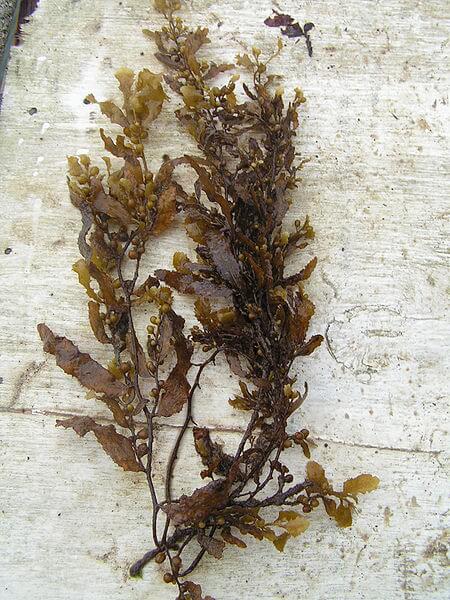
Wireweed is a large brown seaweed with olive-brown fronds. In its native habitat, the seaweed grows between 1 to 3 meters in length. However, in areas where it is considered an alien invasive species, it can reach lengths of up to 16 meters.
The main stem is anchored by a holdfast, from which a tapered axis arises. Younger plants have leaves growing directly from this axis, while older plants develop branches, creating a bushier form. Lateral shoots spiral off the main axis, protected by scale-like leaves at their bases.
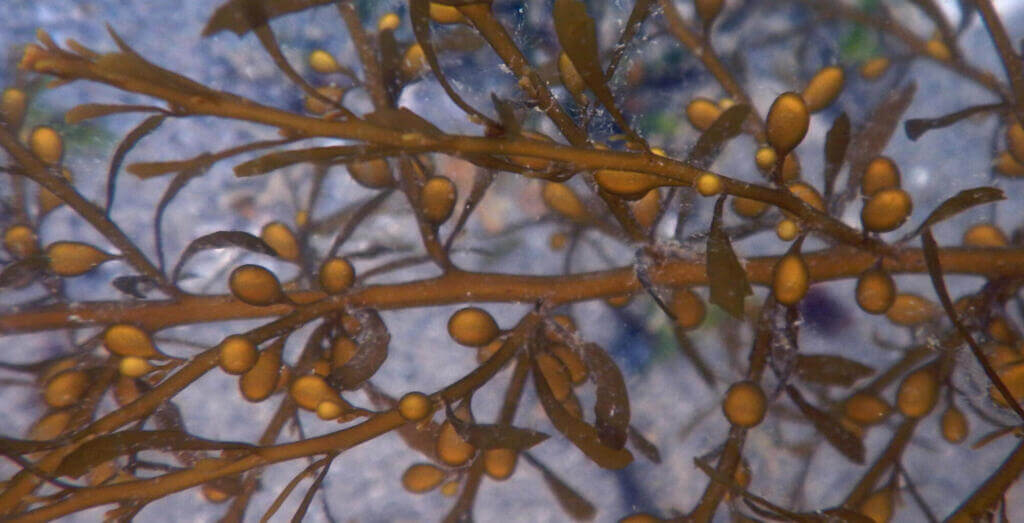
These lateral shoots, often twisted by water movement, can also grow to several meters. They bear small, thick leaves in winter and thinner ones in summer when the plant becomes fertile. Interspersed among the leaves are spherical air bladders and reproductive receptacles.
Habitat
Wireweed is native to the Western Pacific and can be found in the shallow waters between China and South Korea to Japan and Southern Russia.
This seaweed can be found in a variety of shallow-water habitats, primarily attaching itself to hard substrata such as rocks, pebbles, and even man-made structures like docks and vessel hulls. It demonstrates a remarkable tolerance for varying environmental conditions, including fluctuations in salinity and temperature, and can even withstand periods of desiccation and full sunlight.
It has since spread far beyond its original range, establishing itself in both the Eastern Pacific and Eastern Atlantic. Its introduction to new regions is largely attributed to accidental transport via shipments of commercial oysters.
This adaptability allows it to occupy a wide range of shallow coastal water environments highlighting its ability to readily colonize new territories.
Reproduction
Wireweed reproduces both sexually and asexually. This combination of reproductive strategies contributes to this seaweed’s invasive success.
Sexual reproduction is synchronized with the lunar cycle, ensuring successful fertilization. Fertilized eggs are released as germlings, which can settle and grow for an extended period, enabling long-distance natural dispersal.
It also propagates through fragmentation. Detached fronds continue to release germlings, further aiding its spread. Even the loss of a frond doesn’t kill the plant; a new one can regenerate from the holdfast.
Ecological Role & Impact
Wireweed plays an important role in its native ecological landscape. As a primary producer, it contributes to the overall productivity of marine ecosystems through photosynthesis. It provides a source of food for various marine organisms, including snails, amphipods, and sea urchins. Its dense growth can also create a complex habitat, offering shelter and refuge for smaller invertebrates and fish.
It’s important to balance these benefits against the negative impacts of its invasive nature. This species often outcompetes native seaweeds and seagrasses, disrupting the natural balance of the ecosystem. Its rapid growth and ability to form dense mats can smother organisms and alter the physical structure of the habitat.
Controlling the Spread
Prevention is key to track its spread and enables early intervention. This includes keeping boats and marine equipment free of fouling, as well as reporting any sightings of the seaweed to local authorities.
Hand-harvesting, raking, and cutting can be effective in smaller areas, while specialized equipment like the SURF RAKE can tackle larger infestations on beaches. Barriers and nets can be used to intercept floating mats of this invasive seaweed and prevent them from reaching the shore.
Physical removal is labor-intensive but preferred over chemical control methods due to its selectivity and minimal impact on the environment.

More Facts About Wireweed
- Wireweed forms dense mats, outcompeting native species and altering marine communities.
- Genetic studies suggest that introduced populations originated from Japan’s Seto Inland Sea.
- Its spread in the Mediterranean is limited and patchy compared to other regions.
- After reproducing, adult plants dramatically disintegrate, leaving only their holdfast to start anew the next season.
- Some grazers have adapted to feed on Wireweed, highlighting its ecological integration.
FAQs
Is wireweed invasive?
Wireweed is an invasive species. It has a high growth rate and can outcompete native species, disrupting the local ecosystem. Its rapid proliferation can also interfere with recreational activities and block sunlight from reaching other marine life.
Can wireweed be used for anything?
This seaweed shows promise in fighting pollution by removing heavy metals and organic matter from sewerage. It’s also a potential source of medicinal compounds, including the anti-cancer agent fucoxanthin. Additionally, its rapid growth rate makes it a possible candidate for sustainable biomass production.
Is wireweed edible?
Wireweed is considered edible in some cultures, particularly in Korea where it is a popular soup ingredient.


