

Comb jellies, which form the phylum Ctenophora, are captivating gelatinous invertebrates that drift through the world’s oceans. They are often mistaken for jellyfish.
They lack stinging cells on their tentacles and rely on sticky cells to capture their prey. Their most distinctive feature is the presence of comb rows and bands of cilia that refract light, creating a shimmering, rainbow-like effect as they propel themselves through the water.
Join us as we explore and uncover their unique adaptations, ecological roles, and evolutionary significance.
Appearance
Comb jellies are delicate, translucent marine creatures with a gelatinous, oval, or spherical body that often appears glass-like in the water.
Their most striking feature is the presence of eight rows of comb-like cilia, which run along their bodies and refract light to create a mesmerizing rainbow effect as they move. These cilia beat rhythmically, propelling the jelly through the water.
While most comb jellies are colorless and transparent, some species display vibrant hues or bioluminescence, glowing softly in the dark ocean depths.
The comb jelly’s bell-shaped horizontal cross-section is formed by the lower mouth lobe margins, which create the edges of its body. The mouth is located where the “clapper” of a bell would typically be. On its walnut-like body, some ridges resemble warts. Depending on the species, mature ctenophores can range in size from just a few inches to as much as 5 feet in length.
Feeding is facilitated by specialized sticky cells called colloblasts, which capture prey such as plankton and small crustaceans, transporting them to their mouth for digestion. In the gastrodermis is the animal’s gut where both food and reproductive cells enter the body. The mesoderm is mostly water and acts as a soft skeleton as it contains muscle cells, proteins, and nerve cells.
Species
Many species of comb jellies can be broadly categorized by their body forms and some of the more well-known or distinct groups. Here are the various types of comb jellies.
- Two species of comb jellies can be found in the Chesapeake Bay: sea walnuts, Mnemiopsis leidyi, and pink comb jellies, Beroe ovata. Sea walnuts have a colorless, walnut-shaped body, with two of their body lobes longer than the rest. Pink comb jellies have a sac- or egg-shaped body that is often tinted pinkish to reddish-brown
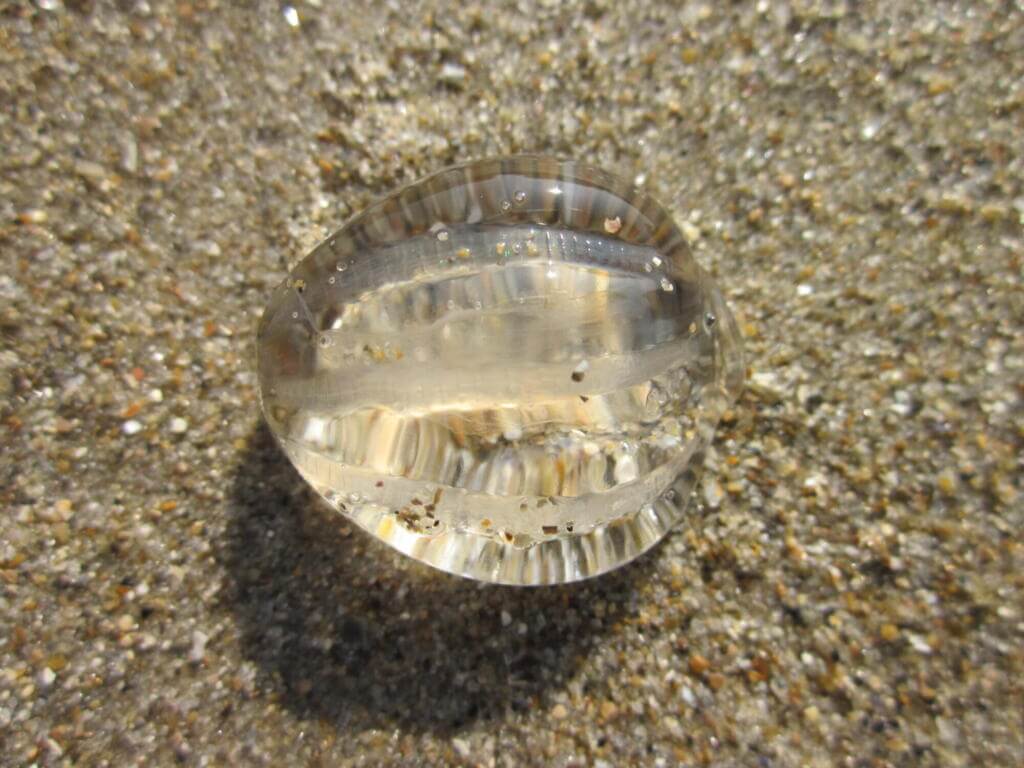
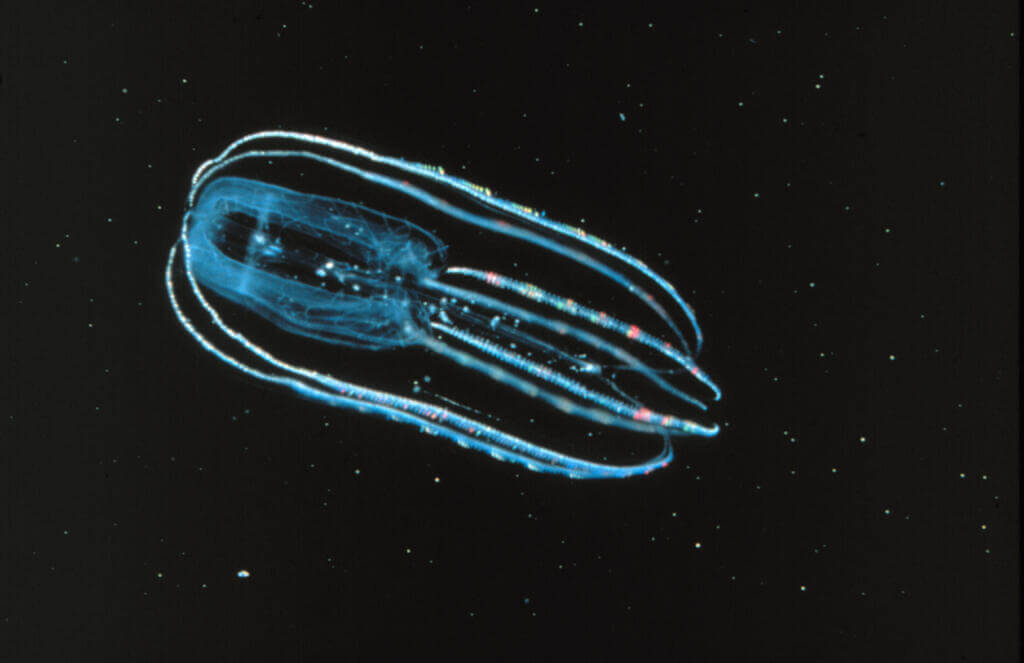
- Cydippida: These are the comb jellies, typically spherical or oval-shaped, characterized by two long, retractable tentacles armed with sticky colloblasts for capturing prey. They are primarily open-ocean dwellers, with well-known examples including the common Sea Gooseberry (Pleurobrachia pileus) and the Arctic Mertensia ovum.
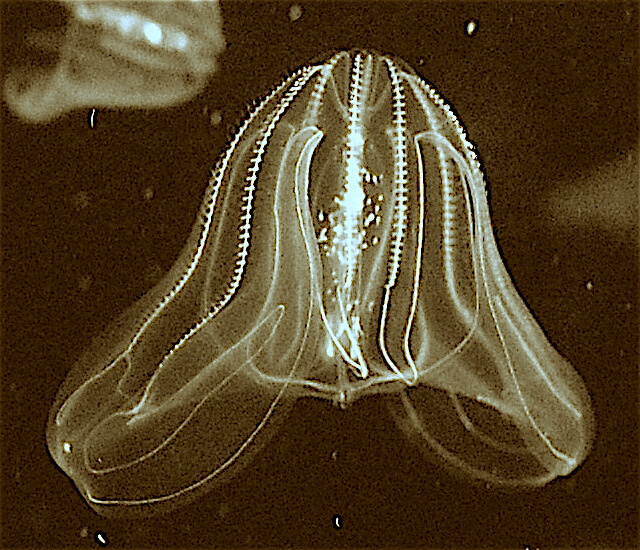
- Lobata: Distinguished by their flattened, compressed bodies and two prominent oral lobes, lobate ctenophores lack long tentacles but use numerous short, oral tentacles and ciliated auricles to sweep food into their mouths. The notorious invasive species Mnemiopsis leidyi (Warty Comb Jelly) is a prime example, alongside the larger Bolinopsis infundibulum found in northern waters.
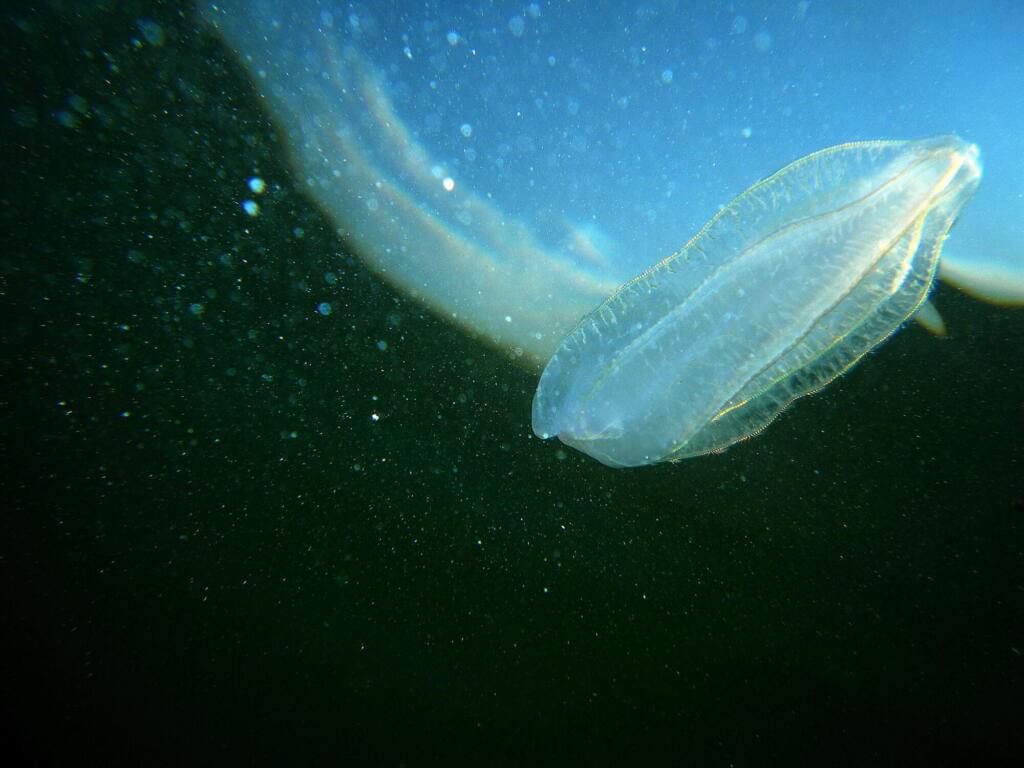
- Beroida: Uniquely tentacle-less among ctenophores, Beroids are voracious predators who consume other comb jellies. They possess a large, sac-like body and a wide mouth capable of engulfing prey larger than themselves.
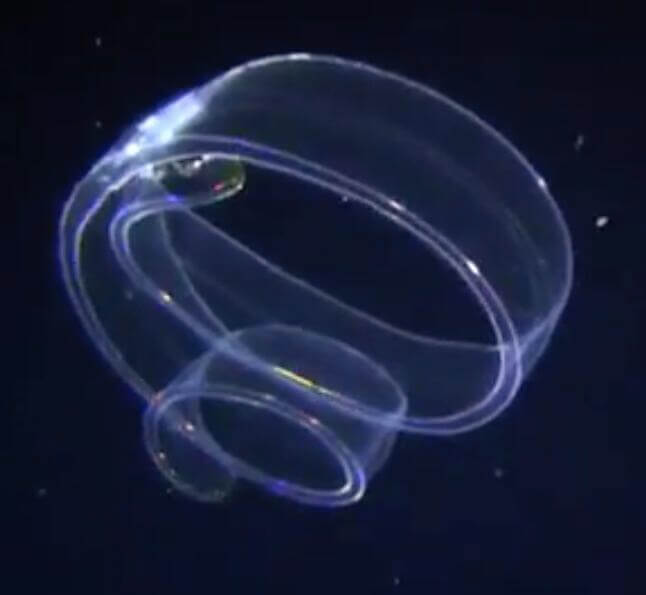
- Cestida: Known as “Venus’s Girdles,” these highly specialized ctenophores are remarkably flattened and ribbon-like, capable of growing over a meter in length. They propel themselves through the water with undulating body movements and comb rows, featuring a row of short tentacles along one edge, exemplified by the beautiful Cestum veneris.
- Platyctenida: The most divergent ctenophores, Platyctenids are benthic (bottom-dwelling) and often highly flattened, resembling sea slugs or flatworms. They creep along surfaces and can be found on other marine organisms, extending two tentacles from their dorsal side, with genera like Coeloplana and Ctenoplana being common examples of these camouflaged, often sessile, forms.
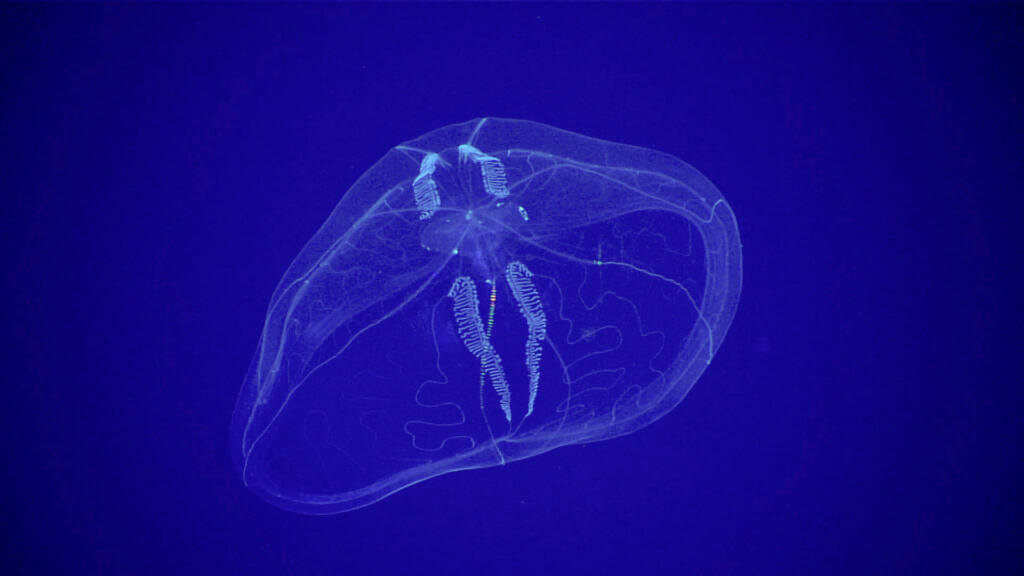
- Thalassocalycida: The members of this order are characterized by their bell-shaped appearance, which can lead to confusion with true jellyfish, though they distinctly possess comb rows. The sole known species, Thalassocalyce inconstans, is a rare inhabitant of deep-sea environments.
Habitat
These ctenophores like maritime saline environments in estuaries and bays, but it can tolerate a broad range of salinity, temperatures, and environmental quality parameters. It is commonly discovered in brackish water that is heavily polluted and with poor oxygen content.
While it appears to favor relatively close to the surface waters, it moves into deep water when the seas are turbulent.
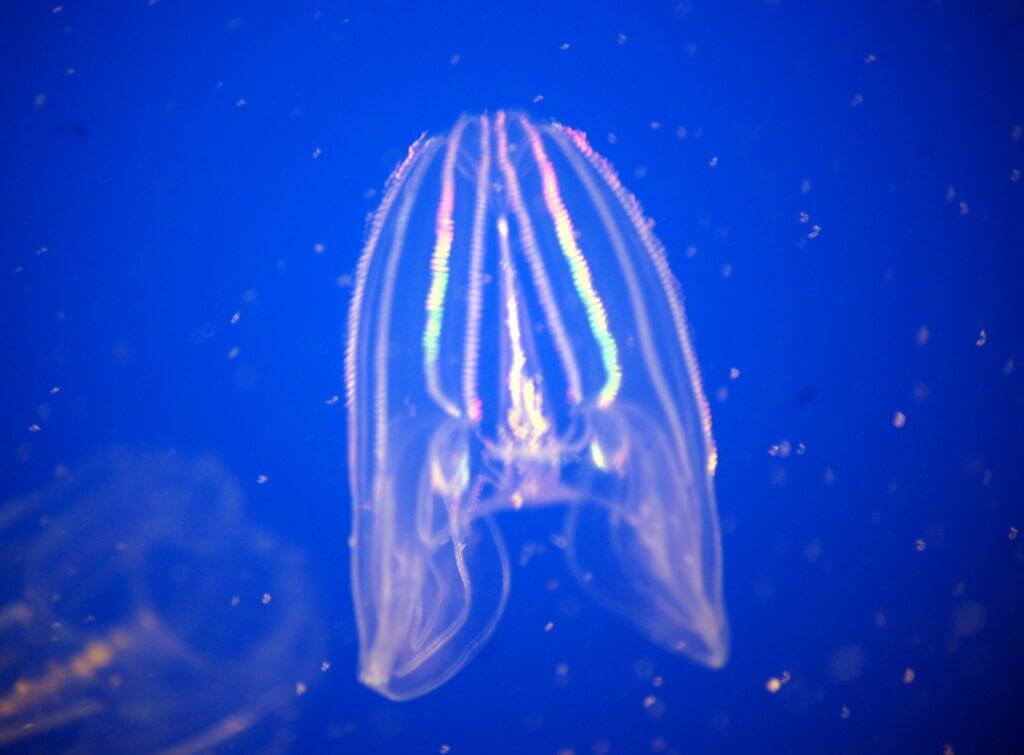
The comb jelly Mnemiopsis leidyi (A. Agassiz 1865) is native to the Atlantic coast of the United States of America (USA) and invasive in Europe.
Diet
This Comb Jelly is a prominent predator of planktons and a ferocious eater, eating as much as tenfold its body mass each day. It eats a varied diet of plankton, which include copepods, sea jellies, fish larvae, fish eggs, and larvae of different invertebrates. They have been reported to cannibalize members of their own species.
They have a simple digestive system, but they do not have a true stomach like more complex animals.
They obtain food by regulating the flow of water into their body cavity, where small animals are trapped on sticky cells located on their tendrils and the inner surfaces of their two lobes. The captured prey is then transported to the mouth for digestion.
Reproduction
Most comb jellies are hermaphroditic, meaning they possess both male and female reproductive organs. They release eggs and sperm into the water column, ensuring the continuation of their species.
The gestation process occurs in the summertime and varies according to the habitat. Although internal fertilization is a possibility, eggs, and sperm are often dispersed throughout the water stream where fertilization occurs. The eggs hatch into a larva that develops completely within a day and grows quickly.
Rapid sexual development allows certain species to start producing eggs as soon as 2 weeks from birth. Depending on the supply of food, mating takes place at nighttime and yields up to 3,000 eggs each day.
Threats
Natural predators of comb jellies include sea turtles, fishes, marine mammals, and even other comb jellies.
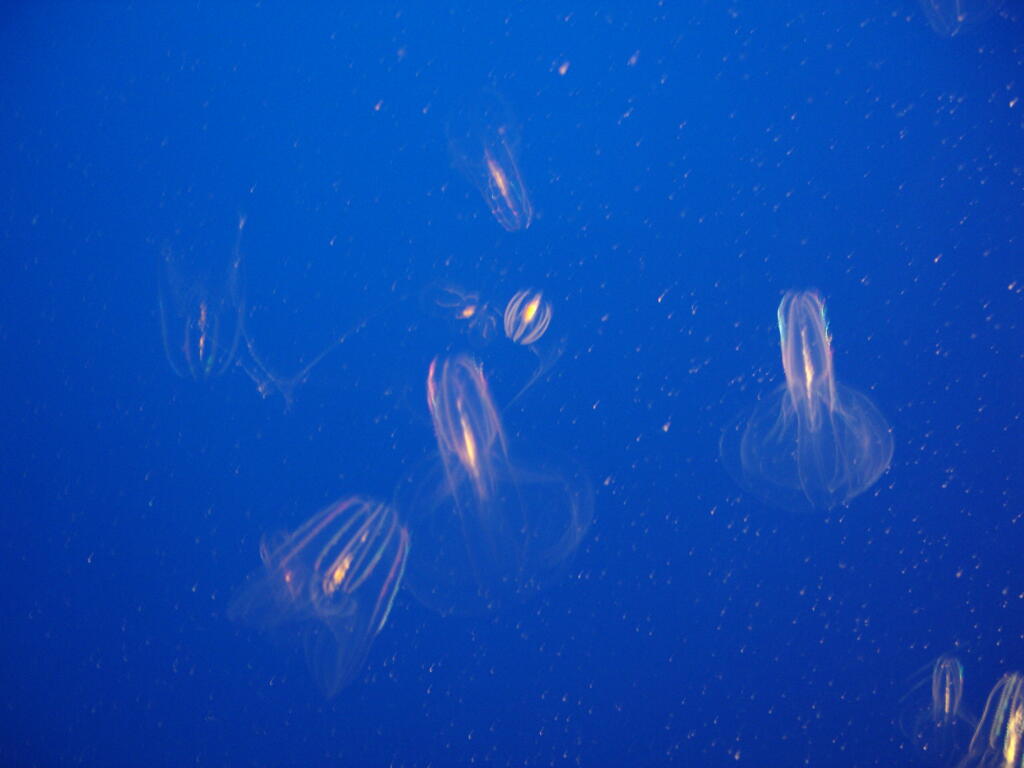
This species can tolerate a wide range of salt levels and water temperatures, thus it is doubtful that climate change would have an adverse effect on it. However, as the oceans warm, some regions that were once too frigid can become potential new habitats, and might turn into a threat to these gelatinous animals.
5 More Amazing Facts About Comb Jelly
- The Comb Jelly body is made of 95% water.
- It dates back as far as 525 million years ago.
- Comb jellies have nervous system cells in their epidermal layer that allow them to sense environmental stimuli like light or chemicals.
- Since they are mostly made of water, they don’t weigh very much at all.
- Recently, scientists discovered that comb jellies remove waste not through their mouths like similar invertebrate species, but instead release the indigestible byproducts of waste into the water through pores at the end of their bodies.
FAQs
Are Comb Jellies safe to touch?
Comb Jellies are jellies that don’t harm. Rather, they grab their prey using special adhesive cells called colloblasts. They are safe for humans to handle because they don’t have stinging cells. In actuality, you may swim alongside them safely.
How deep does Comb Jelly live?
The Ryukyu Trench, which is close to Japan, is home to the benthic Comb Jelly. The deepest resident ctenophore ever recorded was found there, at an incredible depth range of 23,700 ft.
Can humans eat comb jellies?
Comb jellies are not commonly consumed by humans, as they are primarily composed of water and lack significant nutritional value. Additionally, their gelatinous texture and delicate structure make them unappealing as a food source. While some marine organisms may feed on comb jellies, they are not considered edible or practical for human consumption.


