Cryptoclidus is a type of plesiosaur, a group of extinct marine reptiles that roamed the seas during the Mesozoic era. It lived during the Late Jurassic period, around 160 to 145 million years ago.
These creatures were mainly characterized by their long necks, broad flippers, and streamlined bodies. These medium-sized plesiosaurs, measured up to 4.5 metres (14.8 feet) in length.
Useful fossils of this extinct reptile have been found in sedimentary rocks throughout South America, Northern France, England, and Russia. Continue reading to understand valuable information about the anatomy, behavior, and ecology observed from this creature’s remaining adult and juvenile skeletons.
Appearance
The fossil records suggest that they had a streamlined body, a long neck, and four flippers. These animals do not have suborbital fenestrae on the palate. Their teeth were long and pointed. This genus had characteristic teeth with reduced ornamentation. Its skull was relatively small, and its jaws had pointed teeth for catching fish and squid. The neck comprised 38 vertebrae, which was pretty long for a plesiosaur.
Like other plesiosaurs, it had four large, paddle-like flippers for swimming. Its flipper bones suggest powerful muscles, indicating it was a strong swimmer.
Moreover, the vertebrae were elongated and had a relatively low neural spine. This feature allowed cryptoclidus to move its neck more freely than other plesiosaurs.

Habitat
Cryptoclidus lived in the shallow seas that covered much of Europe during the Late Jurassic period. The fossils have been found in England, France, Scotland, Germany, and Russia. During this time, the climate was much warmer than today. At the same time, sea levels were much higher. The shallow seas provided an abundant food source for many marine reptiles.
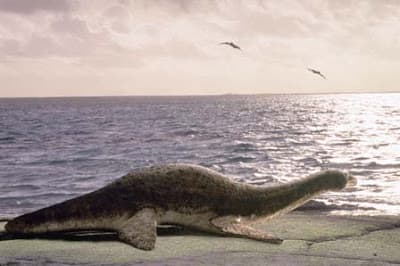
Its fossil locations and body structure suggest it preferred shallow coastal waters. Some scientists speculate that they may have been able to venture onto land like amphibians for short periods, though this is still debated.
The presence of Cryptoclidus fossils in various sedimentary rocks suggests it was a versatile predator that adapted to different marine environments.
Diet
A straightforward way to know Cryptoclidus’ diet is to consider that their fossils have been found in sedimentary rocks deposited in environments ranging from lagoons and estuaries to open oceans. These environments would have provided the ideal conditions for it to feed on its preferred prey.
Cryptoclidus was a carnivore, preying on fish, squid, and other marine animals.
Besides that, its pointed teeth were ideal for catching slippery prey, and its long neck allowed it to reach further into the water to grab its food.

Reproduction
Most paleontologists believe that Cryptoclidus, like other plesiosaurs, was viviparous. This means they gave birth to live young rather than laying eggs. Evidence for viviparity in plesiosaurs comes from fossilized remains of pregnant females containing embryos.
It’s uncertain whether they provided parental care to their young. Some scientists speculate they may have given birth in sheltered lagoons or coastal areas to protect their offspring from predators.
Threats
Cryptoclidus went extinct at the end of the Cretaceous period. This term is usually used when referring to approximately 66 million years ago. A combination of factors, including climate change, volcanic activity, and the impact of a giant asteroid, were responsible for their extinction.
Other threats that they might have faced during the Late Jurassic period are excessive predation from other marine reptiles and competition for food.

4 More Facts About Cryptoclidus
- Its flipper bones suggest incredibly strong muscles, indicating Cryptoclidus was a powerful swimmer, capable of chasing down fast-moving prey and navigating strong currents.
- Cryptoclidus has made appearances in popular culture, including the BBC’s “Walking with Dinosaurs” series and the film “Sea Rex 3D: Journey to a Prehistoric World,” bringing this fascinating creature to life for audiences worldwide.
- Its name, Cryptoclidus, actually means “hidden clavicle,” referring to the fact that its collarbones were small and not easily visible in early fossil discoveries.
- Full-mounted skeletons of Cryptoclidus can be seen in several major museums including the Musee Palaeontologique, Paris; the Natural History Museum, London; the Hunterian Museum, Glasgow; and the American Museum of Natural History, New York.
- The fossils of cryptoclidus have been found in England, France, Germany, and Russia.
FAQs
What is the difference between cryptoclidus and other plesiosaurs?
Cryptoclidus belongs to the family Cryptocleididae, distinct from other families of plesiosaurs. It had a long neck, which comprised more vertebrae than other plesiosaurs. Additionally, they had relatively small flippers, which would have been used more for steering than propulsion. So, there is a possibility that many plesiosaurs were better swimmers than cryptoclidus.
Where have fossils of cryptoclidus been found?
The first specimen was discovered in the Oxford Clay Formation in England in 1851. Since then, archeologists have discovered more specimens that give us a better understanding of the anatomy and behavior of this marine reptile in different parts of the world, especially Europe.
How did cryptoclidus swim?
Cryptoclidus swam by moving its four flippers in a coordinated motion, much like modern sea turtles. Its flippers were relatively small compared to other plesiosaurs. This suggests it could have been a slower swimmer. However, its streamlined body and long neck would have allowed it to move through the water easily.
How do we know what cryptoclidus looked like?
We know what it looked like from the fossils that have been found, which include bones, teeth, and sometimes even skin impressions. Scientists can examine the fossils and reconstruct the animal’s anatomy. They can also make educated guesses about the animal’s behavior and ecology. Additionally, paleoartists can use their extensive knowledge of the anatomy of extinct animals to create realistic depictions of the animal’s appearance.
Are there any living relatives of cryptoclidus?
Yes, its relatives are still alive today. Turtles and crocodiles are some of the best examples. The two reptiles share a common ancestor with plesiosaurs. However, you can’t find close relatives.