Pusa hispida commonly known as the Ringed Seal, is one of the smallest seal species in its environment. The Ringed Seal is among the most numerous and widely distributed ice seal in the Arctic Regions. Their range extends from the Arctic Ocean to the Bering Sea and Okhotsk Sea as far south as the northern coast of Japan.
Ringed Seals can be found in Greenland and Scandinavia in the North Atlantic. Depending on their location, there are about five recognized species of Ringed Seals, with as many as ten, but marine scholars heavily debate it.
Appearance
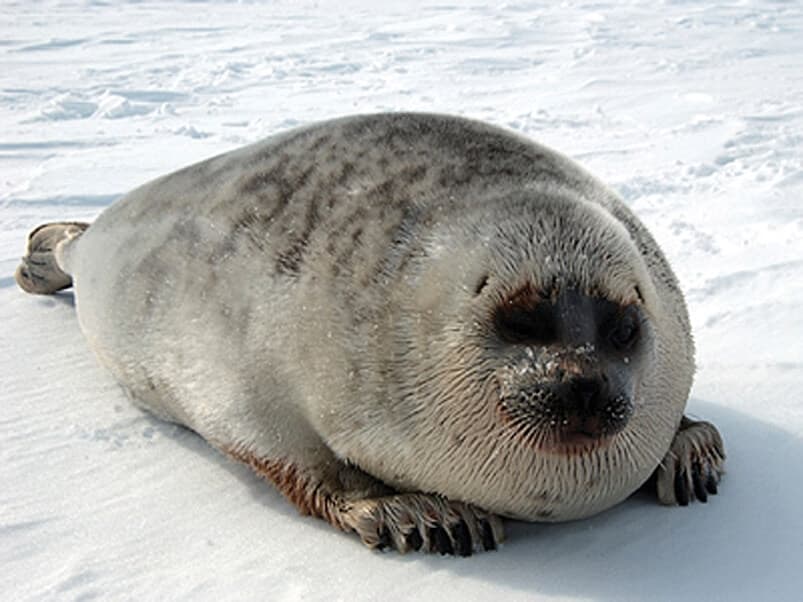
With an average size of up to 5 feet, while weighing about 130-150 lbs. Males and females are similar in size. They are the smallest and most prevalent species of seal. The snout is short, resembling a cat, and its body is chubby. They have a black coat with pale rings on the back, flanks, and abdomen.
Ringed Seals have small heads, large, powerful claws on their little front flippers that they employ to keep breathing holes open.

The most striking feature is their ringed fur pattern, with light-colored rings set against a darker gray or brownish background. This pattern varies among individuals, aiding in identification. Base fur color can range from silvery gray to dark brown or almost black, while the rings vary from light gray to cream or yellowish.
Large, dark eyes provide vision in low-light conditions. Ringed seals have short flippers compared to some other seal species, all equipped with strong claws for gripping ice and creating breathing holes. As the temperatures warm and the snow covering their lairs melts during spring, these marine mammals transition from lair use to basking on the surface of the ice near breathing holes, lairs, or cracks in the ice as they undergo their annual molt.
Puppies have a white natal coat, also known as lanugo, at birth. However, this coat is lost after four to six weeks. They can use their body shape to bounce on slippery surfaces, such as ice, fairly fast. Their heads are relatively small and rounded with a short snout and prominent whiskers.
Did you know…
During the breeding season, males exhibit territorial behavior and emit a strong scent from the glands of their faces; due to their scent, hunters refer to them as “kerosene” or “gasoline seals” and avoid harvesting them because they do not taste good.

Habitat
Ringed seals have a circumpolar range that includes the whole Arctic Basin and extends southward into nearby waters, such as the Bering and Labrador Seas. They are found in all seasonally ice-covered seas of the Northern Hemisphere and in certain freshwater lakes.
Additionally, they may be found in the North Atlantic’s Baltic Sea as well as the western North Pacific’s Sea of Okhotsk and the Sea of Japan.
Lakes in Russia and Finland are inhabited by landlocked species. They extend their migration across Greenland to end up in the approximate north of Canada throughout the winter and spring in North America.
Diet
During the open-water season, crustaceans seem to take on a greater significance in many habitats, and they frequently make up the majority of juvenile seals’ diets.
The Ringed Seal is a carnivore and consumes 72 different types of fish and crustaceans, as well as a broad array of other tiny prey. They like to hunt alone, and their preferred prey includes mysids, shrimp, arctic cod, and herring.
They plunge to depths of 35 to 150 feet while diving for food. In the summer, they hunt for arctic cod at the sea ice’s edge. They consume herring, smelt, whitefish, sculpins, perch, and crabs, among other things.
Even while their diet varies depending on location and time of year, from late October to early spring, fish from the cod family tend to predominate its diet.
Reproduction
Females reach sexual maturity at about the age of 6. Late April is often when the females start mating. To find a mate, males will rove the ice. The male and female may spend a few days after they are located before reproducing. The male then searches for a different partner. Implantation is postponed for several weeks after mating.

The female then gives birth to one pup after a 9 to 11-month gestation period, and she raises it in the privacy of a lair. The nursery shields the baby from predators and adverse weather. Puppies are weaned at around two months and then left to fend for themselves, despite starting to dive soon after birth.
Threats
Polar bears, in particular, rely heavily on Ringed Seals as food. Ringed seal pups birthed outside of lairs during the pupping season are taken by Arctic foxes and glaucous gulls, while killer whales, Greenland sharks, and occasionally Atlantic walruses feed on them in the ocean.
In December 2012 they were listed as threatened under the Endangered Species Act. It is necessary to assess the factors affecting their population and suitable conservation actions should be taken. They are now categorized as Least concern according to the IUCN Red List 2024.
The Arctic’s total size has been reduced due to rising temperatures during the past few decades. This has a big influence on them since they live in the Arctic area. The most serious threats are climate change, declining food supplies, and human fishing practices.
5 More Quick Facts about Ringed Seal
- Ringed Seal blow bubbles up their breathing hole before surfacing to scout for nearby predators.
- They can live up to 30 years in the natural environment.
- These seals are solitary creatures, with hundreds of yards between specimens.
- Ringed Seal pups can dive shortly after birth.
- Ringed Seals use their frontal flipper to clear out ice passages underwater.
FAQs
Are Ringed Seals cuddly?
Ringed Seals are enthusiastic and even demanding cuddle creatures, and they don’t appear to be picky about who they choose to cuddle with. However tempting, it is not recommended that you engage in cuddling with them.
Do Ringed Seals love humans?
Human interaction with seals in the wild usually has a negative net effect. Ringed Seals can become disturbed by human attention and feel uneasy or frightened because they are still regarded as wild creatures.
What to do if a Ringed Seal approaches you?
It’s crucial to maintain your composure, walk cautiously away, and avoid making any unexpected moves that would push the Ringed Seal to flee. This is important to remember if you are trying to capture footage of such an adorable creature.
Where do Ringed Seals like to stay at?
As soon as there is enough snow, Ringed Seals begin to construct lairs, a form of a snow cave, and become fiercely protective of them as well as the underwater spaces and breathing holes underneath them.