
The Walrus (Odobenus rosmarus) is a large marine mammal inhabiting the Arctic circle and subarctic regions. It is easily recognized by its long tusks and tough, wrinkled thick skin. It is a pinniped and belongs to the Odobenidae family.
They are further divided into two subspecies: The Atlantic Walrus (Odobenus rosmarus rosmarus) and the Pacific Walrus (Odobenus rosmarus divergens).
While these two species share many similarities, several key differences set them apart. The Atlantic subspecies tends to be smaller than its Pacific counterparts. In contrast, the Pacific subspecies is larger and has incredibly long tusks, which can reach up to 1 meter long.
Appearance
Walruses are large marine mammals with tough, wrinkled, brown skin. Their 1.5-inch (4 cm) thick layer of blubber helps to insulate them from the frigid Arctic temperatures. Their short, bristly hairs covering their bodies contribute to their brownish appearance. Males are significantly larger than females.
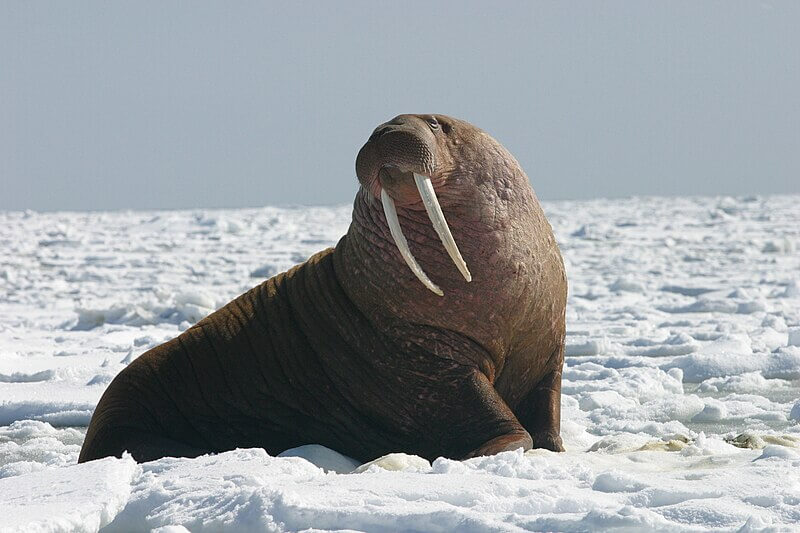
These marine mammals have rounded heads, small eyes, and distinctive whiskered faces. These whiskers serve as sensory tools, helping them locate food on the ocean floor. Their flipper-like limbs are perfectly adapted for swimming and maneuvering in the water.
Walruses are ironically known for their long, downward-curving ivory tusks. These enlarged canine teeth can reach up to 40 inches (1 meter) in length, though they are typically around 20 inches (50 cm). Males have longer tusks than females. They use them for various purposes, including fighting, breaking ice, and hauling their heavy bodies onto land.
Habitat
Walruses can be found in the frigid Arctic and are sometimes vagrants in the North Pacific Ocean. They are semi-aquatic, meaning they spend their life in water and on land. They tend to prefer shallow waters surrounded by abundant sea ice. They use sea ice as a platform for resting, giving birth, and accessing their preferred prey.
The Atlantic Walrus resides in northeastern Canada, Greenland, Russia, and Norway’s coastal areas. The Pacific Walrus lives along the Northern seas of Russia and Alaska, stretching from the Bering Sea to the Chukchi Sea and the Laptev Sea.
Behavior
These marine mammals are highly social and live in groups often referred to as herds. These herds can reach thousands of individuals. The herds consist primarily of mothers and their young, with a few dominant males. Males are known as bulls, while females are called cows.

Compared to other pinnipeds, Walrusеs are not deep divers. They can swim to depths of 1,640 feet (500 meters). However, they rarely venture beyond 65-165 feet (20-50 meters).
They are also known to migrate with the seasonal movement of sea ice. In the summer, they travel north following the ice pack as it recedes. In winter, they migrate back to southern localities within their range.
Diet
These carnivorous marine mammals feed primarily on bivalve mollusks, such as clams. They use their sensitive whiskers to locate prey buried in soft-bottom substrates. In addition to clams, their diet can also include worms, snails, soft-shell crabs, and other invertebrates like turnicates.
They have a unique feeding method. They suck food into their mouths, creating a vacuum to extract soft invertebrates from their shells. This powerful suction allows them to consume large quantities of bivalves in a single feeding session.
On rare occasions, they may even prey on slow-moving fish, birds and seals.
Reproduction
Walruses are polygynous, with dominant males establishing territories on ice floes. They attract females through vocalizations and aggressive displays, often engaging in tusk-fighting contests. Mating occurs in the water during the winter months.

Females give birth to a single calf every two to four years, usually at the age of 7-10 years. Calves nurse for two years and may remain with their mothers for up to five years. Both males and females reach sexual maturity around 7-10 years of age, but males require several more years to become physically and socially dominant enough to successfully breed.
They have an average lifespan of 30 to 40 years, though in some rare cases, they can live up to 50 years.
Threats
Due to their immense size, they have few natural predators. Polar Bears and Killer Whales pose the greatest threat, targeting primarily solitary individuals or calves.
Humans, however, are the most significant threat to Walrus populations. Historical and ongoing hunting for their meat, oil, skin, and ivory has significantly impacted their numbers, especially in the Pacific. While subsistence hunting continues in some regions, it is crucial to ensure sustainable practices to prevent further population declines.

Climate change poses another severe threat. The rapid loss of sea ice, their primary habitat, forces Walruses to congregate on land-based haul-outs. This can lead to overcrowding, stress, and increased mortality, particularly among calves. Additionally, increased human activity, such as shipping and oil exploration, in these areas can further disrupt populations. They are listed as Vulnerable on the IUCN Red List of Threatened Species.
Conservation Status
The Atlantic Walrus is a protected species in Norway and Russia, and harvests are regulated in Canada and Greenland. It is considered a species of “special concern” in Canada due to climate change impacts on sea ice.
In Russia, commercial hunting ceased in the 1990s. However, subsistence hunting by indigenous peoples is permitted under a quota system. Russian law also prohibits sport hunting and provides protection for major Walrus haulout sites.
In the US, the Marine Mammal Protection Act prohibits hunting except for subsistence purposes by Alaska Natives. While the Pacific Walrus is under consideration for listing under the Endangered Species Act, there are currently no legal mechanisms to regulate greenhouse gas emissions, the primary driver of climate change and sea ice loss.

Fun Facts About Walrus
- They can slow their heart rate to survive in the frigid Arctic waters.
- Prolonged dives in cold water can turn a walrus’s skin almost white.
- Males can sing underwater for up to 65 hours straight during mating season.
- They can run surprisingly fast on land, reaching human speeds on all four flippers.
- Walrus herds can generate so much body heat that they can create a fog cloud above them.
FAQs
How many walruses are left?
Although the exact population size of walruses is unknown, according to the IUCN, the total population is estimated to be above 250,000 animals. This includes roughly 30,000 Atlantic and 220,000 Pacific subspecies.
Are walruses mammals or fish?
Walruses are mammals, not fish. As mammals, they give birth to live young ones, nurse their young with milk, have hair, and breathe air. They are a part of the pinniped family, which also includes seals and sea lions.
What do walruses use their tusks for?
Walruses use their tusks to defend against predators, assert dominance and win mating rights in conflicts with other males, dig out food from the sea bed, and create breathing holes in the ice. They also use their tusks to climb out of the water and onto ice.


