

From the glittering Guppy in a child’s first fish tank to the gargantuan Goliath Grouper patrolling a sunken shipwreck, the letter ‘G’ showcases the incredible scale of the fish kingdom. Extremes define this group: the ancient, armor-plated Gar that has survived since dinosaurs, and the common Goldfish, a creature so familiar it’s easy to forget its wild origins.
This guide takes you into the world of these and many other species, exploring the giants, the gems, and the globally recognized fish that start with G.
Common Fish Names That Start With G
This section highlights fish best known by their common names, which often hint at their impressive size or appearance.
Goldfish (Carassius auratus)
Habitat: Originally from freshwater bodies in East Asia; now domesticated worldwide in ponds and aquariums.
Size: Can grow from 6 inches to over a foot long in proper conditions.
Conservation Status: The wild population is listed as Least Concern (LC) by the IUCN.

As one of the first fish ever to be domesticated, the Goldfish was selectively bred from the Prussian Carp in China over a thousand years ago, resulting in over 200 recognized varieties today. The popular myth that a goldfish has a three-second memory is completely false; they can actually remember things for at least five months and can even be trained to perform simple tricks.
They are surprisingly hardy fish, able to tolerate a wide range of conditions, and unlike most fish, they lack teeth in their mouths, instead using bony structures in their throat called pharyngeal teeth to crush food. This hardiness means that if released into the wild, they can grow to a massive size and become a destructive invasive species.
Grouper (Subfamily Epinephelinae)
Habitat: Worldwide in tropical and subtropical waters, typically around reefs, wrecks, and rocky bottoms.
Size: Varies immensely, from one foot to over 8 feet long for the Giant Grouper (Epinephelus lanceolatus).
Conservation Status: Varies greatly. Many species, like the Goliath Grouper (Epinephelus itajara), are listed as Vulnerable (VU) or Endangered due to overfishing.

As top predators and a keystone species crucial to maintaining the health of coral reef ecosystems, Groupers are classic ambush predators. They use their excellent camouflage to blend in before lunging and swallowing their prey whole. Possessing a stout body and a huge mouth, they are capable of swallowing prey over half their own size.
This is achieved by creating a powerful vacuum with their mouth to inhale prey, and the suction is so strong it produces a distinctive “boom” that can be heard from a distance underwater. Many species also have a fascinating life cycle as protogynous hermaphrodites, beginning life as females and later changing sex to become males.
Giant Gourami (Osphronemus goramy)
Habitat: Freshwater rivers, swamps, and marshes in Southeast Asia.
Size: Can grow up to 28 inches (2.3 feet) long, making it the largest of all gourami species.
Conservation Status: Least Concern (LC)

The Giant Gourami possesses a labyrinth organ, similar to a lung, which allows it to breathe atmospheric air directly from the surface and survive in stagnant, low-oxygen water. Its appearance changes dramatically as it ages; juveniles have attractive stripes and a pointed snout, while mature adults become large and deep-bodied, with males developing a prominent nuchal hump on their forehead.
Their diet also shifts, as young gouramis are carnivorous while adults become primarily herbivorous, feeding on aquatic plants and fruits. Due to its large size and hardiness, it is an important food fish in many parts of Southeast Asia.
Scientific Fish Names That Start With G
Here, we focus on species or genera where the scientific name is particularly significant.
Gadus (True Cods)
Habitat: Cold, deep waters of the North Atlantic and Arctic Oceans.
Size: Typically 2 to 4 feet long.
Conservation Status: Varies; the Atlantic Cod is listed as Vulnerable (VU) due to massive overfishing.

The genus Gadus, whose name is the direct Latin word for “codfish,” has been so commercially important to civilization that actual wars, such as the “Cod Wars” between Iceland and the UK, have been fought over fishing rights. As top predators in their benthic ecosystem, they feed on a wide range of fish and invertebrates.
Their defining feature is a single sensory barbel on the chin, which they use to feel and taste for food on the seabed. This effective feeding strategy contributes to their status as one of the most historically significant food fish in the world, renowned for their low-fat, flaky white flesh.
Gymnothorax (Moray Eels)
Habitat: Crevices and holes in coral and rocky reefs in tropical and subtropical seas worldwide.
Size: Varies from under a foot to over 13 feet for the Slender Giant Moray.
Conservation Status: Most species are listed as Least Concern (LC) by the IUCN.
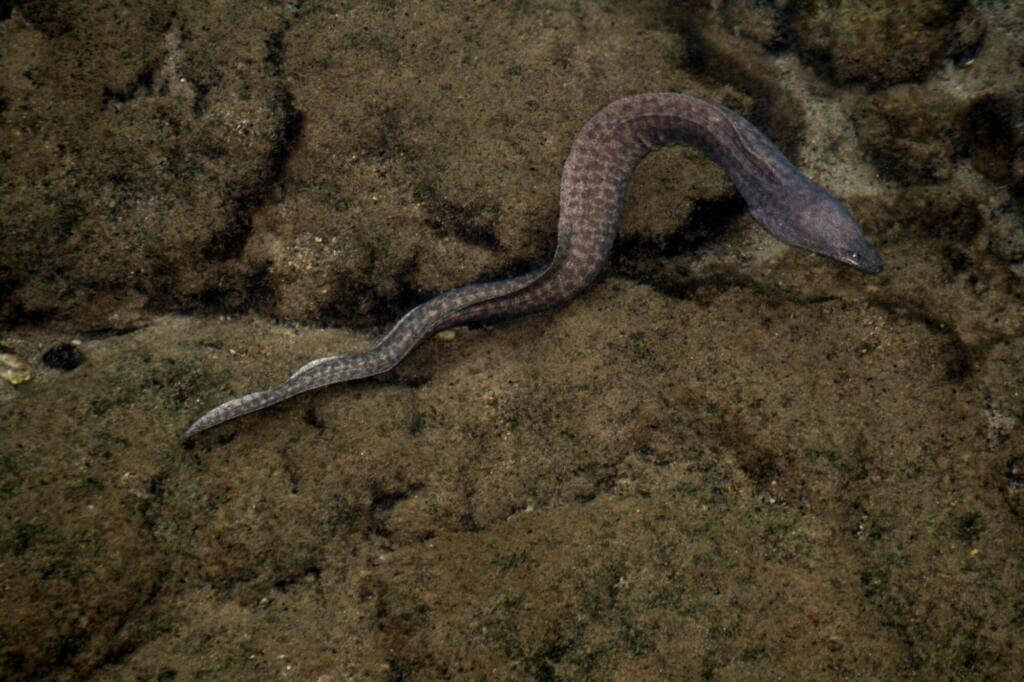
As vital reef predators that control populations of other fish and invertebrates, Moray Eels have several unique adaptations. They possess thick, leathery, scaleless skin covered in a protective, often toxic, layer of mucus.
You will often see them constantly holding their mouths open, which is not a threat but is actually how they pump water over their gills to breathe.
Their most incredible feature is a second set of jaws in their throat called pharyngeal jaws, famously like the creature from the movie Alien, which they launch forward to grasp prey and pull it into their gullet.
Other Fish Species That Start with G
- Galjoen Fish (Dichistius capensis)
- Gar (Family Lepisosteidae)
- Garibaldi (Hypsypops rubicundus)
- Garden Eels (Genus Heteroconger)
- Gray Piranha (Serrasalmus rhombeus)
- Ghost Flathead (Hoplichthys gilberti)
- Ghost Knifefish (Apteronotus albifrons)
- Ghost Pipefish (Family Solenostomidae)
- Ghost Shark (Callorhinchus milii)
- Giant Danio (Devario aequipinnatus)
- Giant Puffer (Arothron stellatus or related species)
- Giant Raphael Catfish (Megalodoras uranoscopus)
- Giant Sea Bass (Stereolepis gigas)
- Giant Snakehead (Channa micropeltes)
- Giant Trevally (Caranx ignobilis)
- Giant Whiptail Catfish (Rineloricaria lanceolata group)
- Gila Trout (Oncorhynchus gilae)
- Gizzard Shad (Dorosoma cepedianum)
- Glassfish (Family Ambassidae)
- Glowlight Tetra (Hemigrammus erythrozonus)
- Goatfish (Family Mullidae)
- Goblin Shark (Mitsukurina owstoni)
- Goby (Family Gobiidae)
- Goldfish (Carassius auratus)
- Golden Dorado (Salminus brasiliensis)
- Golden Dojo Loach (Misgurnus anguillicaudatus)
- Golden Julie (Julidochromis ornatus)
- Golden Loach (Misgurnus spp. / Cobitidae)
- Golden Perch (Macquaria ambigua)
- Golden Shiner (Notemigonus crysoleucas)
- Golden Trout (Oncorhynchus mykiss aguabonita)
- Goliath Grouper (Epinephelus itajara)
- Goliath Tigerfish (Hydrocynus goliath)
- Gopher Rockfish (Sebastes carnatus)
- Goosefish (Lophius americanus)
- Gray Mullet (Mugil cephalus)
- Gray Reef Shark (Carcharhinus amblyrhynchos)
- Grayling (Thymallus thymallus)
- Great White Shark (Carcharodon carcharias)
- Green Swordtail (Xiphophorus hellerii)
- Green Terror Cichlid (Andinoacara rivulatus)
- Grenadier (Family Macrouridae)
- Grunion (Leuresthes tenuis)
- Grunt (Family Haemulidae)
- Grunt Sculpin (Rhamphocottus richardsonii)
- Guitarfish (Family Rhinobatidae)
- Gunnel (Family Pholidae)
- Guppy (Poecilia reticulata)
- Gurnard (Family Triglidae)
FAQs
What is a golden fish that starts with G?
The most famous golden fish is the Goldfish (Carassius auratus), which was selectively bred for its brilliant metallic colors. For a more impressive predator, the Golden Dorado (Salminus brasiliensis) is a powerful South American game fish known for its spectacular golden scales.
What’s the difference between a Gar and a Pike?
While they are both long, slender, freshwater predators, they are unrelated. Gars are ancient fish with hard, diamond-shaped ganoid scales and are famous for their ability to breathe air. Pike are more modern fish with typical scales and are known for their explosive ambush attacks.
Why are so many different fish called “Goby”?
“Goby” refers to the family Gobiidae, which is one of the largest fish families in the world with over 2,000 species. They are typically small, bottom-dwelling fish found in a huge variety of marine and freshwater habitats, so you will encounter many different types all over the globe.
Are Guitarfish a type of shark or a ray?
Guitarfish are fascinating because they look like a perfect mix of both. They are technically a type of ray, but they represent an evolutionary link between sharks and rays. They have the flattened body and wing-like fins of a ray but swim by moving their shark-like tail from side to side.
What is a giant fish that starts with G?
In saltwater, the Goliath Grouper (Epinephelus itajara) is a true giant, growing over 8 feet long and weighing nearly 800 pounds. In freshwater, the Giant Gourami (Osphronemus goramy) is the largest of all gourami species, reaching over two feet in length.


