

The letter ‘L’ introduces us to some of the true living legends of the aquatic world, species whose very existence tells a story of incredible survival and adaptation. This category features the ancient Lungfish, a creature that breathes air and can live for years buried in dry mud, and the lethal Lionfish, a beautiful but invasive predator of coral reefs. From the luminous Lanternfish of the deep sea to the loyal Lingcod guarding its nest, this guide explores the remarkable lifestyles of fish that start with L.
Common Fish Names That Start With L
This section features fish recognized by their common names that perfectly capture their most remarkable traits.
Lionfish (Pterois genus)
Habitat: Native to Indo-Pacific coral reefs; now a major invasive species in the Atlantic Ocean.
Size: Can grow up to 18 inches in length.
Conservation Status: Least Concern (LC) in their native range; considered a major pest in their invasive range.
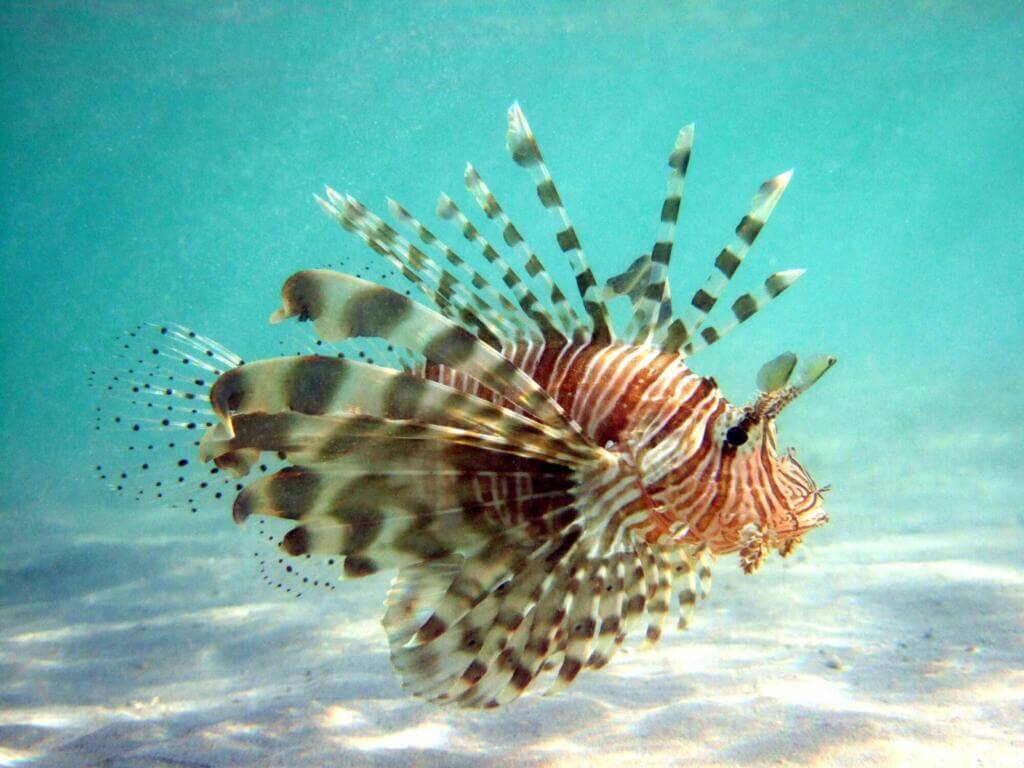
The Lionfish is famous for its spectacular appearance, with long, dramatic fins that fan out like a lion’s mane. These fins are not just for show; the dorsal, pelvic, and anal fins are equipped with exceptionally long spines containing a powerful venom. This venom is used purely for self defense, providing formidable protection from would be predators.
As voracious predators themselves, they use their ornate pectoral fins to corner smaller fish and crustaceans before swallowing them whole with their large mouth. Their status as a highly successful invasive species in the Atlantic and Caribbean is a major ecological concern. With no natural predators in their new environment, their rapid reproduction and huge appetite have allowed them to devastate native reef fish populations.
Lungfish (Order Ceratodontiformes)
Habitat: Freshwater rivers, swamps, and floodplains in Africa, South America, and Australia.
Size: Varies by species, from 3 to over 6 feet long.
Conservation Status: Most species are Least Concern (LC), but are threatened by habitat loss.
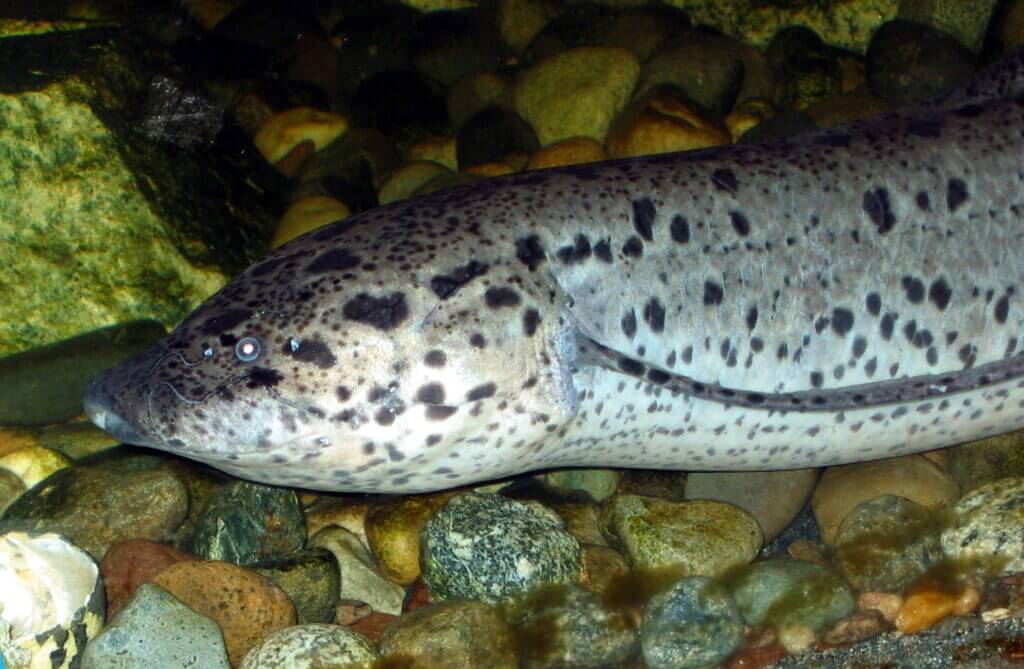
The Lungfish is a true living fossil, belonging to an ancient lineage that has survived for over 400 million years. Their most incredible feature is the ability to breathe atmospheric air. They possess one or two lungs, similar to those of terrestrial vertebrates, and must surface regularly to gulp air. This adaptation allows them to thrive in stagnant, low-oxygen water where other fish would perish.
The African Lungfish takes this survival skill to an extreme. During a drought, when its riverbed dries up, it can burrow into the mud and secrete a mucus cocoon around its body. It then enters a state of suspended animation called estivation, where it can remain dormant for months or even years, breathing air through a small tube to the surface until the rains return.
Lamprey (Order Petromyzontiformes)
Habitat: Freshwater rivers and coastal seas worldwide; many species are anadromous (live in saltwater, spawn in freshwater).
Size: Varies by species, typically 1 to 3 feet long.
Conservation Status: Varies greatly. Some species are endangered in their native European rivers, while the Sea Lamprey is a destructive invasive pest in the North American Great Lakes.

The Lamprey is a true living fossil, belonging to an ancient lineage of jawless fish that predates the dinosaurs. Its most infamous feature is its life as a parasite. Instead of a typical jaw, it has a large, circular suction cup mouth that is filled with concentric rows of sharp, horny teeth. It uses this powerful mouth to latch onto other fish, then employs its rasping tongue to drill a hole through the host’s skin and scales to feed on its blood and bodily fluids.
This predatory adult stage is only half of its incredible life story. A Lamprey begins as a harmless, blind larva called an ammocoete. This larval form lives buried in the silt of riverbeds for several years, acting as a simple filter feeder, straining microorganisms from the water. After this long period, it undergoes a radical metamorphosis, completely transforming its body into the parasitic adult form, developing eyes, its iconic sucker mouth, and the ability to hunt.
Scientific Fish Names That Start With L
Here, we focus on species or genera where the scientific name is particularly significant.
Labroides (Cleaner Wrasse)
Habitat: Coral reefs throughout the Indo-Pacific and Indian Oceans.
Size: Small, typically 2 to 4 inches long.
Conservation Status: Most species are listed as Least Concern (LC).

The genus Labroides is famous for its role as the “cleaner” of the coral reef. These small wrasses operate “cleaning stations,” where larger fish, including huge predators like groupers and moray eels, will line up and patiently wait their turn to be serviced. The Cleaner Wrasse performs a unique dancing motion to signal that it is open for business and to assure its “clients” that it is not prey.
This is a classic example of mutualistic symbiosis. The wrasse gets a full meal by eating parasites, dead tissue, and mucus off the larger fish’s body, gills, and even from inside its mouth. In return, the client’s fish is freed from irritating and harmful pests. This interaction is so vital that the removal of cleaner wrasses from a reef has been shown to cause a decline in the health and diversity of the entire fish community.
Loricariidae (Armored Catfish)
Habitat: Freshwater streams and rivers in Central and South America.
Size: Varies immensely, from tiny 1-inch species to some that exceed 3 feet.
Conservation Status: Varies by species; many are Least Concern, while some are endangered due to habitat loss.
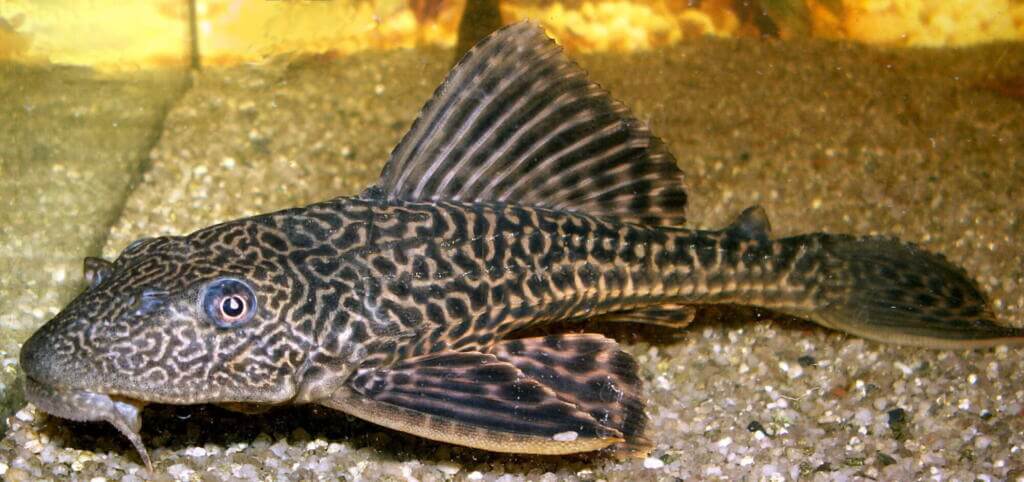
The family Loricariidae is known as the armored catfish, a name that perfectly describes their primary defense. Instead of scales, their bodies are covered in overlapping bony plates, or scutes, forming a flexible suit of armor. This family is massive, containing over 900 species, including the popular aquarium fish known as Plecos or suckermouth catfish.
Their most recognizable feature is a ventral mouth (located on the underside of the head) that has been modified into a powerful suction cup. This allows them to anchor themselves to rocks in fast flowing water and to scrape algae and biofilm off surfaces. Many species are nocturnal, using their sensitive barbels to navigate and find food in the dark.
Other Fish Species That Start with L
- Labyrinth Fish (Suborder Anabantoidei / Family Osphronemidae)
- Labout’s Fairy Wrasse (Cirrhilabrus laboutei)
- Ladyfish (Genus Elops, e.g., Elops saurus, Elops affinis)
- Lake Chub (Couesius plumbeus)
- Lake Chubsucker (Erimyzon sucetta)
- Lake Trout (Salvelinus namaycush)
- Lake Whitefish (Coregonus clupeaformis)
- Lancetfish (Alepisaurus ferox)
- Lancer Catfish / Loach Catfish (Amphilius grandis)
- Lateolabrax (Japanese Sea Bass, Lateolabrax japonicus)
- Lawnmower Blenny (Salarias fasciatus)
- Leaf-fish (Family Polycentridae, Family Nandidae)
- Leatherjacket (Family Monacanthidae)
- Lemon Shark (Negaprion brevirostris)
- Lemon Sole (Microstomus kitt)
- Lemon Tetra (Hyphessobrycon pulchripinnis)
- Lenok (Brachymystax lenok)
- Leopard Shark (Triakis semifasciata)
- Leleupi Cichlid (Neolamprologus leleupi)
- Lesser Spiny Eel (Mastacembelus spp.)
- Leopard Danio (Danio rerio variant)
- Leopard Ctenopoma (Ctenopoma acutirostre)
- Leptosoma Cichlid (Cyprichromis leptosoma)
- Lionfish (Genus Pterois)
- Lionhead Cichlid (Steatocranus casuarius)
- Lined Sole (Achirus lineatus)
- Linam’s Pimelodella (Pimelodella spp.)
- Ling (Molva molva)
- Lingcod (Ophiodon elongatus)
- Lipped Bream (Gymnocranius spp.)
- Lizardfish (Synodus spp.)
- Livebearer (Family Poeciliidae)
- Loach (Family Cobitidae, e.g., Pangio spp.)
- Loach Goby (Rhyacichthys aspro)
- Loach Minnow (Rhinichthys cobitis)
- Long-Band Rasbora (Rasbora einthovenii)
- Long-Finned African Tetra (Alestes longipinnis)
- Long-Finned Barb (Barbus arulius)
- Long-Finned Char (Salvethymus svetovidovi)
- Long-Finned Dragonfish (Tactostoma macropus)
- Long-Finned Smelt (Spirinchus thaleichthys)
- Longfin Bannerfish (Heniochus acuminatus)
- Longhorn Cowfish (Lactoria cornuta)
- Longjaw Mudsucker (Gillichthys mirabilis)
- Longnose Dace (Rhinichthys cataractae)
- Longnose Gar (Lepisosteus osseus)
- Longnose Sucker (Catostomus catostomus)
- Longnose Whiptail Catfish (Sturisoma barbatum)
- Long-Whiskered Catfish (Pseudoplatystoma tigrinum)
- Lost River Sucker (Deltistes luxatus)
- Louvar (Luvarus imperialis)
- Loweye Catfish (Pseudoplatystoma spp.)
- Luderick (Girella tricuspidata)
- Lumpfish (Cyclopterus lumpus)
- Lungfish (Neoceratodus forsteri)
- Luminous Hake (Steindachneria argentea)
- Live Sharksucker (Echeneis naucrates)
FAQs
What is the most dangerous fish that starts with ‘L’?
The Lionfish is considered one of the most dangerous ‘L’ fish to other marine life due to its devastating impact as an invasive species. To humans, its Long, venomous spines can deliver an extremely painful, though rarely fatal, sting. The Lingcod is also known for its aggressive territorial defense and can inflict a nasty bite on unwary divers.
Are there any ‘L’ fish that live in the deep sea?
Yes, the deep sea is home to several ‘L’ fish. The Lanternfish is one of the most abundant vertebrates on Earth, using its own light-producing organs (photophores) to communicate in the dark. The Lancetfish is a fearsome deep-sea predator with huge, fang-like teeth and a sail-like dorsal fin.
What’s the difference between a Loach and a Catfish?
While both are often bottom-dwellers with barbels, they are from different orders. Most Loaches (like the Kuhli Loach) have slender, eel-like bodies and a small, sharp spine below their eye for defense. Catfish come in a much wider variety of shapes and sizes and many, like the Loricariidae family, are covered in bony armor instead of scales.


