
Our planet is nearly inconceivably old. Circling the sun for over 4.5 billion years, our life-supporting rock has seen changes that we can only glimpse from what was left behind.
Meteor showers, ice ages, and various climate conditions have led to the rise and fall of massive ecosystems and species – One of these is the Chazy Reef, which is referred to as the oldest reef on planet Earth.
Although this glimpse into the past is no longer living, it is no less captivating than any of the oldest living reefs on Earth.
We are all curious about how the world developed, so come with me to explore this 450 million-year-old fossil reef.
Location and Geological Formation
Nestled in the outstandingly beautiful landscape of Vermont, United States, the Chazy Reef spans across three of the Champlain islands.


Credit: Google Maps
Beginning its journey approximately 450 million years ago during the Ordovician Period, reef-building organisms, primarily bryozoa, slowly left limestone deposits behind.
Although they are reef-building organisms and often confused with coral reefs, bryozoa are more complex, older, and closely related to sponges.
Making their home in what was the Iapetus Ocean, the reef eventually spread from Tennessee to Quebec and Newfoundland before conditions changed, and it was no longer able to thrive.
Ecology
Like most of our modern-day reefs, The Chazy Reef thrived in warm tropical waters of the region’s shallow continental shelf, where Bryozoa thrived in their environment without the competition of larger branching and stony coral.
As the reef matured, it evolved into a complex ecosystem, providing a variety of ecological niches that fostered the first rich local biodiversity.
The Chazy Reef Formation marks a pivotal moment in the evolution of life, showcasing a slowly evolving faunal succession.
Fossil Diversity and Past Life
Fossils embedded in the black limestone of Isle La Motte provide a remarkable snapshot of the diverse organisms that contributed to the reef’s formation and the life that once inhabited the Iapetus Ocean.
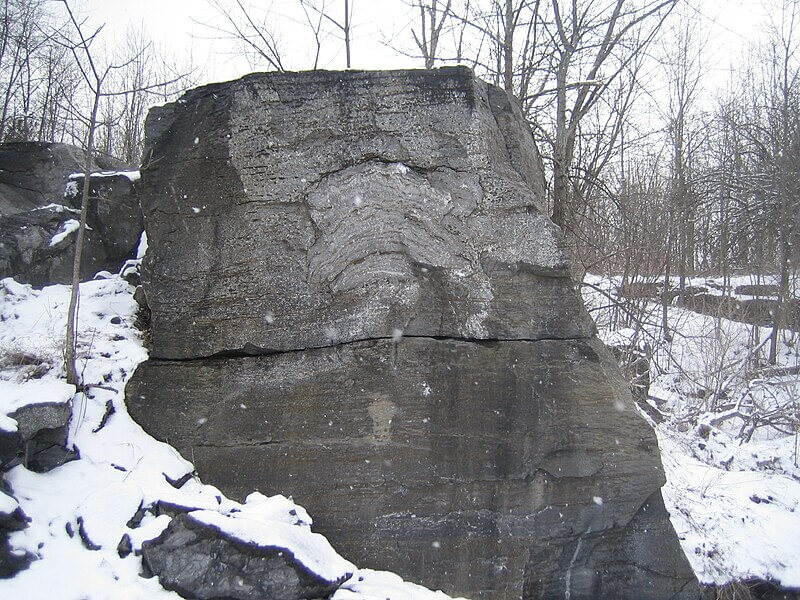
Preserved fossils of:
- Stromatoporoids: Ancient reef builder sponges of the benthic zone
- Gastropods: (Snails and Slugs)
- Cephalopods: Members of the Mollusca phylum, including squid, octopuses, and cuttlefish
- Echinoderms: Sea stars
- Brachiopods: Shellfish, similar to clams
- Coral: Small calcium carbonate-secreting invertebrates known as polyps (builders of reefs)
- Bryozoa: Simple, sedentary marine invertebrates capable of building reefs
- Stromatolites: layered deposits of mainly limestone, formed by the growth of blue-green alga
Can be found layered throughout the Chazy Reef.
This is the first indication of a complex marine ecosystem and reef.
Chazy Reef’s Ecological Evolution Over Time
It’s not clear when the demise of the reef began, but we can tell from back-dating fossils that the succession of the reef spaned over millions of years.
From the limestone deposits of the bryozoa, the reef began vertically growing, where it saw a continuous evolution of fauna.

This complex succession eventually led to the Chazyan faunal stage, where complex marine life, such as various trilobite species, developed.
The Demise of Chazy Reef
The demise of the Chazy reef, like most geological formations, was a complex process, and likely the result of various factors coming into play over a prolonged period.
Although it’s unclear as to the exact reason for the reef to discontinue its growth, the geographical changes in the area can give us some indication.
Some factors that could have led to the discontinuation of the development of Chazy Reef include:
- Climate Shifts: While Chazy Reef thrived in a warm, ice-free environment during its formation around 460 million years ago, changes in global climate, such as cooling or alterations in sea levels, could have affected the reef’s ability to sustain itself.
- Tectonic Activity: Tectonic activity, including the shifting of tectonic plates, could have altered the geological setting of the Chazy Reef. Changes in the surrounding landscape, such as shifts in sea levels or the reef’s relation to landmasses, might have impacted the reef’s structure and ecosystem.
- Faunal Succession: Over time, changes in the dominant organisms contributing to the reef’s growth would have changed. The shift from one dominant reef-building organism to another is a natural part of faunal succession that could have led to a change in the reef’s dynamics.
- Accumulation of Sediments: The accumulation of sediments over time can lead to the burial of reef structures. As Chazy Reef continued to grow vertically, the sedimentation processes might have influenced its ability to sustain the vibrant ecological community seen during its peak.
- Competition and Succession: The succession of dominant reef-building organisms might have been driven by changes in environmental conditions and biological interactions. For example. When stony or branching coral is present, it tends to outcompete with bryozoa and, therefore, becomes the dominant reef-building species.
- Diagenesis and Lithification: Geological processes such as diagenesis (changes in sedimentary rocks) and lithification (conversion of sediments into rock) over millions of years would have impacted the physical structure of Chazy Reef. These processes can alter the original composition and appearance of the reef, marking the geological “end” of its active growth phase.
Chazy Reef as a National Natural Landmark
In 2009, Chazy Reef earned the title of a United States National Natural Landmark.
Being the planet’s oldest reef, Chazy Reef holds outstanding examples of the country’s biological and geological history and is closely managed by the Isle La Motte Preservation Trust.

Although the reef is well protected and preserved, there are regions that remain open to the public.
Fisk Quarry, the oldest quarry in Vermont, and Goodsell Ridge are two such places where ancient fossils of Chazy Reef can be viewed.
Future Challenges and Opportunities: Sustaining Chazy Reef
Balancing accessibility with conservation remains paramount to sustaining Chazy Reef’s legacy for future generations.
With a continuously changing environment, scientific interest, and a desire from the general public to explore the world’s oldest reef, constant challenges are met in the conservation of the national park.
Education, access limitations, and close monitoring of the environmental conditions are essential to the preservation of the Chazy fossil reef.
FAQs
What role did stromatolites play in the formation of Chazy Reef?
Stromatolites, layered deposits formed by the growth of blue-green algae, are part of the fossil diversity in Chazy Reef. They played a role in the early stages of the reef’s formation, contributing to the complex marine ecosystem.
How do climate conditions of the Ordovician Period compare to today’s climate?
During the Ordovician Period, the climate was significantly warmer than today, with higher levels of atmospheric carbon dioxide. Understanding these ancient climate conditions provides context for the development and thriving of ecosystems like Chazy Reef.
How do the fossils in Chazy Reef contribute to our understanding of prehistoric marine ecosystems?
The fossils in Chazy Reef offer a valuable archive of prehistoric marine ecosystems. Studying these fossils provides insights into the composition, interactions, and adaptations of organisms that inhabited the Iapetus Ocean during the Ordovician Period.
How did Chazy Reef contribute to the creation of limestone formations in the surrounding areas?
Chazy Reef’s growth and development contributed to the creation of limestone formations in the surrounding areas, particularly on Isle La Motte. The reef’s vertical growth and sedimentation processes played a role in forming the distinctive limestone layers.


