Since the beginning of time on this planet, rivers have been a source of life for animals and flora that thrive on fresh water. The Niger River, being one of the 15 longest rivers in the world and the third longest river in Africa, travels approximately 2600 miles, providing life through western Africa.
Let’s take a look at this life-giving beauty and how it plays a part in our world.
Geography
The Niger River is the principal river of western Africa. It finds its origin in the densely forested mountain plateau of the Fouta Djallon highlands in the Guinean Highlands of Guinea, 240 km from the Atlantic Ocean, slightly east of the Sierra Leone border.
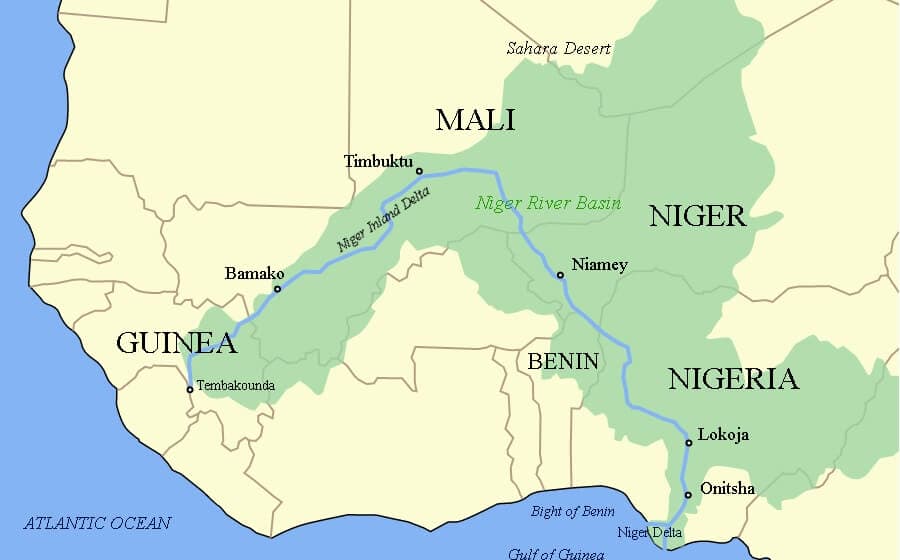
The river flows through major cities like Bamako, Niamey, Onitsha, and Lokoja, each boasting unique cultures and histories.
Formation
Although unclear, one theory that’s commonly agreed on is that the Niger River formed its shape from two preexisting rivers connecting. It’s believed that as the Sahara began drying out, the south-running river altered its course and met up with the northern river.
Alternatively, it’s also possible that multiple streams formed as a result of rainfall accumulation. These streams converged and gained volume and speed, eventually becoming rivers. This process is typical of how many of the world’s major rivers begin.
River Course
From its origin, it flows north towards the Sahara Desert, through Mali, meeting the Bani River, and forming a large network of wetlands, rivers, and streams known as the Niger Inland Delta.

This unique delta spreads to a size approximately as large as Berlin. In its middle course, the river passes through regions with low terraces and sandbanks, creating diverse landscapes. From central Mali, near Gao, the river takes a turn to the south and heads through the southwest region of Nigeria and along the border of Benin.
The Niger River passes through the point where the borders of Niger, Benin, and Nigeria meet. From here, it goes downstream from Jebba in Nigeria, where it eventually empties into the Gulf of Guinea in a large networking delta—the Niger Delta that has also become known as the Oil Rivers. The Niger enters what is commonly referred to as the “internal delta” of the Niger, a region of lakes, creeks, and backwaters, after meeting the Bani, its largest tributary on the right, at Mopti.
The Niger River has several important tributary rivers, with the Benin River being the largest contributor.

The large river has created a huge diversity of flora and fauna, which has greatly aided human development; however, despite the Niger River’s importance in the ecology of the regions it travels through, it faces environmental risks due to human negligence.
Physiography of Niger River
The Niger River starts in Guinea, about 150 miles from the Atlantic Ocean, in the Fouta Djallon highlands. It begins as the Tembi stream, 2,800 feet above sea level, flowing north for 100 miles. It then changes course northeast, picking up smaller rivers like the Mafou, Niandan, Milo, Sankarani, and Tinkisso, before reaching Mali. Near Bamako, the Sotuba Dam marks the end of this upper section. Beyond it, the river used to drop sharply, but now the Markala Dam has smoothed out this part. At Koulikoro, the river heads east-northeast, running smoothly for around 1,000 miles.
Tributaries and Lakes Along the Niger
The Bani River, the Niger River’s largest tributary to the right, joins it at Mopti. Situated on the river’s left bank, the majority of the lakes are joined by directional seasonal channels. During floods, many of the lakes merge into a large water body. The largest lake in this area is Lake Faguibine, which is about 75 miles long, 15 miles wide, and over 160 feet deep in some spots.
River’s Journey Through Timbuktu and the Sahara
The network of lakes and creeks ends at Kabara, Timbuktu’s port. From there, the Niger River turns east. A rocky ridge blocks the river about 250 miles downstream from Timbuktu, but it still passes through a narrow gorge that is over a mile long, about 800 feet wide, and more than 100 feet deep. When water levels are low, the strong current here makes navigation dangerous. Shortly after, the river turns southeast, becomes much wider, and flows toward Gao across a broad floodplain, 3 to 6 miles wide, on the southern edge of the Sahara Desert.
Navigability and Course Through Nigeria
The Niger River is navigable for small boats during the wet season as far as Ansongo, 1,100 miles downstream. Below Ansongo, rapids interrupt navigation, but it becomes navigable again at Labbezanga and continues to the Atlantic. In Nigeria, the river joins the Kaduna and Benue Rivers, doubling its size near Lokoja. From there, it flows through valleys and wide plains, eventually splitting into many branches in its large delta, which stretches over 14,000 square miles. The Benue River, an important tributary, rises in Cameroon and flows west into Nigeria, draining a vast area along with the Niger’s other tributaries.
Historical Significance
The Niger River has unique behavior that has put entomologists to the test. The Niger River has long homed human civilization that can be traced back to the Paleolithic ages, roughly 2.5 million years ago.

The Sarakali Empire of Ghana, the Mandingo Empire of Mali, and the Songhai Kingdom all paid tribute to the upper and middle Niger for their trade success between the 8th and 15th centuries.
In modern times, the Niger River is a major source of food, water, transport, and minerals for ethnic groups that live along its banks, as well as for large corporations that pillage the area for its resources.
Cultural & Economic Significance
In the past, the river was also a trade route for the cities of Timbuktu, playing a key role in the region’s development for millennia.
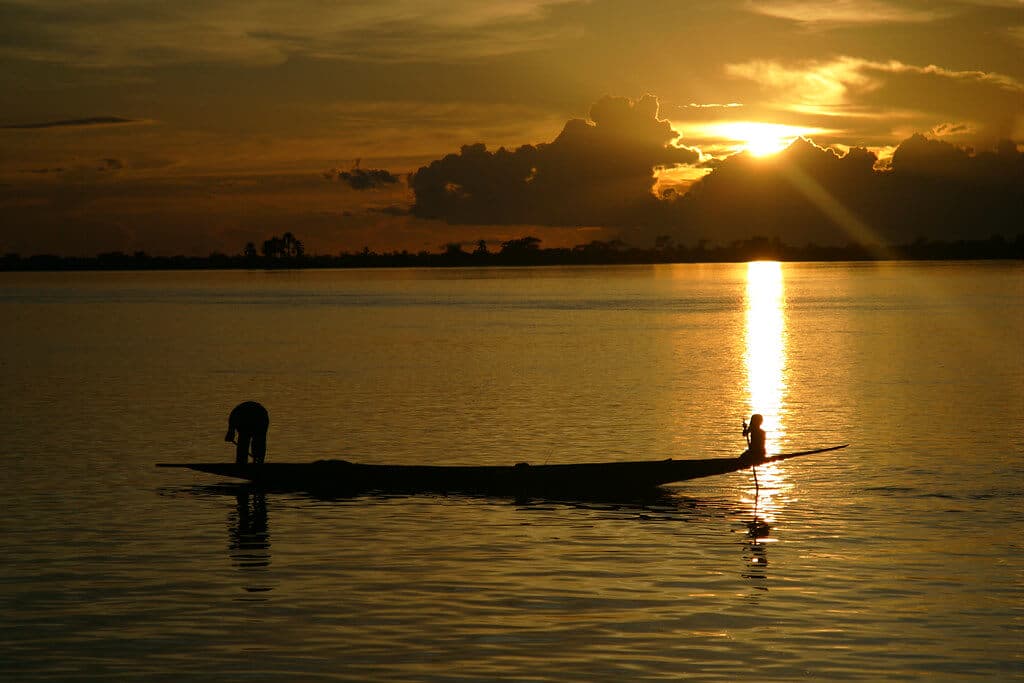
Today, the Niger River is central to West Africa’s economy, supporting activities like rice farming along its banks and facilitating trade across regions. Its role in the livelihoods of inhabitants and its contribution to the economies of the surrounding areas cannot be overstated.
Ecosystem
The Niger River is an important and unique ecosystem, partly due to its extensive length as well as its course that travels through the arid Saharan desert.
The Niger River ecosystem includes unique areas like the marshes around the Sotuba Dam and the Csepel Island, enhancing its biodiversity.
Not only does the river support aquatic life, but its wide flood plans provide a home through forests and grasslands for a wide variety of life that would otherwise not survive in the dry desert conditions.
The river houses 36 families and over 200 species of freshwater fish, of which 20 are found only in the Niger River.

Although the river holds a key to the ecosystem of northwest Africa, the ecology of the Niger is constantly under threat from human activity.
Plant life in Niger River
The Niger River flows through nearly every vegetational zone of western Africa, offering a diverse landscape along its course. It begins in the Fouta Djallon plateau, where fine, wiry tufts of sedge vegetation are scattered across bare rock surfaces. As the river travels from the Fouta Djallon to well below its junction with the Benue, it passes predominantly through savanna grasslands. The short, sparse grasses in the northern savanna are characterized by acacia trees and prickly shrubs. Further south, the grass becomes taller and denser, mingling with patches of wooded vegetation. Around the latitude of Onitsha, the river enters the lush rainforest zone, which gradually transitions near Aboh into the mangrove swamps of the Niger Delta.
Animal Life in Niger River
The Niger River and its tributaries are home to a wide variety of fish species, with catfish, carp, and Nile perch being the primary sources of food. The Tuareg and Bambara communities herd cattle and other large mammals in the river, along with a variety of aquatic species. The river is also a habitat for diverse fauna, including hippopotamuses, several species of crocodiles—most notably the fearsome Nile crocodile—and a variety of lizards. Birdlife along the Niger is abundant, with geese populating the lake region and herons, egrets, and storks thriving both on the riverbanks and around the lakes.
The distinctive crowned crane is commonly seen in open grasslands, while pelicans and flamingos are particularly associated with the upper Benue area. Smaller river-dwelling birds include white-headed plovers, crocodile birds, sandpipers, curlews, and green-red shanks.
The Niger’s unique wildlife also includes:
- West African Manatee
- Nile Perch
- African Fish Eagle
- Malian Firefinch
- Hippopotamus
- West African Crocodile
- Red-bellied Monkey
- African Clawless Otter
- African Elephant
- African Pangolin
Environmental Threats
Human activities such as deforestation, pollution, climate change, and overfishing have led to a negative impact on the ecology of the Niger River and its surrounding habitats.
The Niger has traditionally been a relatively sediment-free river, which has allowed for its vast diversity of life.
Deforestation, however, is impacting this. As trees and other plants are removed, the soil is loosened and begins to erode.
Soil runoff leads into the river, which increases sediment levels that suffocate aquatic life and make water unsuitable for drinking.
Agriculture plays a similar role in the destruction of this habitat through excessive nutrient runoff, which leads to algal blooms similar to those seen with the Bryopsis plant in the river and surrounding lakes.

Dams and overfishing have also led to changes in habitats, animal life, and food sources for animals and humans alike.
Furthermore, a quickly changing climate is altering rain patterns and the river’s temperature. This is slowly leading to the area not being suitable for some previously thriving life.
As a result of all the above, the rapid current and fluctuating depths, especially during dry seasons and peak wet season months like September and November, pose challenges for conservation.
Although the river’s health is under threat, steps are being taken to conserve the habitat that Niger has created.
Pollution Impacts the Ocean
The pollution of the Niger River significantly impacts the environment, contributing to the contamination of the oceans. Over six hundred million liters of liquid and solid waste are dumped into the river, which eventually flows toward the ocean. This waste includes harmful pollutants that not only damage freshwater ecosystems but also carry over into marine environments. Such pollution disrupts the balance of ocean ecosystems, contributes to oceanic pollution, and accelerates the degradation of marine life, affecting global biodiversity and further exacerbating environmental challenges like climate change.
The rivers that meander through our landscapes eventually reach the oceans, playing a critical role in sustaining the marine environment. These freshwater systems support a rich diversity of life, from fish and aquatic plants to mammals and birds that thrive along their banks. In addition to providing clean drinking water, rivers serve as vital sources of food and income through activities like fishing, and they offer spaces for recreational activities such as swimming and boating. Preserving our rivers ensures that these benefits continue for future generations, while also helping to protect our oceans from pollution and mitigate broader environmental challenges like climate change.
Oil Spills
Between 1976 and 2006, the Niger Delta experienced over 7,000 oil spills, polluting more than 2,500 square kilometers of land and ocean. These spills have severely damaged marine ecosystems, contaminating water sources and causing harm to both sea life and the local populations dependent on these resources.
Mangrove Destruction
Water pollution has led to the destruction of mangrove forests, a critical habitat for marine life and a source of income for coastal communities. The loss of mangroves has reduced fish stocks, damaged livelihoods, and increased vulnerability to storms and coastal erosion.
Gas Flaring
The practice of burning excess natural gas during oil drilling emits harmful pollutants into the atmosphere, further degrading marine ecosystems. This pollution harms ocean biodiversity and contributes to the overall environmental degradation in the region.
Impact on Marine Species
Overfishing, combined with pollution, has threatened marine animals like manatees, sea turtles, and dolphins. The decline in marine biodiversity disrupts the food chain, worsening environmental degradation and making ocean ecosystems less resilient to pollution.
Pollution in the Niger Delta has drastically affected the ocean by damaging marine ecosystems, depleting fish stocks, and threatening biodiversity, which in turn worsens poverty and environmental challenges for the local communities.
River Conservation
Various organizations and governments have banded together to help preserve the ecosystem of the Niger River. Because of the size of the river, different efforts are implemented at different stages of the river, as well as throughout different countries and regions. For example, efforts in areas like Isa Ber and N Gheren are focused on managing the river’s transport capacity and preserving its cultural landscape.
Other efforts being put forward to conserve the Niger River include, but are not limited to:
- Protected areas: Protected areas such as the W National Park in Niger, Burkina Faso, and Benin and the Niger River Delta Biosphere Reserve in Nigeria have been established to conserve biodiversity
- Reforestation: The planting of trees in the Niger River basin is done to help combat soil erosion
- Sustainable agriculture: Sustainable agriculture practices are promoted in the Niger River basin, which increases soil fertility and reduces pollution and erosion
- Renewable energy: Solar and wind-powered electricity farms help reduce pollution that makes its way into the Niger River
- Community-based conservation: Education on the river’s importance and conservation helps locals understand how to find a balance with the river
- Water infrastructure management: Promotion of the use of water-efficient technologies and reducing the impact of dams on the river’s natural flow helps to balance the needs of both humans and the river
FAQs
Can the Niger River be navigated by boats and ships?
The Niger River is an important mode of transport for the region and can easily be navigated by small boats and ships for large parts of its course.
Does the Niger River have any hydroelectric potential?
The Niger River has a large potential for generating electricity. Several dams have been constructed along the river for this purpose, with the Kainji Dam in Nigeria being one of the largest.
What are the largest tributaries of the Niger River?
The Benue River is the longest and is the largest tributary by volume to the Niger River. However, the Sokoto River also contributes significantly as the second biggest tributary to the Niger.
What is the Niger River basin?
The Niger River basin is the area of land that is drained by the Niger River and its tributaries. This area covers approximately 849,000 square miles (2.2 million square kilometers).