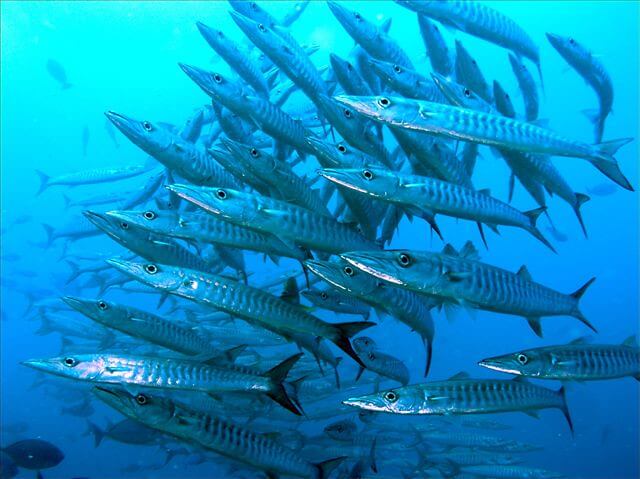

The aquatic world has astonishing varieties of fish, many of which have names that begin with the letter B. From the brightly colored Betta to the enormous Bluefin Tuna, and from the peculiar Blobfish to the powerful Barracuda, these species showcase the diversity of life beneath the waves. Each fish not only plays a unique role in its ecosystem but also captures our imagination with its distinctive appearance, behavior, or habitat.
In this article, we’ll explore some of the most fascinating fish starting with B and uncover what makes them stand out in rivers, lakes, and oceans around the globe.
Common Fish Names That Start With B
This section introduces fish best known by their common names, which often highlight their most striking traits.
Barracuda (Sphyraena barracuda)
Habitat: Tropical and subtropical oceans, commonly found near coral reefs, seagrass beds, and mangroves.
Size: 24 to 48 inches, with some giants exceeding 5 feet.
Conservation Status: Least Concern (LC) by the IUCN
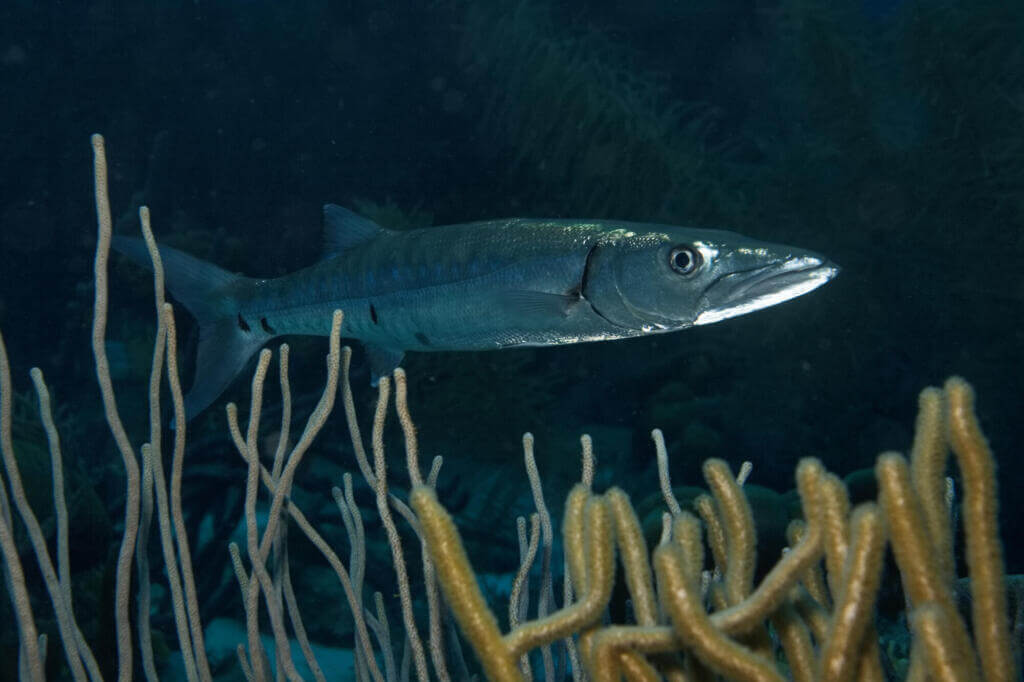
A Great Barracuda can reach up to 36 mph (58 km/h) in short, explosive bursts to catch its prey. Built for ambush predation, its long, streamlined, torpedo-shaped body allows it to remain motionless before striking with incredible speed. Its mouth is filled with two sets of formidable, dagger-like teeth that can slice through prey with ease.
As visually oriented predators, they are famously attracted to shiny, metallic objects, which they can mistake for the silvery scales of their prey, like jacks, mullet, and grunts. While attacks on humans are rare, this inquisitive nature means they will often shadow snorkelers and divers out of curiosity.
Betta (Betta splendens)
Habitat: Shallow, low-oxygen freshwater environments like rice paddies and slow-moving streams in Southeast Asia.
Size: 2 to 3 inches in length.
Conservation Status: Vulnerable (VU) in the wild due to habitat loss and pollution.

The Betta, or Siamese Fighting Fish, has a specialized labyrinth organ that allows it to breathe atmospheric air directly from the surface, a crucial adaptation for its low-oxygen native habitat. Males are known for their spectacular coloration and long, flowing fins, which have been greatly enhanced through selective breeding for the aquarium hobby.
These magnificent features are not just for show; they are also used in dramatic displays of aggression when males flare their gills and fins to intimidate rivals. Despite this aggressive nature towards other males, they can form complex bonds with their owners and have been known to recognize them.
Bluefin Tuna (Thunnus thynnus)
Habitat: The open waters (pelagic) of the Atlantic Ocean and the Mediterranean Sea.
Size: Typically 6-8 feet long, but can grow over 10 feet and weigh more than 1,500 pounds.
Conservation Status: Least Concern (LC) by the IUCN.
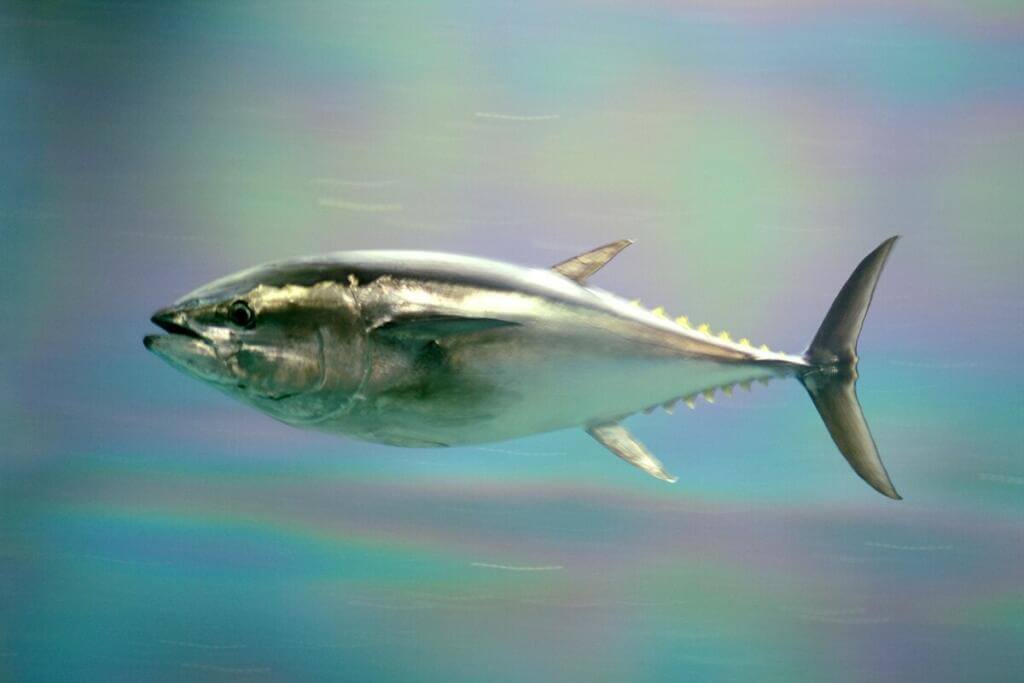
The Bluefin Tuna is a warm-blooded fish with the power and speed to dominate cold ocean environments. This fish’s status as a high-performance predator is due to a suite of remarkable adaptations. Its unique circulatory system allows it to retain metabolic heat, making it effectively warm-blooded and capable of powerful, sustained swimming. To maximize this power, it can retract its pectoral and dorsal fins into special grooves in its body, drastically reducing drag at high speeds.
This incredible speed is complemented by exceptionally keen eyesight, which it uses to hunt other fast-moving prey like herring and mackerel. These combined abilities make it a highly migratory species, capable of crossing the entire Atlantic Ocean in as little as 60 days.
Basking Shark (Cetorhinus maximus)
Habitat: Temperate coastal and shelf waters around the world.
Size: Averages 20 to 26 feet, but can exceed 40 feet in length.
Conservation Status: Endangered (EN) by the IUCN due to a long history of overfishing for its liver oil, meat, and large fins.
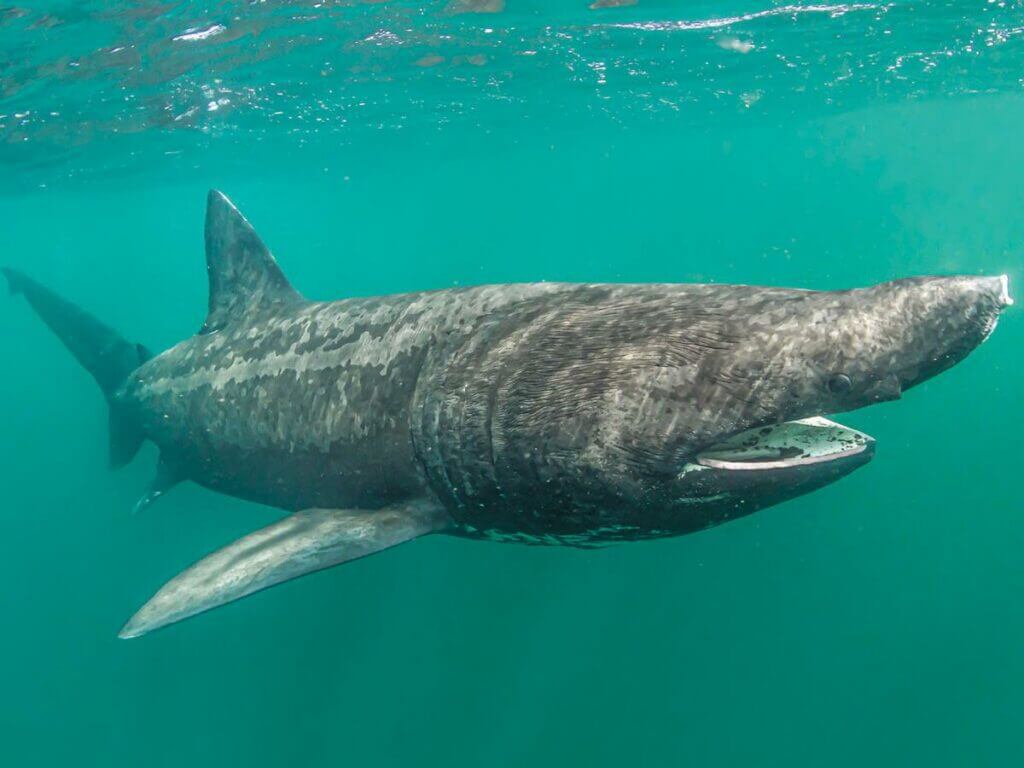
Its most prominent feature is its enormous mouth, which can open over 3 feet wide as it filter-feeds near the surface. To do this, it uses long, bristle-like structures called gill rakers to strain plankton from the thousands of gallons of water that pass through its gills every hour.
This feeding style makes it the slowest-swimming of all predatory sharks, typically moving at a leisurely pace of about 2.3 mph. Its effortless buoyancy is aided by a massive, oil-rich liver that can make up 25% of its total body weight. Despite this slow pace, they are known to travel in social groups, often segregated by sex, and will occasionally engage in surprising behaviors like breaching or leaping completely out of the water.
Blobfish (Psychrolutes marcidus)
Habitat: Deep waters at depths of 2,000 to 4,000 feet off the coasts of Australia, Tasmania, and New Zealand.
Size: Up to 12 inches in length.
Conservation Status: Not formally evaluated by the IUCN, but it is considered threatened due to being caught as bycatch in deep-sea bottom trawling nets.
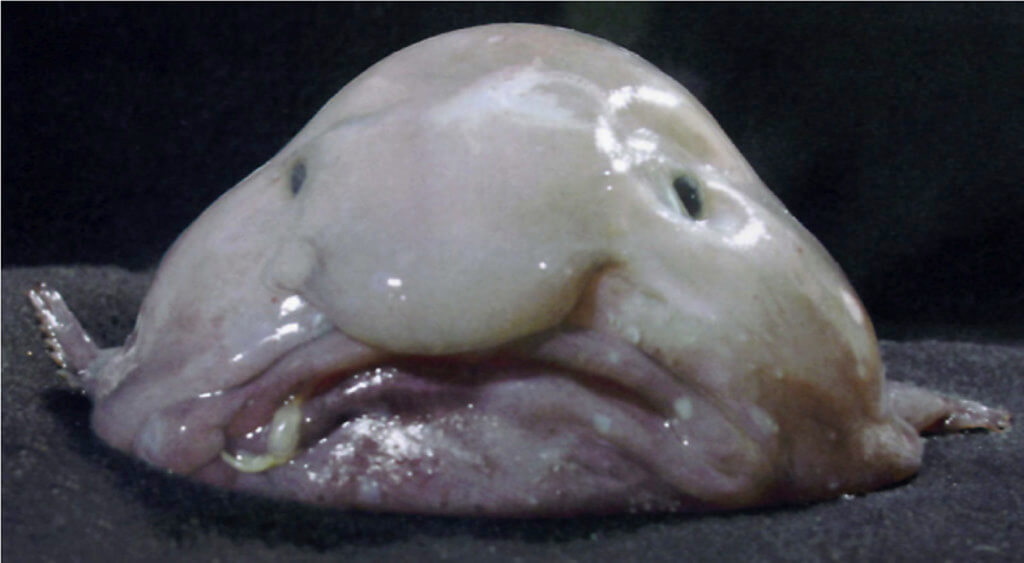
This fish is uniquely adapted to its deep-sea habitat and lacks a swim bladder because the intense pressure at those depths would crush such a gas-filled organ. Instead, it has very little muscle and a soft, cartilaginous skeleton, since structural rigidity is not needed in the supportive, high-pressure environment. This composition allows it to simply float and swallow small crustaceans and other edible matter that drifts in front of its mouth.
The iconic “nose” for which it is known is not a real feature, but simply a flap of skin that droops dramatically when the fish is removed from the water’s supportive pressure.
Beluga Sturgeon (Huso huso)
Habitat: The Caspian and Black Sea basins; it is anadromous, living in saltwater but migrating up freshwater rivers to spawn.
Size: One of the largest freshwater fish, capable of growing over 20 feet long and weighing more than 3,000 pounds.
Conservation Status: Critically Endangered (CR) by the IUCN.

Instead of traditional scales, its body is protected by five rows of large, bony plates called scutes, which serve as a form of natural armor. As it patrols the seabed, it uses four whisker-like barbels on its snout to sense its prey of crustaceans and mollusks.
The Beluga Sturgeon is the source of the world’s most famous and expensive caviar, a fact that has tragically driven this ancient fish to the very brink of extinction. This ancient fish also has an exceptionally long lifespan and is slow to mature, a life strategy that sees females often not spawning until they are over 15 years old.
Scientific Fish Names That Start With B
Here we focus on the scientific names that give each species its precise place in the aquatic world.
Boleophthalmus (Mudskippers)
Habitat: Intertidal mudflats and mangrove estuaries in the Indo-Pacific region.
Size: 4 to 8 inches in length, depending on the species.
Conservation Status: Most species are listed as Least Concern (LC) by the IUCN.
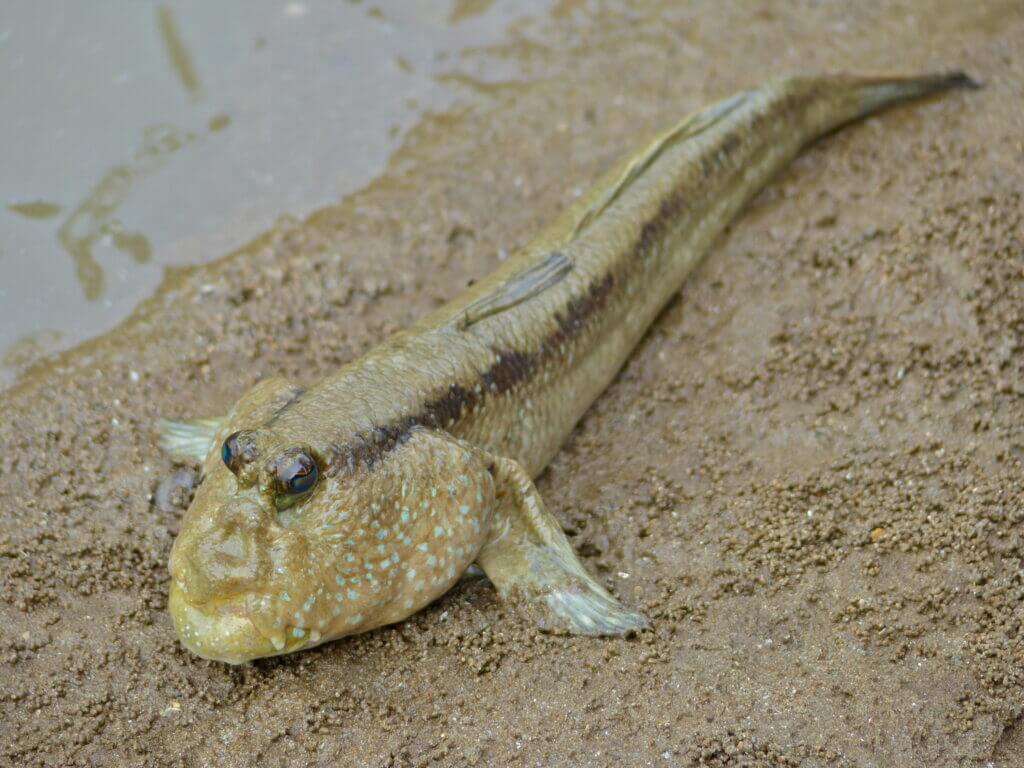
This is a truly amphibious species of fish, with pectoral fins so highly modified they function like legs, allowing it to “walk,” crawl, and even perform impressive leaps across the mudflats. Its eyes, perched high on its head like periscopes, enable it to see above the water while remaining partially submerged. It can spend up to 75% of its life out of the water, carrying its own water supply within its large gill chambers to keep its gills moist.
To stay cool and moist during its time on land, it will often roll in the mud or retreat into water-filled burrows it has dug. This life on the mudflats has also led to complex social behaviors, as males are highly territorial and will perform elaborate “push-up” displays and fin flares to defend their patch of mud from rivals.
Balistoides conspicillum (Clown Triggerfish)
Habitat: Tropical coral reefs, particularly on outer reef slopes with clear water, in the Indo-Pacific.
Size: Up to 20 inches in length.
Conservation Status: Least Concern (LC) by the IUCN.
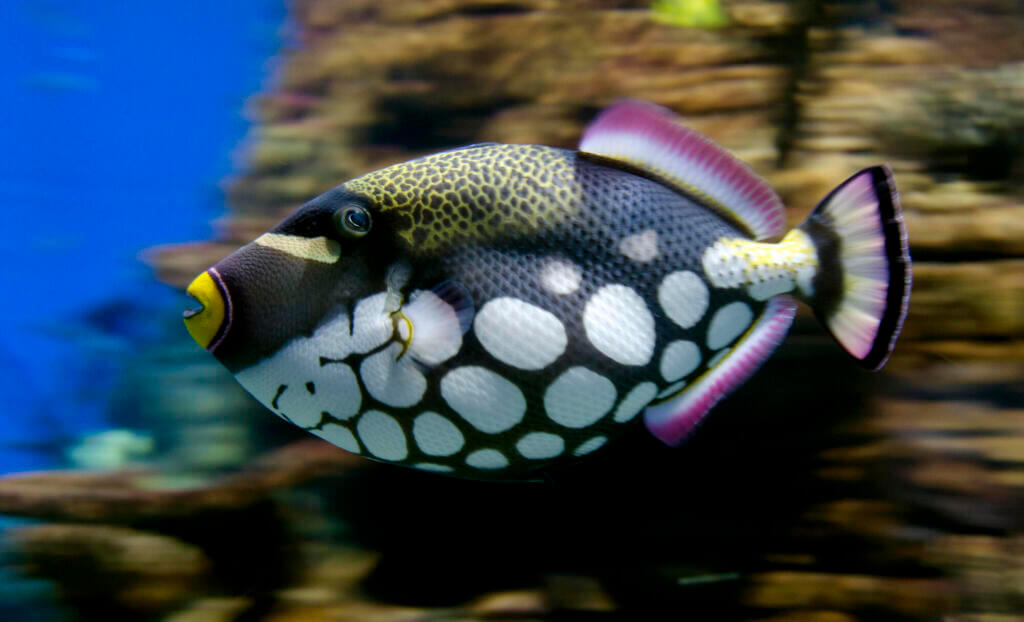
With eyes set high on its head that can move independently, this fish has excellent awareness of its surroundings. This is crucial for its feeding strategy, which relies on an exceptionally powerful jaw and strong, chisel-like teeth designed for crushing the hard shells of prey like crustaceans and sea urchins.
It navigates its environment not by tail propulsion, but by primarily undulating its large dorsal and anal fins, giving it a unique ‘sculling’ or flapping motion. It locks its large dorsal spine firmly into place with a second, smaller spine, creating a defensive “trigger” that makes it almost impossible for a predator to dislodge it from a rocky crevice. Beyond its physical prowess, this fish is known to be highly intelligent and displays a distinct personality, often observed rearranging rocks and coral in its territory.
Bothus (Left-eyed Flounders)
Habitat: Sandy or muddy bottoms of tropical and subtropical oceans worldwide.
Size: Varies greatly by species, but commonly ranges from 6 to 12 inches.
Conservation Status: Most species are listed as Least Concern (LC) by the IUCN.
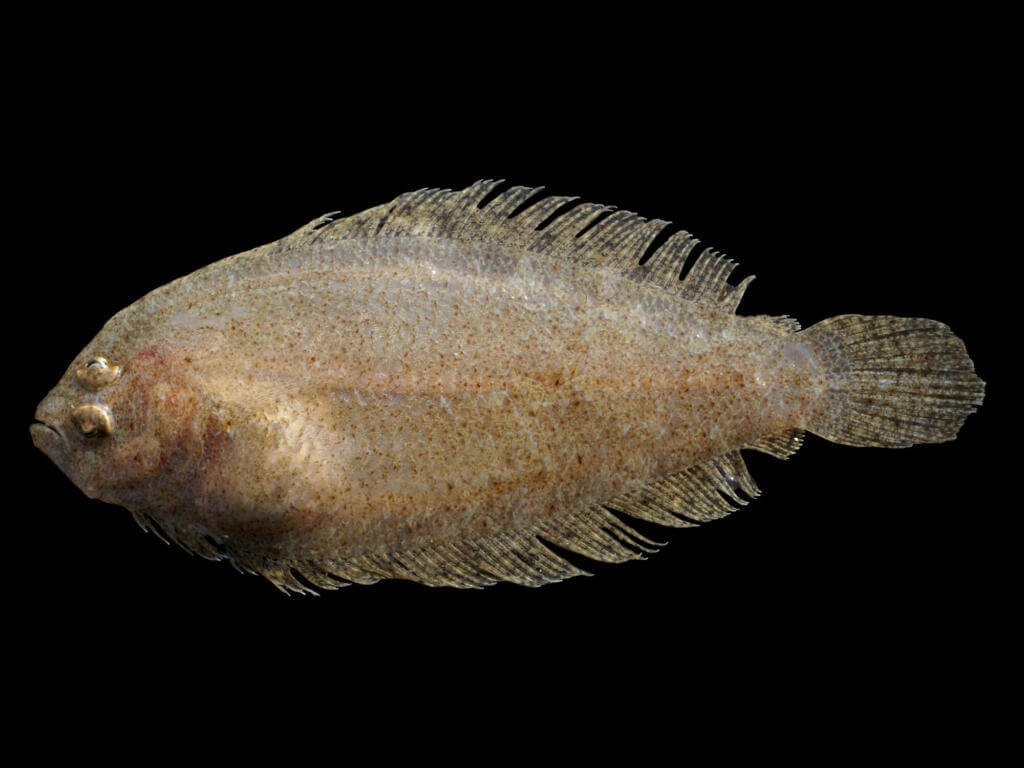
As masters of camouflage, these flounders can change the color and pattern of their skin in seconds to perfectly match the texture of the surrounding seafloor. Their extremely compressed and flattened body allows them to lie perfectly flush with the seabed, making them virtually invisible to both predators and their unsuspecting prey.
Their ‘left-eyed’ anatomy makes this unique lifestyle possible, as they lie on their right side with both eyes located on the left side of their head. Despite their stationary hunting strategy, they are capable of surprising bursts of speed, propelling themselves with a distinct, undulating wave-like motion when they need to move.
Other Fish Species That Start with B
- Bala Shark (Balantiocheilos melanopterus)
- Baldchin Groper (Choerodon rubescens)
- Ballan Wrasse (Labrus bergylta)
- Ballyhoo (Hemiramphus brasiliensis)
- Bamboo Shark (Genus Chiloscyllium)
- Banded Archerfish (Toxotes jaculator)
- Bandit Cory (Corydoras metae)
- Banjo Catfish (Bunocephalus coracoideus)
- Barbus (Barb fish)
- Barbeled Dragonfish (Stomias boa)
- Barcoo Grunter (Scortum barcoo)
- Barn-door Skate (Dipturus laevis)
- Barramundi (Lates calcarifer)
- Barreleye (Macropinna microstoma)
- Barreleye Fish (Opisthoproctus soleatus)
- Bass (Micropterus salmoides, etc.)
- Basslet (Gramma loreto, etc.)
- Beardfish (Polymixia nobilis)
- Bengal Sergeant (Abudefduf bengalensis)
- Bichir (Family Polypteridae)
- Bigeye Tuna (Thunnus obesus)
- Bighead Carp (Hypophthalmichthys nobilis)
- Billfish (Order Istiophoriformes)
- Bitterling (Rhodeus amarus)
- Black Bass (Genus Micropterus)
- Black Drum (Pogonias cromis)
- Black Ghost Knifefish (Apteronotus albifrons)
- Black Mackerel (Scomberomorus commerson)
- Black Marlin (Istiompax indica)
- Black Piranha (Serrasalmus rhombeus)
- Black Swallower (Chiasmodon niger)
- Blacktip Shark (Carcharhinus limbatus)
- Blacktip Reef Shark (Carcharhinus melanopterus)
- Black Buffalo (Ictiobus cyprinellus)
- Black Angelfish
- Black Bullhead (Ameiurus melas)
- Black Neon Tetra (Hyphessobrycon herbertaxelrodi)
- Black Phantom Tetra (Hyphessobrycon megalopterus)
- Black Scabbardfish (Aphanopus carbo)
- Black Scalyfin (Parma alboscapularis)
- Black Triggerfish (Melichthys niger)
- Blowfish (Pufferfish family Tetraodontidae)
- Blue Acara (Andinoacara pulcher)
- Blue Catfish (Ictalurus furcatus)
- Blue Gouramis (Trichopodus trichopterus)
- Blue-RedStripe Danio (Danio kyathit)
- Blue Shark (Prionace glauca)
- Blue Tang (Paracanthurus hepatus)
- Bluefish (Pomatomus saltatrix)
- Bluegill (Lepomis macrochirus)
- Bluestreak Cleaner Wrasse (Labroides dimidiatus)
- Boarfish (Family Caproidae)
- Bombay Duck (Harpadon nehereus)
- Bonefish (Albula vulpes)
- Bonito (Genus Sarda)
- Bonnethead Shark (Sphyrna tiburo)
- Bothus (Left-eyed Flounders)
- Bowfin (Amia calva)
- Boxfish (Family Ostraciidae)
- Bream (Abramis brama, etc.)
- Bristlenose Pleco (Genus Ancistrus)
- Bronze Corydoras (Corydoras aeneus)
- Brook Trout (Salvelinus fontinalis)
- Brook Stickleback (Culaea inconstans)
- Brotula (Bearded Cusk-eels)
- Brown Trout (Salmo trutta)
- Buffalo Fish (Genus Ictiobus)
- Bigmouth Buffalo (Ictiobus cyprinellus)
- Bull Shark (Carcharhinus leucas)
- Bull Trout (Salvelinus confluentus)
- Bullhead (Genus Ameiurus)
- Barbelled Dragonfish (Stomias boa group)
- Bumblebee Goby (Brachygobius doriae)
- Burbot (Lota lota)
- Butterfish (Peprilus triacanthus)
- Butterfly Ray (Family Gymnuridae)
- Butterflyfish (Family Chaetodontidae)
- Bluntnose Minnow (Pimephales notatus)
FAQs
What is the biggest fish that starts with the letter B?
The Basking Shark (Cetorhinus maximus) is the longest, reaching over 40 feet, making it the second-largest living fish. However, the Beluga Sturgeon (Huso huso) is one of the largest and heaviest freshwater fish, capable of exceeding 20 feet and weighing over 3,000 pounds.
Why are the Bowfin and Bichir called “living fossils”?
The Bowfin (Amia calva) and fish from the Bichir family (Polypteridae) are called “living fossils” because they belong to ancient lineages that have survived for millions of years with very few changes. They retain primitive features, like the ability to breathe air and lobe-like fins, that give us a glimpse into what the ancestors of modern fish looked like.
Is the Bull Shark really the most dangerous ‘B’ fish?
While the Barracuda looks fearsome, the Bull Shark (Carcharhinus leucas) is widely considered far more dangerous to humans. This is due to its aggressive nature, large size, and its unique ability to travel far up freshwater rivers, which brings it into much closer contact with human populations than most other shark species.
Are there any popular aquarium fish that start with ‘B’?
Yes, the letter ‘B’ is very popular in the aquarium hobby. The Betta (Betta splendens) is famous for its vibrant colors, the Bristlenose Pleco (Ancistrus genus) is a beloved algae-eater for community tanks, and the Bala Shark (Balantiocheilos melanopterus) is a popular choice for owners of very large aquariums.


