
Also known as Spook Fish, this group of Barreleye fish are named for the shape of their eyes, which resemble tubes or barrels. Their unusual eyes allow the fish to see in total darkness and are directed upwards. These deep-sea creatures are incredibly rare and there have only been a handful of sightings in recent years.
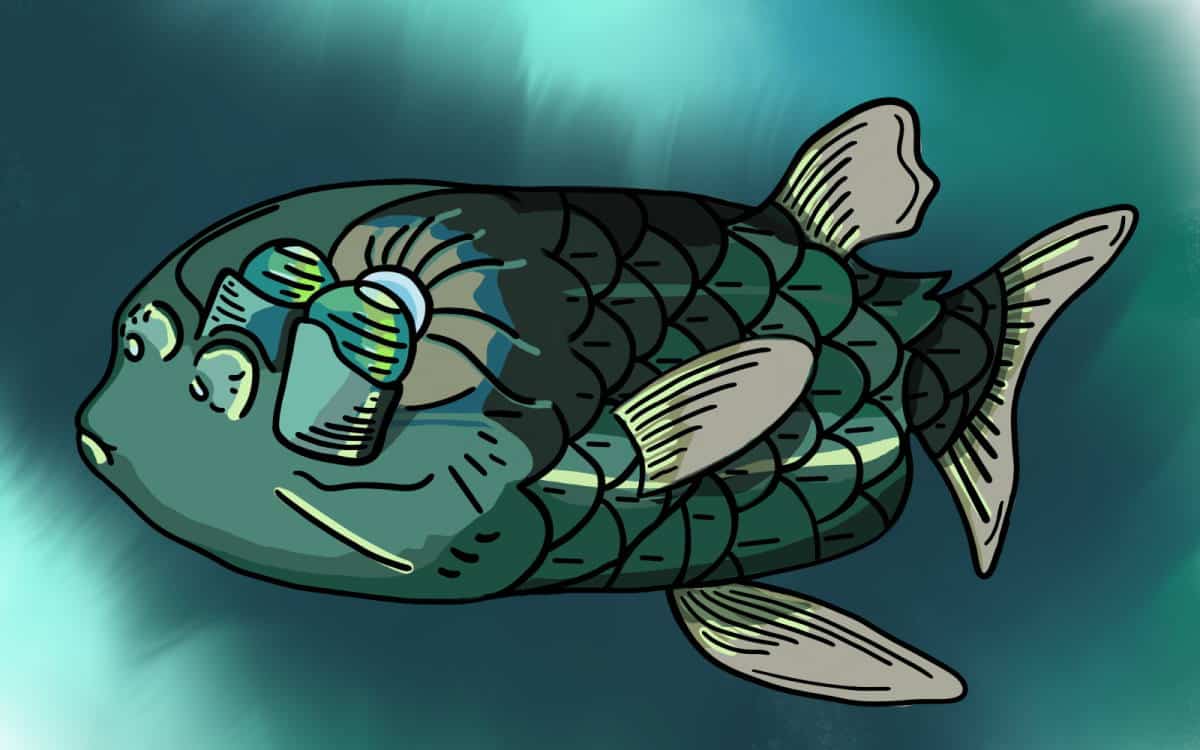
Barreleyes encompass a variety of genera including Bathylychnops, Dolichopteroides, Dolichopteryx, Ioichthys, Macropinna, Monacoa, Opisthoproctus, Rhynchohyalus, and Winteria. The iconic “Barreley Fish”, Macropinna microstoma (pictured below), is part of this broad deep-sea fish grouping.
Appearance
Barreleye fish generally have tubular bodies and large, transparent heads made from soft tissue. They have a number of physical adaptations that help them to thrive in deep-sea life.
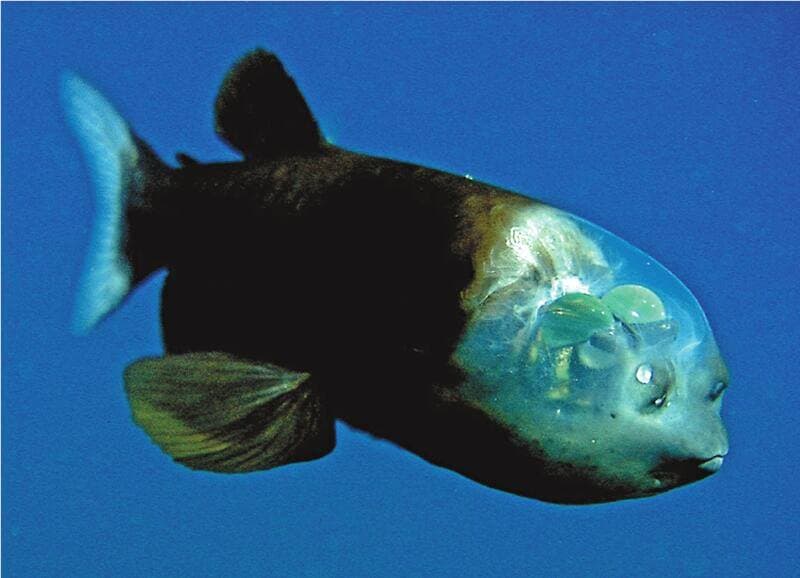
The telescoping eyes are found in all species of Barreleyes. Their protuberant eyes allow them to simultaneously observe the silhouettes of prey and predators above while directing their eyes forward to see the food they’re eating. Their eyes appear as two glowing green orbs, seen through their transparent heads.
Barreleyes have no teeth, a pointed snout with tiny mouths, and a dark brown body. Most species are covered in silvery scales with the exception of the Dolichopteryx. Without scales, it is a transparent white color. The Dolichopteryx, Opisthoproctus, and Winteria species all have some luminous organs. These parts of their body, mostly along their bellies, glow with the help of bioluminescent bacteria.
Most species are under eight inches long, however, the Javelin Spook Fish can grow up to twenty inches in length.

Habitat
Barreleyes are solitary, making the mesopelagic to the bathypelagic zone, approximately 400 to 2,500 meters deep, their natural habitat.
They remain in deep waters just below the limit of light penetration, preferring the dimly lit depths of temperate or tropical waters in the Pacific, Atlantic, and Indian Oceans. These Spook Fish do not undergo diel vertical migrations and can be found in various locations, from the Bering Sea to Japan and Baja California.
Diet
These unusual fish use their sensitive, upward-pointing tubular eyes to survey the waters above for potential prey.
The high number of rods in their retinas allows them to resolve the silhouettes of objects overhead in the faintest ambient light and to accurately distinguish bioluminescent light.
Their telescoping vision enables them to track and capture small zooplankton such as hydroids, copepods, and other pelagic crustaceans.
Scientists suggest that Barreleyes may also find food by hovering beneath siphonophore’s tentacles to consume discarded scraps.

Reproduction
Barreleyes are pelagic spawners, releasing eggs and sperm directly into the water. The fertilized eggs are buoyant and float towards the surface, aided by an oily substance. Larvae and juveniles drift with the currents at shallower depths before descending to deeper waters upon reaching adulthood. There is no parental care in Barreleyes, and no sexual dimorphism is observed between males and females.
5 More Fun Facts About the Barreleye Fish
- They have a unique digestive system with a specialized organ for grinding up food.
- Some species have elongated, wing-like pectoral fins that may aid in stability.
- They are part of the deep-sea food web, serving as both predator and prey.
- The green pigment in their eyes may help filter out sunlight from the surface.
- Their slow metabolic rate allows them to survive in the nutrient-poor deep sea.
FAQs
Why does the Barreleye fish have a transparent head?
The fish has a transparent head in order to better serve their vision. Their telescoping eyes can move up, allowing them to see straight up through their heads.
What do Barreleyes eat?
Their diet mainly consists of crustaceans, small jellies, and other tiny organisms.
What is so weird about the Barreleye fish?
The fish is “weird” because it has tubular, telescoping eyes and a clear head. Their eyes move upward and forward in order to spot prey. It can also see straight through its own head.