
The ocean, a world filled with millions of species of underwater plants and marine life, is a treasure chest of breathtaking wonders waiting to be discovered. Among the most remarkable inhabitants of this aquatic world are the underwater plants and corals, whose beauty and importance transcend mere aesthetics.
These plants and corals not only dazzle the eye but also play vital roles in marine ecosystems. From providing habitat and shelter for countless marine species to contributing to the health of our oceans, these remarkable organisms remind us of the wonder and significance of life beneath the surface.
From symbiotic anemones to underwater forests, let’s dive in and explore some of the most fascinating marine plants that grace our oceans.
Sea Whip (Gorgonacea)
Habitat: The sea whip lives in shallow waters of tropical and subtropical oceans. It attaches to hard substrates like rocks to benefit from strong currents for food and oxygen.
Remarkable features: Engage in carnivorous behavior, using their tentacles to catch zooplankton

These vibrant soft corals, aptly named for their whip-like appearance, come in striking hues of purple, yellow, red, and white. They grow up to 3 ft in height and are called octoral for possessing eight tentacles at each polyp. Unlike hard corals, they lack calcium carbonate but make up for it with numerous polyps on a single stem. These polyps feed on plankton, helping the sea whip grow up to 3 ft in height in shallow waters worldwide.
Sea Anemone (Actiniaria)
Habitat: Sea anemones are found in diverse marine ecosystems, ranging from shallow coastal waters to deep sea floors.
Remarkable features: Elongated polyps, reduced metabolism, enhanced sensory organs, and flexible body structure.

Thanks to “Finding Nemo,” the sea anemone has become a household name. Despite its plant-like appearance, this creature boasts powerful stinging tentacles, only tolerated by the resilient clownfish. This symbiotic relationship, where the anemone provides protection, and the clownfish offers nutrients, can be observed in both shallow and deep waters globally.
Deep Water Glowing Corals
Habitat: Deep-water glowing corals are found in the dark depths of the ocean, typically in the mesophotic and bathyal zones. Their depths range from 200 to 3000 meters or more.
Remarkable features: Bioluminescent symbiosis, enhanced skeletal structures, and reduced dependence on photosynthesis
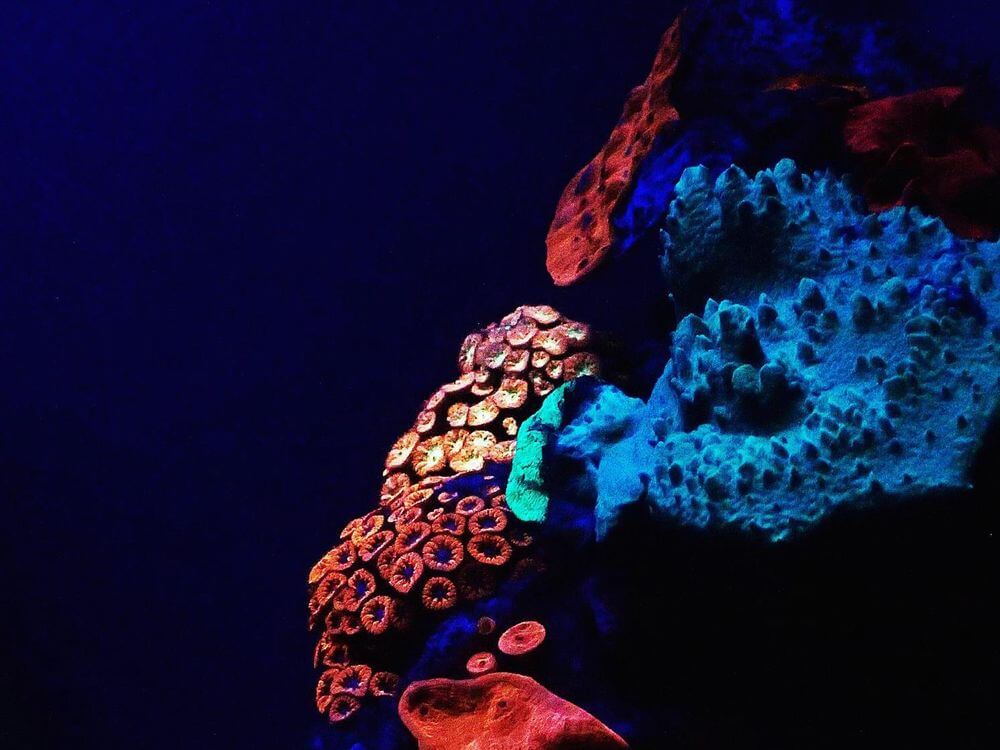
Deep-sea exploration reveals the mesmerizing sight of glowing corals. Unlike their shallow-water counterparts that light up to avoid excessive sunlight, deep-water corals glow to attract as much sunlight as possible. This helps the tiny algae (zooxanthellae) living within them to perform photosynthesis, providing essential nutrients.
Acropora Coral (Acropora pharaonis)
Habitat: Acropora corals are present in shallow tropical/sub-tropical clear and sun lit waters. They are commonly found from the intertidal zone to depths of around 100 meters.
Remarkable features: Branching growth form, symbiotic algae, and a fast growth rate

Acropora, also known as purple corals are the first type of corals that divers see. Their color ranges from the darkest purple to the lightest lavender shades and is the rarest among the sea plants to find. These stunning beauties are also reef-building species which means they create the backbone for coral reefs providing a home and habitat for many other fish and sea life.
Kelp (Laminariales)
Habitat: Kelp forms underwater forsts in cool and nutrient rich coastal waters, typically in the temperate and polar regions.
Remarkable features: Holdfast attachment ability, flexible stem, and have gas-filled pneumatocysts

Kelp, often dismissed as mere seaweed washed ashore, forms dense underwater forests beneath the waves. Towering at an average height of 100ft (30m), these dark plants, known as Kelp, create a dense, underwater forest. Dating back around 23 million years, these towering plants serve various purposes, from commercial uses to renewable energy sources for yielding methane.
Giant Green Anemone (Anthopleura xanthogrammica)
Habitat: The giant green anemone is typically found in the intertidal and shallow subtidal zones along the Pacific coast of North America.
Remarkable features: Large in size, stinging tentacles and show photosynthetic symbiosis with algae

The Giant Green Anemone bears a strong resemblance to the Anastasia flower. Often found nestled in rock crevices and coral reefs, these carnivorous creatures are a vibrant addition to the underwater landscape. They get their bright color from photosynthetic organisms living within them.
Scroll Algae (Padina pavonica)
Habitat: Scroll algae inhabits the tropical and subtropical marine environments.
Remarkable features: Calcified structures, photosynthetic pigments, and a tolerance to environmental fluctuations

Scroll algae, also known as Potato algae, are unique ringed plants usually found in low tide lines. They grow in a curl-like pattern. Their resilience in strong sunlight makes them popular aquarium plants for freshwater fishes.
Waterwheel Plant (Aldrovanda vesiculosa)
Habitat: The waterwheel plant is found in nutrient-poor freshwater environments such as ponds, lakes, and slow-moving streams.
Remarkable features: Carnivorous, floating habit, and a reduced root system

This carnivorous underwater snap trap resembles the Venus flytrap, trapping and digesting small invertebrates. Free-floating in the waters of Asia, Africa, and Europe, these plants produce flowers that briefly surface before sinking back for seed production.
Bubble Tip Anemone (Entacmaea quadricolor)
Habitat: Bubble tip anemone is found in tropical reef environments. Adults prefer deep waters with dimly lit conditions whereas young ones prefer shallow waters near the surface.
Remarkable features: Possess great regeneration ability, adhesive basal disc and inflatable tentacles

One of the most beautiful anemones that decorate coral reefs, the bubble-tip anemone comes in many colors, including pink, red, and green. It is carnivorous in nature and nourishes under bright sunlight with the help of zooxanthellae. While feeding, it stretches its sweeper tentacles to grab prey and then retracts to its regular bubble-like appearance.
Sea Fan (Gorgonia ventalina)
Habitat: Sea fan are present in the shallow waters of all oceans, abundantly found along the Atlantic coasts of Florida, Bermuda, and the West Indies.
Remarkable features: Sessile, colonial, slow growth, and possesses filter-feeding polyps

Sea fans, giant living nets found across reefs, grow and branch out in fan-like shapes influenced by water depth. They belong to the family of corals and are composed of numerous polyps. Known for their antibacterial qualities, they are of interest to scientists for potential medical applications.
Bubble Coral (Plerogyra sinuosa)
Habitat: Bubble corals are commonly found in warm shallow waters ranging from a few meters to around 30 meters deep.
Remarkable features: Photosynthetic symbiosis with algae, inflatable vesicles, and hard skeleton

Bubble Coral, or Grape Coral, thrives in gentle currents. They are nocturnal corals
and have a soft grape upper part and a hard bottom. They feed on plankton by extending their tentacles at night.
Sun Coral (Tubastraea)
Habitat: Sun corals are present at depths ranging from 10 to 200 meters and inhabit tropical coral reef environments.
Remarkable features: Enhanced reproductive strategies and polyps expansion.

Sun Corals, named for their bright orange and yellow polyps, are found in deep dark underwater and on artificial surfaces like shipwrecks. Sun Corals don’t need much sunlight to survive. First discovered in 1943, these corals feed on plankton and are considered an invasive species in the Caribbean Sea.
Open Brain Coral (Trachyphyllia geoffroyi)
Habitat: Open brain corals are found in shallow warm water regions worldwide
Remarkable features: Toxin production, altered growth patterns, and symbiosis with bioluminescent organisms

Open Brain Corals, found in the Red Sea, Indian Ocean, and Australia, are both solitary and colonial and can live up to 900 years! Their advanced structure sets them apart from other coral species.
Flowerpot Corals (Goniopora)
Habitat: Flowerpot corals inhabit tropical and subtropical regions. They are often found in shallow waters near coral reefs and rocky substrates
Remarkable features: Fluorescent pigments, symbiotic algae, and extended polyp tentacles.

Flowerpot Corals, the underwater bouquet, get their daisy-like appearance from their tiny tentacles that branch out at the end. Mostly nocturnal, they add a touch of beauty to the rocky sea floor.
Sea Pen (Pennatulacea)
Habitat: Sea pens live in deep-sea habitats attaching themselves to soft sediments.
Remarkable features: Pulsating and elongated polyps, bioluminescent symbiosis, and camouflaging chromatophores

Resembling antique quill pens, Sea Pens can survive as single entities or colonial families. Found in shallow waters and sea floors as deep as 20,000 ft, some even glow, adding to their alien-like appearance. They are formed by a single large primary polyp, also known as the initial polyp or oozooid. The primary polyp is anchored into soft sediment by a proximal muscular peduncle.
From the vibrant colors of the Sea Whip to the eerie glow of deep-water corals, the ocean is a wonderland of incredible biodiversity. As we continue to explore this vast underwater world, who knows what other marvels we might discover?
Ocean Insights: Hear From Our Experts

By Hamna Faizan
Marine Life Researcher and Lecturer, with an MSc in Zoology
FAQs
How do Deep Water Corals differ from other coral species?
Deep Water Corals live in darker, colder parts of the ocean and do not require sunlight to survive. They are slow-growing and can live for thousands of years, making them vital indicators of ocean health.
What distinguishes the Bubble Tip Anemone from other anemones?
The Bubble Tip Anemone gets its name from the bulbous tips of its tentacles. It hosts clownfish and provides them protection, while the clownfish bring food, enhancing the anemone’s survival.
How does the open-brain coral contribute to the reef ecosystem?
Open Brain Coral contributes to reef-building and provides shelter for many small marine creatures, playing a vital role in the reef ecosystem.
How does Sun Coral feed without relying on sunlight?
Sun Coral feeds by extending its tentacles at night to capture plankton from the water.
How does a Sea Fan contribute to marine food chains?
A Sea Fan filters plankton from the water for food. It plays a significant role in marine food chains and provides habitat for many small marine creatures.


