
The Devil’s Sea is the equivalent of the Pacific Ocean’s Bermuda Triangle. It is also called the Dragon’s Triangle. It is located off the coast of Japan and is the center of a number of mysterious disappearances and deaths that have gone on for centuries.
What is the Devil’s Sea?
The Devil’s Sea is an area of the Pacific Ocean near Japan that is said to play host to mysterious forces. Dating back to the age of Kublai Khan and the Mongol Empire of the 13th century, legends describe the area as being notoriously dangerous for sea-bound travelers.
Some have suggested that the danger stems from typhoons, hard-to-spot shoals, strange tidal patterns, methane gas, and more.
Some of the supernatural suggestions for why ships seem to disappear at an unusually high rate in the area include alien abductions, portals to other worlds, sea monsters, and secret military operations.
Where is the Devil’s Sea?
The Devil’s Sea is located in the Pacific Ocean, centered around the Izu Islands. The exact location is often disputed. Some say The Devil’s Sea is approximately located between the Japanese coast, about 100 km south of Tokyo, the east coast of the Philippines, level with Manilla, and the west coast of Guam, a U.S. island territory in Micronesia. It includes a major section of the Philippine Sea.
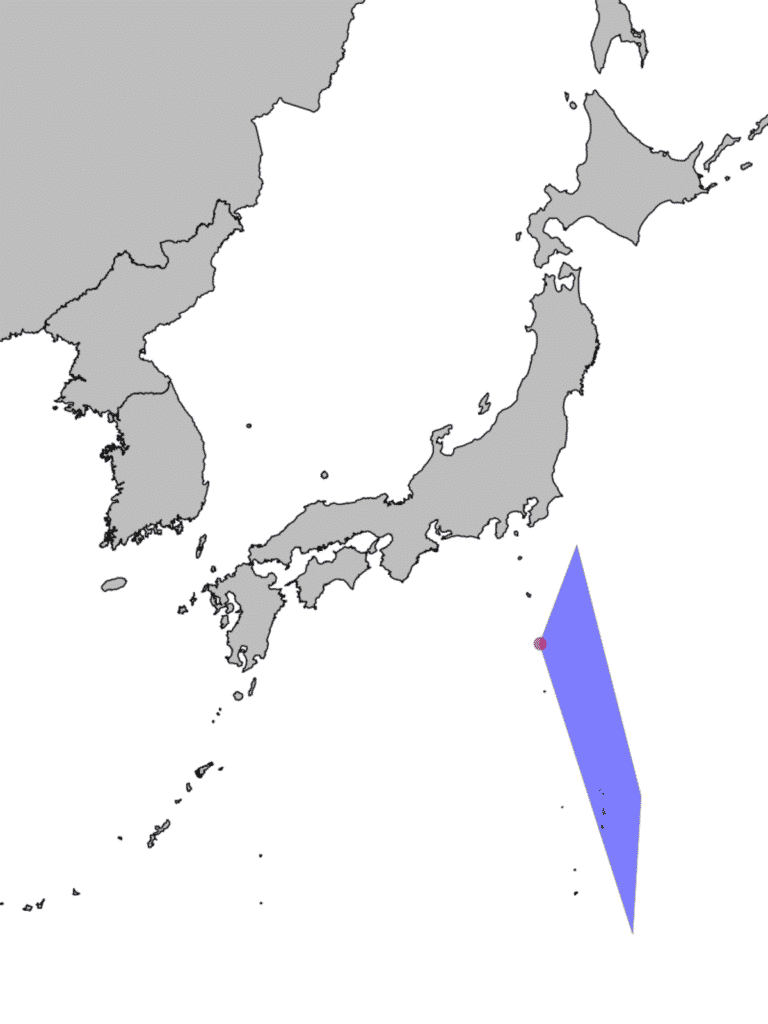
But, it is generally said to be located to the east of Japan, around 62 miles or 110 kilometers from the main island. Another suggestion places it farther from Japan, around 745 miles or 1,200 kilometers from the eastern coast. The loose interpretation of which area of the Pacific Ocean constitutes the devil sea is one of the main reasons that scientists and everyday people have expressed doubt regarding the veracity of some of the more supernatural claims.
This region is also referred to as the Pacific Bermuda Triangle, highlighting its location directly opposite the Bermuda Triangle and its similar reputation for “paranormal phenomena.” This is similar to the proposed maps depicting the Bermuda Triangle. They vary in their exact location. Below is one of the more commonly referenced Bermuda Triangle maps.
Origin of the Name
The name “Devil’s Sea” has its roots in ancient Chinese folklore, which tells of dragons inhabiting these waters. According to these legends, sea dragons would attack passing ships to satiate their hunger. These stories date back to around 1000 BC, well before the AD era.
On January 4, 1955, the Japanese ship Shinyo Maru No. 10 (第十伸洋丸) lost radio contact near Mikura-jima. Following this incident, Japanese newspapers started referring to the area as “ma no umi.” This name was coined years ago when tales of supernatural occurrences in the area became widespread. The ship was eventually found safe on January 15.
The superstitions and legends associated with the Devil’s Sea have long discouraged the Japanese from venturing into this part of the ocean, fostering a deep-seated fear of the mysterious forces believed to lurk beneath its surface.
The superstitions and legends associated with the Devil’s Sea have long discouraged the Japanese from venturing into this part of the ocean, fostering a deep-seated fear of the mysterious forces believed to lurk beneath its surface.
Disappearances
In 1989, American writer and paranormal activity theorist Charles Berlitz published a book titled The Dragon’s Triangle, following extensive research on the Devil’s Sea’s alleged paranormal phenomena. Berlitz claimed that the sinister nature of the sea was responsible for the accidents involving five Japanese military vessels, resulting in the deaths of over 700 people.
Berlitz claimed that “nine modern ships and several hundred crews were lost without traces between 1950 and 1954; in 1955, the Japanese government sent Kaiyo Maru No 5 to the sea to investigate unexplained ship losses, but this ship vanished as well.”
As noted above, strange occurrences in this specific area of the Pacific Ocean date back centuries. One particularly interesting story relates to the reign of Kublai Khan in Mongolia.
The Mongol Ships of Kublai Khan
The legend states that while trying to invade Japan in the late 1200s, Conqueror Kublai Khan, the grandson of Genghis Khan failed, losing a fleet of 900 Mongol ships carrying around 40,000 sailors in an area that is now included in the Devil’s Sea. This occured because of Kamikaze or “divine winds”. Due to his immense losses, Kublai Khan changed his plans, believing that it was too dangerous to continue attempting to invade Japan. Specifically, stories reference incredibly dangerous and surprising typhoons in the area. The Japanese considered these typhoons a blessing in disguise to save them from enemies.
A6M Zero
Another well-known disappearance occurred in August 1945. A Mitsubishi A6M Zero, a long-range fighter plane, went missing in the area of the Devil’s Sea towards the end of World War II. Prior to radio silence, the pilot, Shiro Kawamoto, managed to relay one final message:
Something is happening in the sky…the sky is opening up—

Kaiyō Maru No. 5
One of the best-known stories regarding the Devil’s Sea focuses on the research ship Kaiyo Maru. This ship was tasked with finding a number of small and large fishing vessels, as well as military vessels, that disappeared in the area between the 1940s and 1950s. (Specifically, between Miyake Island and Iwo Jima.)
The ship, and its thirty-one crew members, started their investigation in 1951 and soon disappeared as well. The wreck was later under covered, but the fate of the thirty-one crew members remains unknown. After the research vessel vanished, the Japanese government labeled this area of the ocean as especially dangerous and warned sailors moving through the area.
Is the Devil’s Sea Real?
The Devil’s Sea, like the Bermuda Triangle and many other sea-based stories, is just that—a story. While some disappearances in the area remain unexplained, scientists have proposed a number of explanations that are far more plausible than portals to other worlds, alien abductions, or vanishing sea creatures.
One of the more prominent phenomenon is that the area contains a field of methane hydrates present at the bottom of the ocean. When overheated, these create gas eruptions that can easily sink a ship. Others have suggested that submarine or undersea volcanoes that result in seismic activities could be responsible for the disappearance of vessels in the area.
Scholars like Ivan Sanderson suggested that the hot and cold currents crossing this Vile Vortice led to the disappearance of vessels in the Devil’s Sea. According to him, these currents result in electromagnetic disturbances that trap the ships passing by. Other explanations include typhoons, unusual tidal patterns, and simple coincidence.

Additionally in 1995, Larry Kusche challenged Berlitz’s original assertions about the Devil’s Sea with his book The Bermuda Triangle Mystery Solved. Kusche disputed the existence of both areas by arguing that the missing vessels were actually fishing boats, not warships. He also stated that the Japanese research ship, which Berlitz claimed had a crew of 100, actually had only 31 people on board and was destroyed by an undersea volcano in September 1952. The recovery of the wreckage by the Japanese authorities further discredited Berlitz’s claims.
Ocean Insights: Hear From Our Experts

By Rida Nasir
Researcher and Conservationist, with an MSc in Environmental Science
I view the mystery of the Devil’s Sea with a blend of skepticism and scientific curiosity. Often likened to the Bermuda Triangle, this region’s reputation for mysterious disappearances is likely enhanced by a mix of natural oceanic conditions and human error rather than any supernatural causes. My stance is that thorough scientific investigation can demystify much of the lore surrounding such areas, leading to safer navigation and better understanding of complex maritime environments.
FAQs
Is the Devil’s Sea dangerous?
According to legends, stories, and real-life accounts, the area in the Pacific Ocean known as the Devil’s Sea should be approached with real caution. An unusually high number of ships have disappeared in the area. This has led some scientists to speculate about typhoons, tidal patterns, underwater volcanoes, and more. Others have suggested far more unusual reasons, such as alien abductions and portals to other worlds.
What are the other names for the Devil’s Sea?
There are many names for this unusual area of the Pacific Ocean. They include the Pacific Bermuda Triangle, The Dragon’s Triangle, the Formosa Triangle, and in Japanese, Ma no umi.
Is there any connection between the Bermuda Triangle and the Devil’s Sea?
The Devil’s Sea is often regarded as the Pacific Ocean’s answer to the Atlantic Ocean’s Bermuda Triangle. Both areas have been seemingly responsible for the disappearance of ships and planes for centuries. But, the Bermuda Triangle has been written about, documented, and speculated about to a greater degree and is, therefore, much better known.


