

Bowhead Whales (Balaena mysticetus) are one of the heaviest whales in the ocean. They are the only baleen whales that spend their lives solely in Arctic and subarctic seas. Because of this, they are also known as Arctic whales, Greenland whales, or Polar whales.
Bowheads have massive triangular skulls which they use to break through thick Arctic ice. They are named for their remarkably arched upper jaw and mouth which resembles an archer’s bow. We will learn more interesting facts about this unique creature below.
Appearance
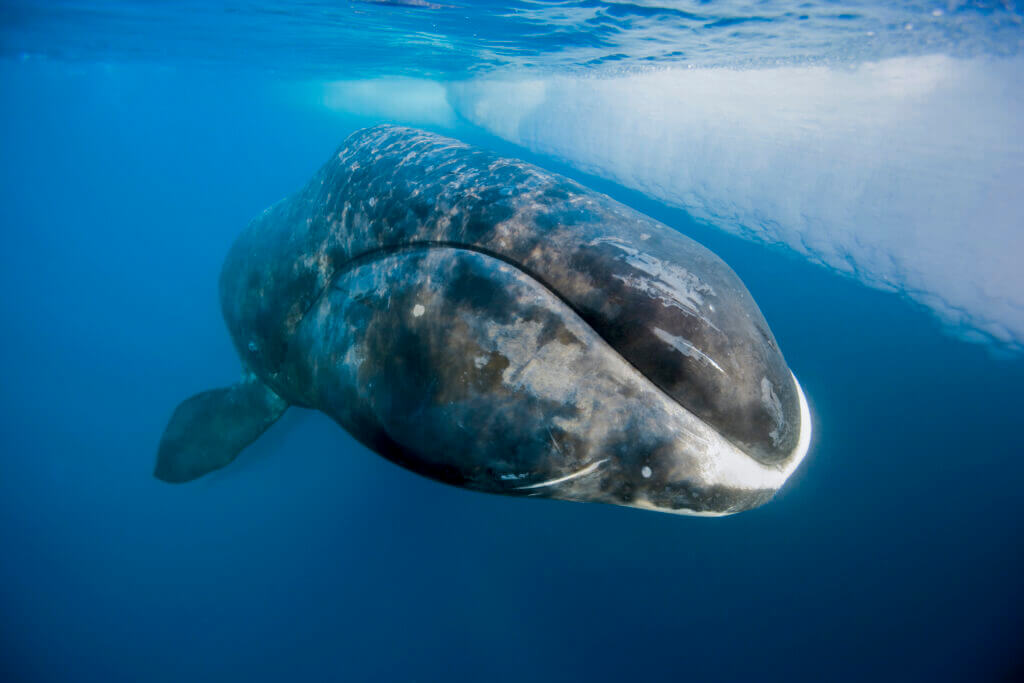
Adult whales are completely black with a distinguishing white chin. They lack a dorsal fin compared to most cetaceans because they spend so much time swimming under the sea ice. Some Bowheads have pale patches around the end of their tailstock. Younger Bowheads may also have a lighter grey belly.

They have enormous heads and stocky bodies. Their bow-shaped skull may grow over 16.5 feet long—roughly one-third the length of a Bowhead’s body. The Bowhead Whale has V-shaped twin blowholes at the highest point of its head, from which it may spew a 20 ft (6.1 meter) high blow.
The Bowhead Whale also has the thickest blubber layer of any whale, measuring up to 19 inches (50 cm) to keep them warm in the icy Arctic waters. Their massive robust skulls also allow them to break through sea ice almost 40 inches (1 meter) thick!
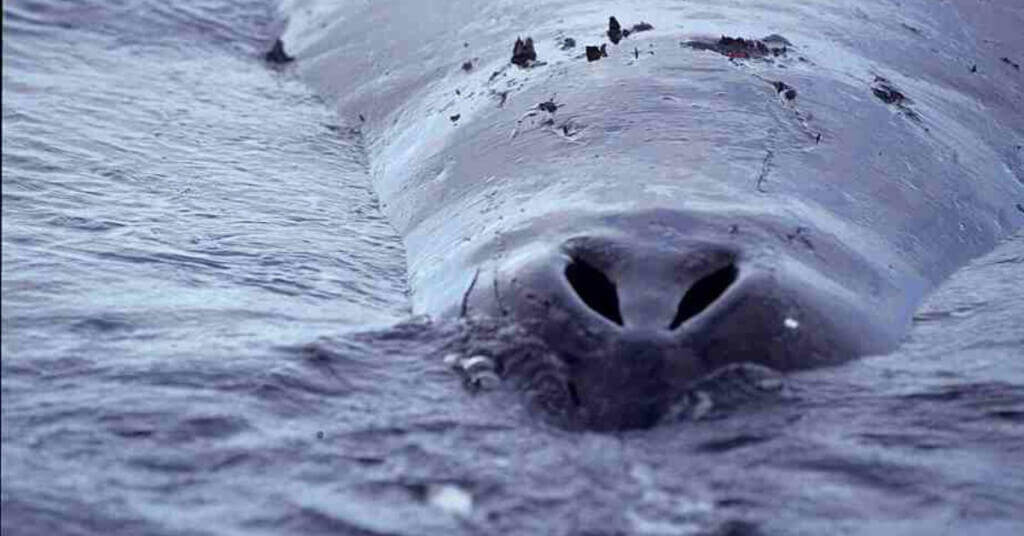
As Bowhead Whales don’t have dorsal fins, scientists use white scars on their bodies to identify individual whales. These scars arise from old harpoon wounds, collisions with ships, or attacks from orcas.
Habitat
The Bowhead Whale is the only baleen whale that spends its whole life in the Arctic Circle in and near sea ice.
Bowhead Whales are nomads of the sea and migrate seasonally to avoid getting trapped by ice and to reach areas rich in food. However, the increasing impacts of climate change in the Arctic and subarctic mean that sea ice cover is shrinking. Today, Bowheads are more often found in open water throughout the Summer.
Beyond the Arctic Ocean, their habitat reaches Baffin Bay, Hudson Bay, the Sea of Okhotsk, and the Davis Strait. These whales also navigate the Beaufort seas, Chukchi, and Bering Seas, including the waters surrounding the Canadian Arctic Archipelago.
Diet
Like other baleen whales, Bowheads filter large amounts of ocean water through their baleen plates (which look like comb teeth) to trap tiny zooplankton – their primary food source. Their massive jaws house up to 300 baleen plates, each reaching an impressive 13 feet (4 meters) in length.
Bowhead whales have the most extensive baleen plates of any whale species and survive nearly entirely on copepods and krill. They are adaptable feeders able to dive up to 437 yards (400 meters), filtering food from the water column or even near the seabed. Other invertebrates such as bottom-dwelling crustaceans as well as tiny fish are also consumed.
Bowheads will also scavenge on dead whales or seals when krill becomes scarce.
Behavior
Sound is the Bowhead Whale’s lifeline. With exceptional hearing, they can detect, recognize, and pinpoint crucial underwater noises. These sonic signals help them find food, avoid predators, and communicate with each other.
Bowhead whales have a wide range of calls. The echoes of some calls bounce back, providing a “sonic map” of their surroundings, helping them to navigate the harsh Arctic waters.
While scientists haven’t directly measured their hearing, anatomical similarities to other whales suggest Bowheads excel at picking up low-frequency sounds. These low tones travel exceptionally well underwater, allowing them to communicate across vast distances.
Reproduction
Bowhead Whales are polyandrous, meaning a single female may be involved with one or more males. Reproduction is a slow process for these long-lived animals. Females reach sexual maturity around 25 years old, and calving only occurs every 3-7 years.
The mating season typically lasts from late winter through early April – although it has been observed year-round. Spring migration follows shortly after, and calves are born between April and June, with a peak calving in May.
A single calf is born after a 13-14 month gestation period. The first year of a calf’s life is a critical period when they grow the fastest, accumulating a thick layer of blubber – essential insulation for the harsh Arctic environment. Bowhead calves are weaned between 9-15 months after birth when they are ready to begin their own journey in the Arctic Circle.

Bowhead Whales separate into groups to migrate once they have given birth. Mothers and their calves are in the front row. This might enable them to be the first to eat new food.
Threats
Bowhead Whale populations face several hazards imposed by humans, including:
- Pollution (for example oil spills, heavy metals, chemicals and waste)
- Vessel collisions and disruption
- Entanglement in fishing gear
- Loss of sea ice due to global warming
- Ocean acidification may have an impact on their prey
- Noise pollution from ships and submarine activities can impair their ability to forage, navigate, communicate, and detect and evade predators.
7 Facts About Bowhead Whales
- Bowhead Whales have the thickest blubber of all whales at 19 inches (50 cm) thick.
- They can break through 40 inches (1 meter) of sea ice with strong their heads.
- They can live for over 200 years, possibly linked to genes that help with DNA repair.
- Their thick blubber keeps them warm in the frigid Arctic waters.
- They can eat up to 100 tonnes of food annually.
- They are the second heaviest animal on the earth after Blue Whales.
- Bowhead whales have been seen holding their breath over an hour while navigating beneath the sea ice.
FAQs
How big are bowhead whales when they are born?
Bowhead Whales enter the world as impressive newborns, measuring around 4 meters long and weighing roughly 1,000 kilograms. Despite their size, they’re capable swimmers from birth and rely on their mothers’ care for survival in the harsh Arctic environment.
Is the bowhead whale endangered?
The global conservation status of the Bowhead Whale is “Least Concern” according to the IUCN Red List of Threatened Species. However, specific populations (such as those around Greenland) are threatened. In the past, they were traditionally hunted for oil, flesh, and baleen by commercial whalers until the 20th century.
How many bowhead whales are left in the world?
According to The International Union for Conservation of Nature (IUCN) Red List, it is estimated that 10,000 mature Bowhead Whales are remaining worldwide – which does not include calves and young adults. Fortunately, due to conservation efforts, their population is increasing. However, climate change and human activities pose a serious threat to their population status.
How do bowhead whales combat climate change?
Bowhead whales play a surprising role in carbon storage. Their diet of zooplankton helps maintain a healthy balance in the ecosystem. This indirectly protects phytoplankton, tiny marine plants that absorb vast amounts of atmospheric carbon dioxide. By keeping the zooplankton population in check, Bowheads indirectly contribute to mitigating climate change.
Why do bowhead whales sing?
Bowhead Whales, like their Humpback Whale relatives, are believed to use their complex songs to attract mates and possibly for display purposes. However, the full range of their vocal repertoire likely has other functions as well.


