Groupers are a diverse family of fish popular for their delicious meat and widely sought after by commercial and recreational fishermen. They belong to the family Serranidae, which consists of over 400 species, including sea basses, and come in various sizes and colors.
These fishes are associated with hard structures like reefs (both natural and artificial), rock hinds, and ledges. They are late-maturing, long-lived, top-level predators in tropical and subtropical waters in the Caribbean Sea and western North Atlantic Ocean.
Appearance
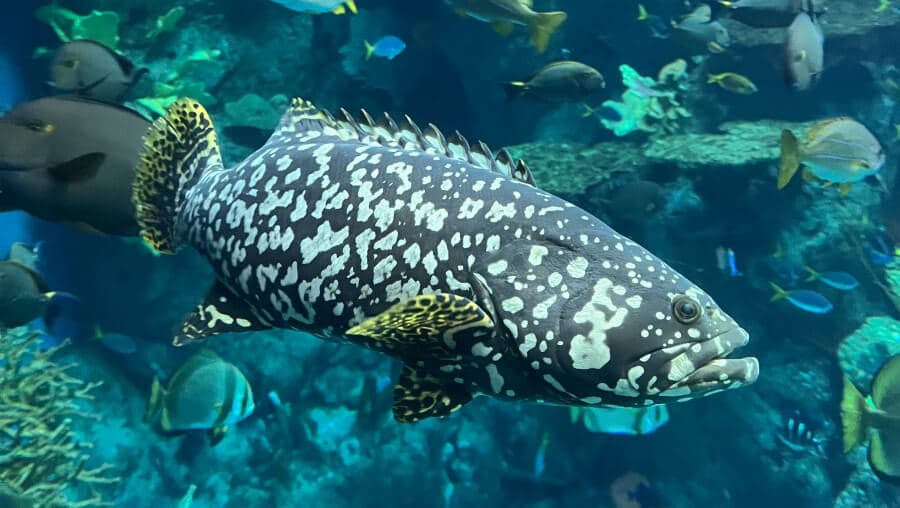
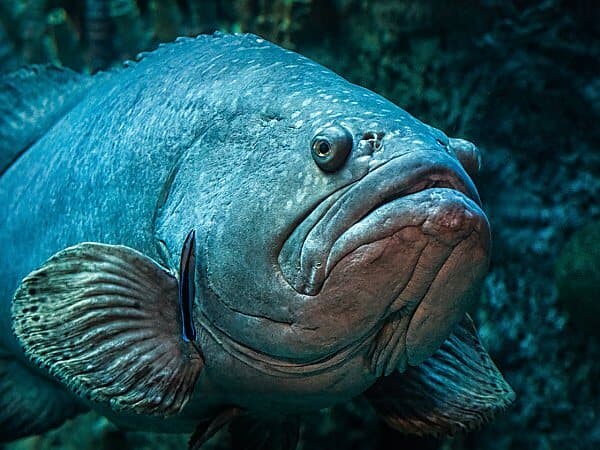
Groupers are characterized by their large size and distinctive coloration, ranging from pale white to dark brown or black. They are also easily distinguished for their thick, fleshy lips, which they use to suck in prey.

Some, such as the Nassau grouper (Epinephelus striatus), are noted for their ability to change from one to any of several other color patterns.
The Goliath grouper is the most iconic. It can reach lengths of up to 7 feet and weigh over 680 pounds. The black and red groupers are smaller, usually weighing around 20-50 pounds.
Grouper Types
The grouper subfamily Epinephelidae includes over 160 species. The most common types of grouper include:
- Goliath Grouper (Epinephelus itajara): Known for its massive size, the Goliath grouper can grow up to 8 feet in length and weigh as much as 800 pounds. It’s found in the Atlantic Ocean and is notable for its vulnerability to overfishing.
- Red Grouper (Epinephelus morio): Common in the Gulf of Mexico and the Atlantic Ocean, this species is popular among commercial and recreational fishers due to its significant role in the seafood industry.
- Nassau Grouper (Epinephelus striatus): Famous for its large size and striking coloration, the Nassau grouper is a key species for coral reef health but is endangered due to overfishing and habitat loss.
- Black Grouper (Mycteroperca bonaci): Commonly found in the western Atlantic from Florida to Brazil.
- Yellowfin Grouper (Mycteroperca venenosa): Recognizable by its bright yellow fins, prevalent in the Caribbean and off the coast of Florida.
- Tiger Grouper (Mycteroperca tigris): Features distinctive dark bands and blotches resembling a tiger’s pattern, common in Caribbean waters.
- White Grouper (Epinephelus aeneus): Found in the eastern Atlantic, including the Mediterranean Sea, distinguished by a more elongated body and lighter coloration.
- Honeycomb Grouper (Epinephelus merra): Noted for its honeycomb-like pattern across the body, found in the Indo-Pacific region.
The Rarest Grouper
The Neptune grouper (Cephalopholis igarashiensis) is one of the rarest and most visually striking groupers, recognized for its vibrant yellow and blue coloration. It’s found at greater depths, which makes encounters with this species quite uncommon.
Habitat
Groupers are typically bottom-dwellers and can be found in various habitats, including coral reefs, mangroves, and rocky outcroppings. They are found in tropical and subtropical shallow waters around the world.
The Goliath grouper, in particular, can be found in the western Atlantic Ocean, including south Florida and the Gulf of Mexico, while black groupers are also found in the western Atlantic Ocean and the Gulf of Mexico. Red groupers are found in the west of the Atlantic Ocean and the Gulf of Mexico.
Nassau groupers used to be one of the most common species in the United States; however, they are now considered endangered.
Diet
Groupers are opportunistic predators that feed on a wide variety of prey, including fish like small sharks, crustaceans, and mollusks.
They are known for their powerful jaws and sharp teeth, which they use to crush the shells of their prey.
Adults eat only fish, while juveniles eat a variety of fish and invertebrates (e.g., shrimp and crabs).

That said, the grouper diet varies depending on the species and their environment. Some, such as the goliath grouper, feed mostly on crustaceans and fishes, while others such as the red grouper are known to feed on smaller fish and squid.
Reproduction
Groupers are protogynous hermaphrodites, meaning they can change their sex from female to male. They typically begin life as females and then switch to males as they reach maturity.
They typically spawn during the summer, with the exact timing varying depending on the species and location. During spawning, they release large numbers of eggs and sperm into the water to fertilize and form larvae.
Three species of this group spawn in aggregations—gatherings of hundreds, thousands, or tens of thousands. They form from November through February around the full moon, when water temperatures are around 79°F. The timing and synchronization of spawning may be a behavior to accommodate widely dispersed adults, facilitate egg dispersal, or reduce predation on adults or eggs.

Threats
Groupers face several threats today, including overfishing, habitat destruction, and pollution. Overfishing is a major concern is that they are often caught at high rates due to the demand for their meat worldwide.
Notably, young groupers are particularly vulnerable, as sharks depend on young ones for food.
Habitat destruction, such as the destruction of coral reefs, is also a problem for them, as these habitats provide important breeding and feeding grounds for the fish.
Conservation efforts to introduce sustainable fishing practices and resources are yet to bear fruit in many places.
In fact, the grouper was listed as a candidate for listing under the Endangered Species Act, but was later listed as a species of concern. Because of the success of the harvest prohibition, it was removed from the species of concern list in 2006.

4 More Facts About Groupers
- The black and red groupers are smaller, usually weighing around 20-50 pounds.
- They produce a range of booms, grunts, and other noises using their swim bladders, with different sounds potentially conveying specific messages or warnings.
- Some grouper species possess remarkable camouflage abilities, blending seamlessly with their surroundings to ambush prey or evade predators.
- Groupers are important in commercial and recreational fishing, which is why it is important to support sustainable fishing practices to conserve them.
FAQs
Can a Goliath grouper swallow a human?
It is unlikely that a Goliath grouper would swallow a human whole. These fish are known for their gentle nature and tendency to approach divers, and there are no recorded instances of them attacking or attempting to swallow humans. However, it’s important to remember that any wild animal can act unpredictably, so it’s always best to respect the animal and give them space.
Do sharks eat groupers?
Sharks are known to be predators of many marine species, including groupers. As they are relatively large fish, but some large sharks, such as tiger and bull sharks, can feed on them. Additionally, groupers are known to defend themselves against shark attacks using their powerful jaws and sharp teeth, and some camouflage themselves to avoid these dangerous predators.
How much is a Goliath grouper worth?
The value of a goliath grouper can vary depending on factors such as the size and condition of the fish and local market conditions. They are considered a protected species, and it is illegal to harvest them in most places. As a result, their value is primarily as trophy fish for sport fishing rather than as a commercial product.
What is the largest grouper ever caught?
The largest grouper ever caught was a goliath grouper, also known as jewfish, which weighed around 680 kg (1,500 lb). A seasoned angler caught it off the coast of Fernando de Noronha, Brazil, in 1961. A.D. This catch is considered to be the current world record for the species.
How long do giant groupers live?
Goliath groupers can live in the wild for a very long time, up to 50 years. They are slow growing and slow to mature, taking several years to reach sexual maturity, and they grow relatively slowly throughout their lives. Due to their long lives and late maturity, overfishing and habitat destruction can significantly impact their population.