

The Scorpionfish is a group of fish in the family Scorpaenidae – comprising the most venomous marine fishes in the world. The name of the Scorpionfish is perhaps the greatest indicator of what they are famous for – their sting. This sting contains some of the deadliest venom on the planet.
Appearance
Distinguishing Characteristics: Dorsal fin covered in venomous spines; red coral-like coloration, enabling them to camouflage with the rocky sea bed
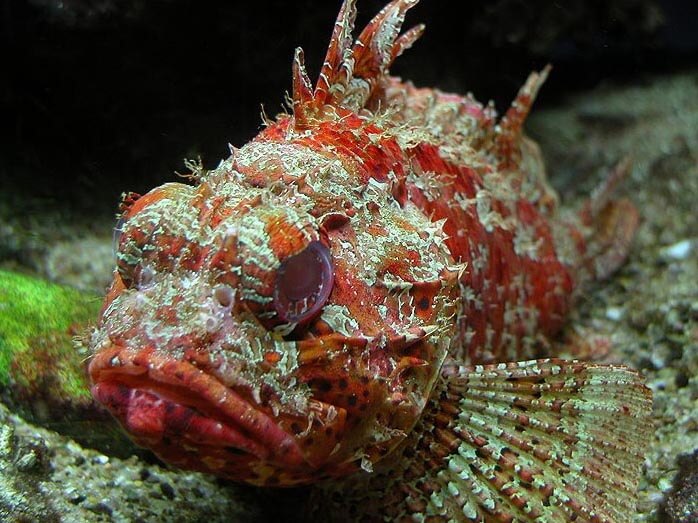
The Scorpionfish is characterized by a stocky, compressed body covered in feathery skin flaps. Their fins contain venomous spines for defense. Scorpionfish have large mouths and high-set eyes that are perfect for ambushing prey.
A true expert in disguise, Scorpionfish are nearly indistinguishable in their surroundings. Their bodies often mirror the corals, rocks, and algae amongst which they lurk.
Their coloration is highly variable, from mottled browns and greens to vibrant reds, yellows, and oranges. This allows them to blend seamlessly with the seafloor where they dwell, providing the perfect cover for both hunting and evading danger.
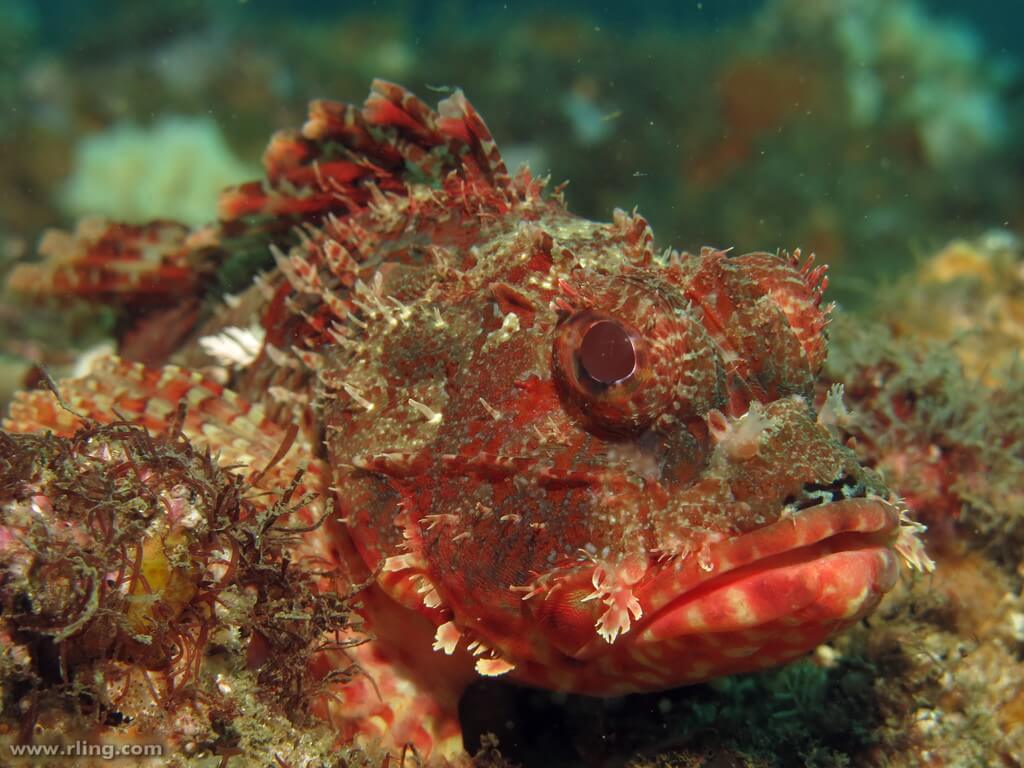
The head of the Scorpionfish is covered in spines and ridges. There are about two spines on the operculum, about five spines on the preopercle, and about seventeen spines on the dorsal fin. All of these spines are equipped with glands at their bases, which contain toxins and venom. These spines help them to deter predators from eating them.
They also have wide mouths for swallowing and suctioning their prey. They have narrow bands of small, fine teeth for seizing their prey. It has a relatively stout tail fin compared to its body size.
Habitat
The Scorpionfish is a bottom-dwelling fish with a global distribution in temperate and tropical waters.

They live mainly in marine environments, especially in coral and rocky reefs where they can hide from predators and prey alike. However, they can also be found in estuarine and freshwater habitats. Most of these fish species tend to inhabit shallow coastal waters, while a few are seen in waters as deep as 2,624 feet (800 meters). They usually live alone and only come together to mate.
Diet
Scorpionfish are carnivorous creatures and they can feed on small fishes, crustaceans, and other invertebrates like snails.
They are primarily ambush predators they hunt by waiting for prey to launch an attack. They are suction feeders and catch their prey by blowing a jet of water toward their victim to generate a suction field that disorients it. There are uncommon cases where this fish species uses its spines to stun or paralyze their prey.
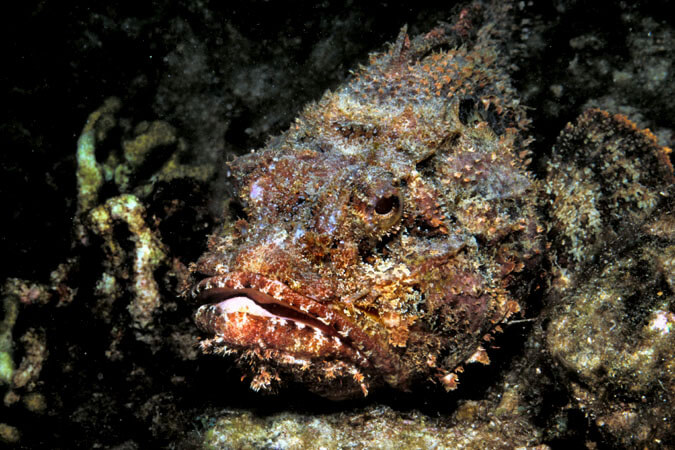
These fish hunt at night and use the daytime for resting. They use their large mouth to capture and maneuver their prey quickly and effortlessly, as well as their sharp teeth to latch onto prey. They have been reported to eat a range of food items including:
- Cephalopods
- Bivalves
- Seaweed
- Even other Scorpionfish.
Reproduction
Their reproduction involves the female releasing thousands of eggs into the water, which are then fertilized by the male. However, some species engage in internal fertilization and give birth to live young. The timing of birth or egg-laying varies among species, occurring from winter to late spring.
Newly hatched Scorpionfishes begin life as plankton-eating drifters, eventually settling to the bottom after several weeks. The exact trigger for this transition remains a mystery. Interestingly, young fishes often display different colors than their adult counterparts.
Behavior
The Scorpionfish is solitary by nature. They are rarely found in groups except during the mating season. This solitary behavior is usually attributed to their hunting technique, where they hide and ambush their prey before capture.
Even though these fish are dangerous, they are not aggressive. However, if they feel threatened, they do not hesitate to erect their dorsal spines and strike. In situations where threat and danger persist, they usually flee in hiding.
Scorpionfish are adorned with colors and patterns that help them to blend with their environment. These colors are not usually on display until they exhibit a behavior known as “flashing.” This behavior is only unveiled when there is a need for it, such as when hunting, disturbed, or at the sight of a predator nearby.
Threats
The Scorpionfish is one of the most venomous fish in the ocean. However, predators that prey on Scorpionfish include sharks, rays, and large snappers.
They are generally not targeted by commercial fisheries due to their venomous nature, but they can still be affected by incidental bycatch when fishing occurs near reefs.
Additionally, their coral reef habitat faces risks from rising ocean temperatures and the broader impacts of climate change. At present, the conservation status of most species remains unassessed.

5 Quick Facts About Scorpionfish
- Scorpionfish are nocturnal hunters with a sit-and-wait strategy.
- They are not commercially fished due to their venom.
- Scorpionfish are primarily found in the Indian and South Pacific Oceans.
- They have feathery fins or skin flaps that aid in camouflage.
- There are over 200 known species of Scorpionfish.
FAQs
Are Scorpionfish poisonous?
They are venomous rather than poisonous, and their venomous spines can give people painful stings. They are not typically deadly to humans unless there is an allergic reaction or an infection develops from the wound.
Are Scorpionfish and Stonefish the same?
Scorpionfish and Stonefish are not the same. They are both members of the Scorpaenidae family, along with Lionfish, and share the characteristic venomous spines. Stonefish have a rounder body, recessed eyes, and an upturned mouth. In contrast, Scorpionfish have a longer body, protruding eyes, and a forward-facing mouth on a distinct jaw.
Are Scorpionfish invasive?
Certain species have proven to be highly invasive, particularly in the western Atlantic and Caribbean regions. They were first reported in Italy in 2016 and have since spread, causing significant ecological disruption due to their ability to decimate native fish populations.
How do Scorpionfish protect themselves?
They protect themselves with venomous spines. These spines, located on their fins, deliver a potent venom when they pierce a threat. This venom can be lethal to other animals and excruciatingly painful to humans, serving as a powerful deterrent against potential predators.
Are Scorpionfish and Rockfish the same?
Scorpionfish and Rockfish are not necessarily the same. While both are often found among rocks on the seafloor, the term “Rockfish” is a broad term that encompasses various species of fish with a tendency to inhabit rocky areas. Scorpionfish, on the other hand, are a specific family of fish known for their venomous spines and perch-like appearance. So, while some Rockfish may indeed be Scorpionfish, not all Rockfish are.


