Sperm whaling was a major industry in the 19th century and was featured in the famed novel of the time, Moby Dick. The Sperm Whale is currently listed as Vulnerable by the IUCN. Their distinctive square-shaped heads make them easily recognizable in comparison to other whales. These marine mammals are also the loudest animals in the world. They create intense vocalizations that could, in theory, vibrate a human being to death.
Appearance
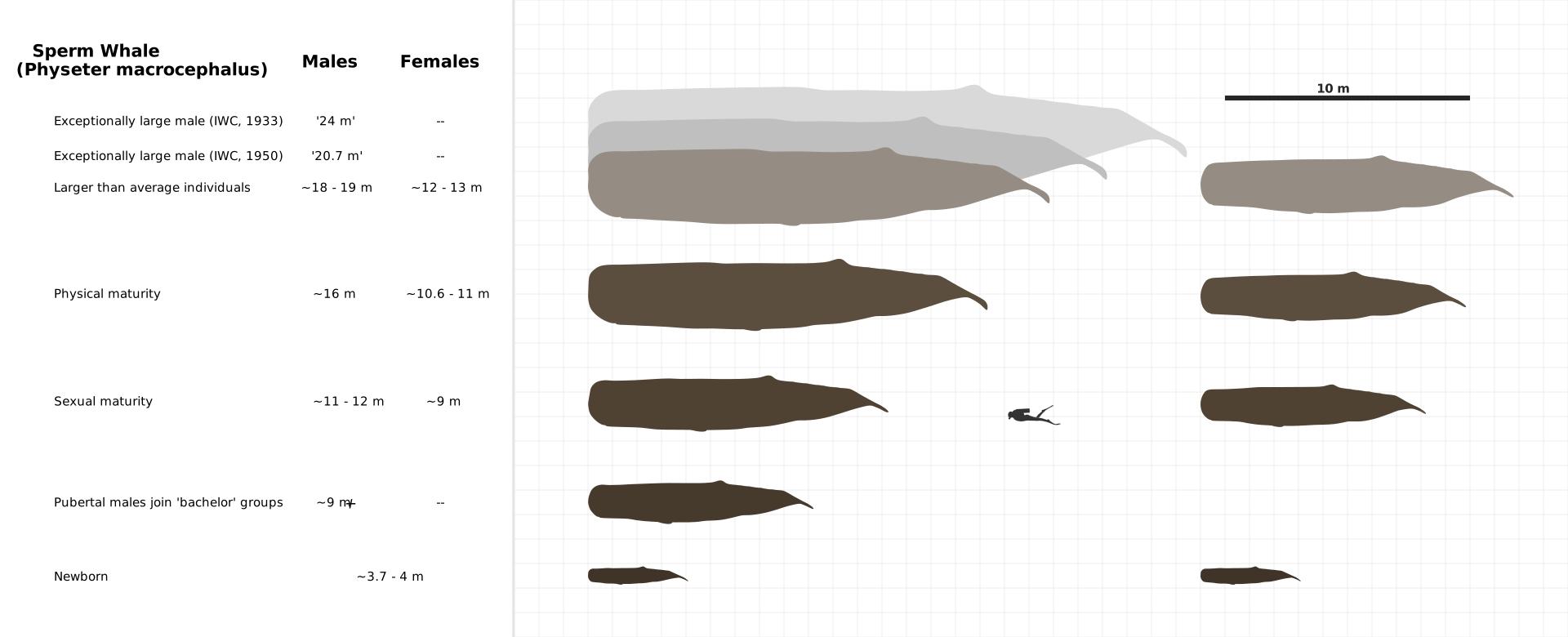
The Sperm Whale is one of the largest whale species in the world. It can grow to around 67 feet and live to 70 years of age and longer. They are the largest toothed whales, more than 20 feet larger than the second largest toothed whale, Baird’s Beaked Whale.
The famed whale that sunk the Essex, the ship that inspired Moby-Dick, is described as being 85 feet (26 meters) in length.

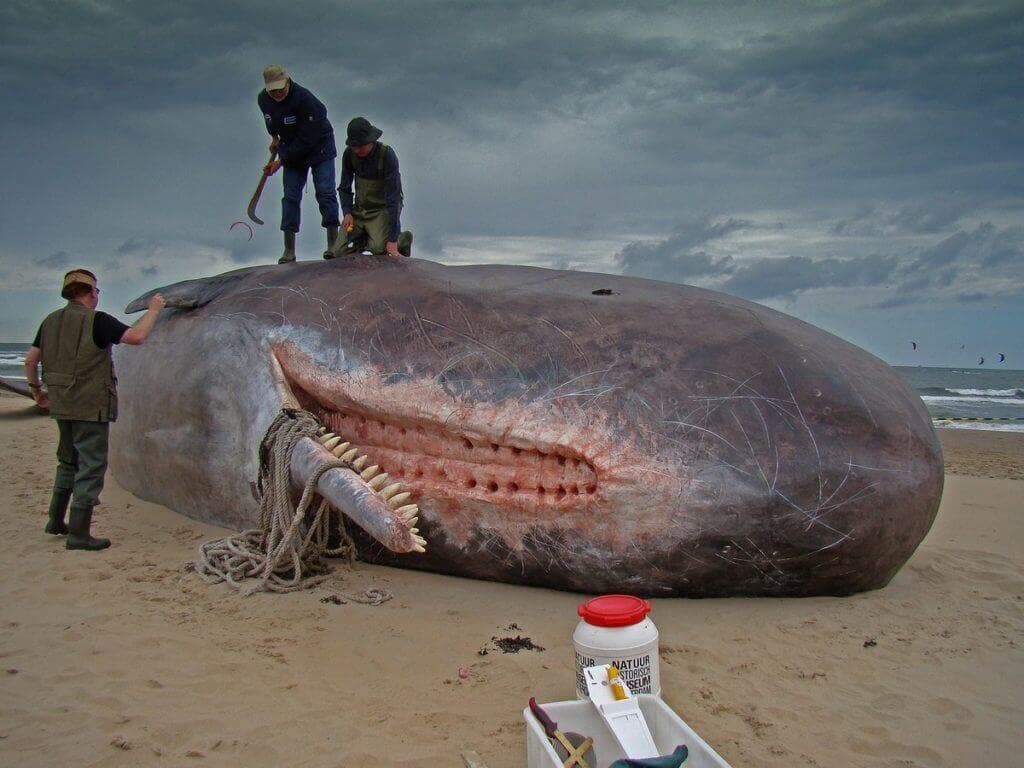
They are instantly recognizable by their enormous heads, which comprise roughly one-third of their total body length. These heads are not only large but distinctly blocky in shape. Interestingly, they have the largest brains of any known animal, weighing approximately 17 pounds (7.8 kilograms).
Their bodies are predominantly dark grey, sometimes with white patches on their bellies. The skin behind their head is often wrinkled, creating a “prune-like” appearance. These whales have paddle-shaped flippers, relatively small compared to their massive bodies.
Their flukes are triangular, and they sport small, low, thick, and usually rounded dorsal fins. A series of ridges across their back, a unique feature among cetaceans, replacing the typical dorsal fin.
When these whales surface to breathe, their blowhole’s asymmetrical placement results in a forward-leaning, S-shaped spray. This, coupled with their wrinkled skin and the absence of a prominent dorsal fin, sets them apart from other whales.

Habitat
These whales inhabit all of the world’s oceans and their distribution is dictated by their food source and suitable conditions for breeding. Unlike the well-understood migrations of Baleen Whales, Sperm Whale migrations are less predictable.

Adult males form bachelor schools undertake extensive oceanic migrations to temperate waters or the poles, while females and juveniles tend to remain in tropical waters year-round. This complex behavior contrasts with their preference for deep water hunting, explaining their infrequent proximity to land, except for occasional visits to islands like New Zealand’s South Island and the Galapagos.
Diet
Sperm Whales routinely dive to depths of 2,000 feet in their relentless pursuit of prey. These dives may last up to an hour. To fuel their massive bodies and sustain their energy-intensive dives, they consume an astonishing one ton of food daily.
Their diet consists mainly of squid, ranging from small species to colossal giants weighing up to one ton and exceeding 40 feet in length. In fact, these whales are known to engage in epic battles with Giant Squid, sometimes bearing the scars of these encounters as evidence of their deep-sea hunts.
They are opportunistic feeders and will also readily consume fish, sharks, rays, and even lobsters encountered in the deep ocean waters.
Reproduction
While whales are known for their strong social bonds and care for their young, they do not form lifelong mating partnerships. Instead, Sperm Whales exhibit a polygynous mating system, with males competing for access to multiple females.
Females reach sexual maturity around 9 years old, measuring about 29 feet long. Male whales become sexually mature around 18 years old. They engage in fierce battles for mating rights, often resulting in scars on their heads.
Females typically give birth to a single calf every five to seven years after a 14 to 16-month gestation period. Their calves nurse for up to eight years, even after starting to consume solid food.
Threats
While Sperm Whale populations have shown signs of recovery since the mid-1980s moratorium on commercial whaling, they continue to face numerous threats in today’s oceans.

Vessel strikes pose a significant risk, particularly due to the whales’ long surface intervals between deep dives. Entanglement in fishing gear can lead to injuries, compromised feeding ability, and even death. They are also vulnerable to underwater noise pollution, which disrupts their communication and essential behaviors such as feeding and breeding.
Ocean debris, particularly plastic, can be mistaken for prey and ingested, leading to potential harm. Climate change and its impact on oceanographic conditions pose an uncertain threat, potentially affecting habitat and prey availability. Oil spills and chemical pollutants further compound the challenges facing these whales.
Biologists continue to advocate for stricter regulations and conservation measures to ensure the long-term survival of these majestic creatures.
Quick Facts About Sperm Whales
- They live in matriarchal pods where young whales learn from the older female Sperm Whales, while mature males prefer a more solitary lifestyle.
- They are found in all oceans except the Arctic Ocean.
- Their skin is up to 14 inches thick to protect them from the immense pressure of deep diving.
- They are known to engage in playful behaviors like breaching and spyhopping.
- Their poop is an important source of nutrients for phytoplankton, which are essential to the ocean’s food chain.
- With their impressive size, Sperm Whales are the inspiration behind the novel Moby-Dick.
FAQs
How did Sperm Whales get their name?
When sailors first encountered these whales, they discovered a waxy substance in their massive heads called spermaceti which was used to make oil lamps, candles, and lubricants. Mistaking this substance for whale semen, they named the species “sperm whale.” The actual purpose of spermaceti remains a mystery, though scientists believe it may play a role in buoyancy, echolocation, or even sound production.
Do Sperm Whales have predators?
While adult sperm whales are formidable, their calves and weakened individuals can fall prey to Orcas, their most common natural predator. Pilot whales and false killer whales also occasionally prey on sperm whales, and even large sharks have been observed attacking them in certain areas like the Galapagos.
Why did whalers target Sperm Whales?
Whalers targeted Sperm Whales for two valuable substances: oil and ambergris. Ambergris is a waxy substance formed in the whale’s digestive system, believed to protect their stomachs from squid beaks. Ambergris was, and still is, highly prized for its use as a fixative in perfumes, contributing to its high value.