
Endurance was a barquentine, three-masted ship that was designed by Ole Aanderud Larsen and built at the Framnæs shipyard in Sandefjord, Norway. The ship was completed on December 17, 1912, and is best remembered for its last incredible voyage, carrying Ernest Shackleton, Captain Worsley, and their crew on the Imperial Trans-Antarctic Expedition. The vessel was trapped in and later crushed by the polar ice in Antarctica’s Weddell Sea. It was lost for 107 years before finally being discovered in March 2022.
Who was Ernest Shackleton?
Ernest Shackleton was an Anglo-Irish explorer born in February 1874. He is remembered for three British expeditions that he led into the Antarctic.

Shackleton was famous for his accomplishments, becoming a public hero well-loved by the British public and a well-respected explorer who was praised by the likes of Roald Amundsen and others.
His first voyage was abroad Discovery Expedition, accompanying Robert Falcon Scott from 1901 to 1904. Later, he and his companions on the Nimrod expedition set a new record for the “farthest South latitude” in 1909. He was knighted by King Edward VII for his early achievements.
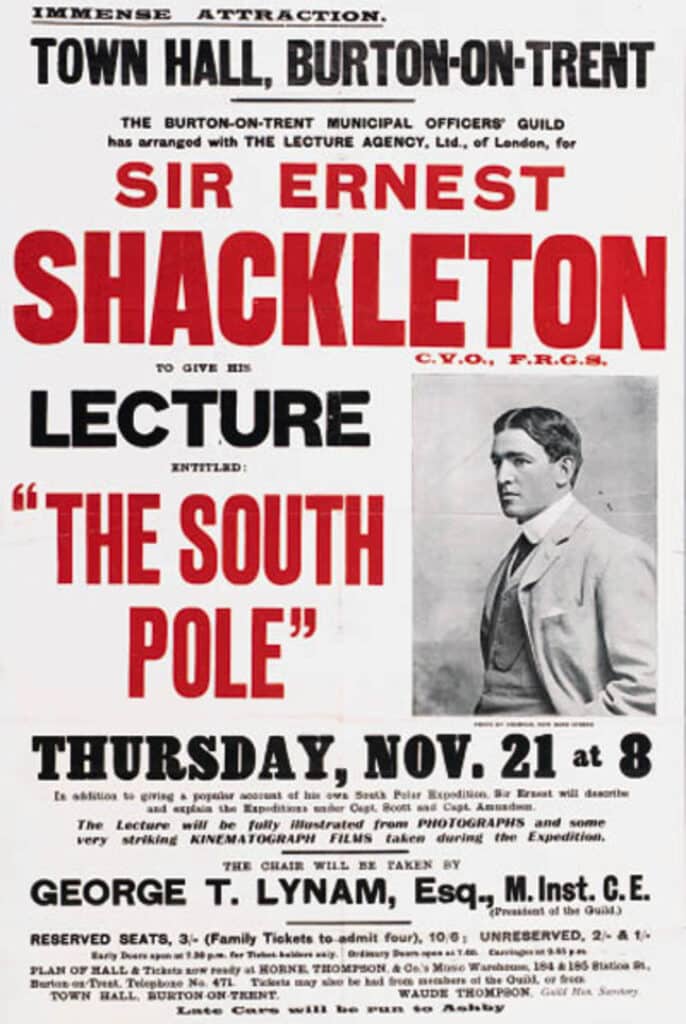
It was in 1911 that Shackleton set a new goal—to cross Antarctica from sea to sea via the South Pole (which had recently been reached by Roald Amundsen). Shackleton leaned on his prestigious and previous successes in order to fund the expedition, raising £10,000 from the British government (close to £1,000,000 or $1,312,000 today). Sailors from around the world applied to become part of his journey (reportedly, he received more than 5,000 applications).
The expedition became known as the Imperial Trans-Antarctic Expedition, and it lasted from 1914 to 1917. It was this fateful voyage onboard Endurance, that doomed the ship and led to a series of catastrophic events that have been described as the most incredible survival story in history.
The Last Voyage of the Endurance
While Shackleton is the best-remembered member of the Endurance crew, the ship was actually captained by Captain F. Worsely. He was an incredibly experienced seaman who is usually credited with navigating the crew to safety, especially in the small boats (a skill that Shackleton was lacking). The crew also included the second in command, Frank Wild, carpenter Harry McNish, Alexander Macklin (a surgeon), the meteorologist Captain L. Hussey, and famously, a male cat named Mrs. Chippy.
Timeline of Events
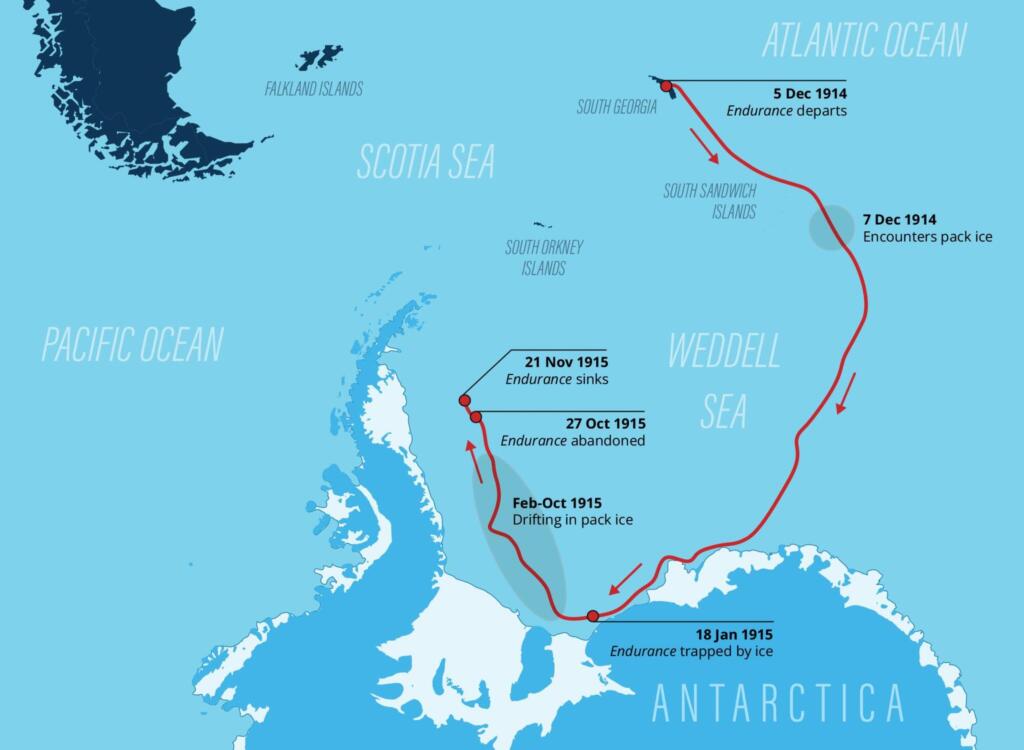
Below is a timeline of events leading up to and following the loss of the Endurance:
Setting Sail
The crew set sail from Plymouth
Start of the Journey
The ship left Buenos Aires, stopping at Grytviken, a whaling station on South Georgia Island
Grytviken Departure
Endurance left Grytviken
Slowing Progress
Two days later, the ship ran into the polar ice pack, the barrier of thick sea ice that stands around Antarctic continent and progress slowed
Several Weeks of Slow Progress
The ship moved slowly through the pack for several weeks (around 30 miles a day)
Nearing Vassal Bay
Endurance was 300 miles from Vassal Bay, the crew’s destination
Trapped
Endurance set sail briefly before becoming trapped again
Icebound
The ship was icebound as far as the crew could see
Unsuccessful Attempt of Removing Ice
The crew tried unsuccessfully to break the ship free from the ice manually
Impassable Route through the Ice
The water opened for a quarter of a mile ahead, but the pack around the open area was solid and impassable
Winter Begins
Antarctic winter begins, and the sun rises and sets for the last time
Drifting (March-May)
Worsley estimates that the ship is drifting with the ice, moving more than 100 miles to the northwest
Blizzard Breaks Ice (July 14th-16th)
A blizzard moves the ship and breaks the ice into smaller pieces
Movement in the Ship from Ice
Movement in the pack tilts the ship, allowing it to float for the first time in six months. Movements continue, moving and compressing the ship violently and dangerously
Leak Discovery
Shackleton and the crew attempt to move the ship and take advantage of an opening, but a leak is discovered. The ice closed in again two days later
Departing off the Ship (October)
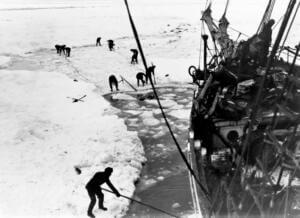
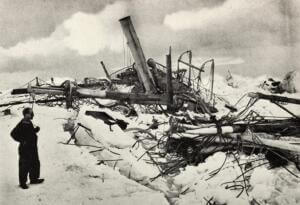
The ship continued to be damaged by the ice, with the pressure steadily increasing. The deck of the ship buckled upward, and the men were ordered out of the ship and onto the ice for their own safety
Endurance Sinks with Crew Stranded
Endurance was lost beneath the icy waters of the Antarctic, and the crew’s situation became even more perilous

How the Crew of Endurance Survived
Shackleton hired experienced cameraman Frank Hurley, whose films and photographs would hopefully pay for part of the expedition.
But within a day’s travel (80 miles) of land, the Endurance was trapped in unusually heavy pack ice. Completely stuck, Shackleton and his crew drifted helplessly northward during the long Antarctic winter night while listening to the shrieks and moans of the Endurance slowly being crushed by the mounting pressure.
What followed is one of the greatest adventure stories ever and a unbelievable tale of courage and survival.The crew drifted on ice floes for months before landing on the completely deserted Elephant Island. Though his crew was safe for now, there was no chance for resue. So Ernest Shackleton and five of his men made a 850-mile journey in an open boat with only a sextent to guide them across the roughest seas in the world to miraculously reach Georgia Island. Even then, they had to become the first people ever to climb over the island’s forbidding mountain to reach civilization on the other side.
The crew of the Endurance, after losing their ship to the polar ice flows, took to the ice in a desperate bid for survival. The crew recovered some critical items from the ship, but the dangers of remaining on board were too great, and the boat was crushed on November 13, 1915, and the remaining wreckage was hit by another pressure wave a few days later. The next day, Endurance had sunk, obliterating any trace of the ship. What happened next has long been regarded as one of the most remarkable feats of survival in the history of exploration.
The crew camped on the ice for nearly two months while Shackleton and Worsley hoped that the ice would drift towards a known island more than 400 km away. Eventually, Shackleton, against the wishes of his captain, decided that the crew’s best hope of survival was to pack their crucial belongings onto the lifeboats and drag them across the ice. This trek didn’t last more than a few days or make it more than a few miles. Noting the dangers of damage to the lifeboats, Shackleton decided to make another camp, known as “Patience Camp, “on another ice flow. Again, the crew hoped that the ice would take them closer to a safe harbor.
On April 9, 1916, Shackleton ordered the crew into their meager lifeboats with the hope of sailing toward Elephant Island. Their destination was a small, rocky, and inhospitable destination that would take around five days to reach. While sailing, the crew endured unimaginable conditions. This included the freezing cold, seasickness, lack of food, unsuitable clothing and provisions, and frostbite.
During this period, Shackleton is described as caring for his crew in every way possible, including giving his mittens to the famed photographer of the expedition. Captain Worsley, whose skill in small boats saved the crews’ lives more than once, was almost entirely responsible for navigating them to the small Elephant Island. The crew, against all odds, reached the island. But they were far from safe.
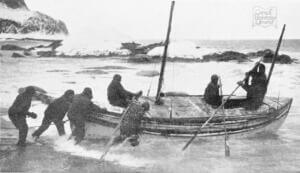
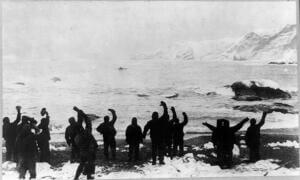
A selected few, including Shackleton, Worsely, and Harry McNish, set off once more in the James Caird, one of the three small lifeboats. The crew outfitted it, breaking down the other two lifeboats, in order to ensure that it would survive the 720-mile journey to the South Georgia whaling station they departed from nearly a year earlier. The captain’s second in command, Frank Wild, was left on Elephant Island along with the remaining members of the crew to wait for Shackleton’s and Worsley’s return with help.
Shackleton packed supplies for around four weeks, refusing to take more from his stranded crew. He was well aware of the risks of the journey and knew that if they did not make it to South Georgia within the four-week time period that everyone would be lost. It took from April 24th-May 8th to reach South Georgia Island. By this point, Shackleton and his small band were near death.

Unfortunately, the small boat landed on the wrong side of the island. Rather than set sail again, part of the small group traveled 32 miles over dangerous, unmapped alpine mountain terrain for 36 hours straight in order to reach a whaling station on May 20.
Sir Ernest Shackleton and Captain Frank Worsley immediately organized a rescue mission by procuring a third ship, the yelcho, from Chile for the twenty-two other crew members on Elephant Island. The crew was successfully rescued, after four failed attempts, on August 30, 1916. Amazingly, every member of Shackleton’s crew survived their harrowing months in the Antarctic.
The Discovery of the Endurance Wreck
Incredibly the wreck of Endurance was discovered in the Antarctic by The Falklands Maritime Heritage Trust, using the South African icebreaker Agulhas II, on March 5, 2022, exactly 100 years after the funeral of Ernest Shackleton and 107 after the ship was crushed by the polar ice.
The ship was found upright and in what scientists are calling remarkably good condition. It is in, as the director of the exploration Mensun Bound noted, “a brilliant state of preservation.” It’s even possible to make out the name “Endurance” on the stern. The wreck is considered one of the most important shipwreck discoveries in modern history.
Ocean Insights: Hear From Our Experts

By Rida Nasir
Researcher and Conservationist, with an MSc in Environmental Science
The Endurance expedition led by Sir Ernest Shackleton exemplifies the resilience of the human spirit and the miracles that can arise in the face of adversity. Trapped in the Antarctic ice, Shackleton and his crew faced seemingly insurmountable challenges, yet their determination and belief in survival shone through. Even when everything seemed like a blocked wall, they chose hope over despair, navigating treacherous seas and scaling daunting mountains to find rescue. In my opinion, Shackleton's journey is a powerful reminder that when we are meant to survive, nothing can extinguish our will to live. Their legacy teaches us that courage and perseverance can illuminate paths even in the darkest times, inspiring countless individuals to believe in the miraculous potential of resilience.
FAQs
Did the crew of Endurance survive?
Yes, the entire crew of the Endurance survived their ordeal. Their survival story is harrowing and incredibly hard to imagine. Today, it is considered one of the most remarkable survival stories in the history of exploration.
Where did Endurance sink?
Endurance sank in the Antarctic. Captain Worsley recorded it at 68° 38.5’S 52° 58’W in the middle of an impassable ice flow.
How long were Shackleton’s crew on Elephant Island?
Shackleton’s crew was on Elephant Island from April 15, 1916, until they were rescued on August 30, 1916. All told the crew’s journey lasted more than two years.


