

Swordfish and sailfish are two of the most prized game fish species for recreational anglers.
Both bearing distinctive features and embodying the essence of speed and power, these iconic creatures have long captured the imagination of seafarers and enthusiasts alike.
In this exploration, we delve into the depths of the marine realm to compare the Swordfish and Sailfish, unraveling the unique traits that set them apart, from their physical characteristics to their hunting techniques.


Left Image Credit: MathKnight – CC BY-SA 3.0; Right Image Credit: wallpaperflare
Swordfish vs. Sailfish: Main Differences
Physical Appearance: Swordfish are characterized by long and thin bodies. They also have an extremely elongated rostrum (sword-like bill), which is where they get their name. They have just one dorsal fin and a curved tail fin. Sailfish, on the other hand, are built in a slimmer and sleeker way than swordfish. They have an eye-catching sail-like dorsal fin running along the back that looks so appealing when they’re excited. Additionally, they have long snouts, but their bills are much less pronounced.
Size: Typically, swordfish are bigger and heavier than sailfish. They can be over 14 feet (4.3 meters) long and may weigh hundreds of pounds. On the other hand, sailfish are much smaller; they commonly measure between 6 and 11 feet in length and weigh between 120-220 lbs.
Habitat: The swordfish are well distributed in and inhabit both warm and cool waters of the sea and are frequently associated with the deep water regions of the ocean. They have a reputation for diving deep in pursuit of prey. The sailfish usually dwell in the warmer, offshore region and are often spotted around the surface or near-surface habitat.
Feeding Behavior: The swordfish is a formidable predator that frequently feeds on deep-sea food like squids and fishes. They make use of their bills to chop up schools of prey. Sailfish, on the other hand, employ a hunting strategy where they inflate their fins to trap their prey.
Speed: Swordfish are fast swimmers and can be even quicker when chasing prey, although they do not possess a remarkable pace. Sailfish, on the other hand, are considered the fastest swimming fish in the ocean and can attain a speed of about 68 miles per hour or even more.
Bill Shape: The swordfish is characterized by a long, sharp-pointed beak for cutting its prey. The sailfish has a somewhat curved bill to congregate and trap schooled prey.
Conservation Status: The swordfish species face conservation issues, though it is not classified as endangered. There are measures in place to help restrict and regulate fishing swordfish. The population of sailfish is more stable, and they are not any close to being considered endangered species. Nonetheless, because of the regional variation of the species, there might be some local conservations.
Swordfish
The Swordfish (Xiphias Gladius) is an amazing marine creature known for its unique appearance and swimming abilities. It is highly sought after by most recreational fishermen all over the globe because of Its tender meat.

Appearance
Size: up to 15 feet (4.6 meters)
Speed: 40 to 50 miles per hour (64 to 80 kilometers per hour)
Distinguishing characteristics: sword-like rostrum, streamlined body, dark blue to brown coloration, crescent-shaped tail
One of the distinguishing characteristics of the swordfish is its extremely elongated bill originating from the top end of its upper jaw. Swordfish takes its name from this singular characteristic. The bill serves many purposes, one of which is a weapon hunting its prey. It also protects predators on its way.
Swordfish have sleek bodies that can cut through the water at breakneck speeds. The upper side of their bodies is colored deep brown to black and off-white for the undersides to enhance camouflage effectively.

Swordfish have a unique adaptation known as regional endothermy. Certain parts of their muscles and eyes are heated above the ambient water temperature, which allows them to maintain higher activity levels in cooler, deeper waters.
Habitat
Swordfish are found in tropical and temperate open oceans around the world. They are believed to travel great distances in search of both prey and suitable water temperatures. While they occur in different seas, they are especially abundant in the Atlantic and Indian oceans. They are also most comfortable when swimming in depths of 600 and 1800 meters deep.
Feeding Behaviour
Swordfish are voracious predators. Squids are their main feeding stock. Also included in their diet are mackerel, tunas, and sardines, among several others.
Swordfish have sword-like bills that slice onto groups of fish and stun or pierce them into submission. Their opportunistic nature makes them fast swimmers capable of chasing down their prey, which explains why they rarely use tools and instead rely on hunting instincts.
Reproduction
Swordfish are oviparous. This means that they reproduce by laying eggs. They lay eggs in the open waters, and the eggs are, in turn, fertilized externally by their males. This unique reproductive strategy allows them to have many offspring that stand a chance of surviving the unpredictable and unreliable sea environment.
Threats
As impressive as they are in size and swimming, swordfish have their adversaries. Commercial and recreational anglers apply fishing pressure on them. Swordfish are vulnerable to overfishing and bycatch during longline fishing.
Sailfish
The sailfish have a dorsal fin that resembles a sail, hence its name. They are also renowned for their fast swimming ability. There are two primary species of sailfish: the Atlantic sailfish (Istiophorus albicans) and the Pacific sailfish (Istiophorus platypterus).

Appearance
Size: lengths of up to 11 feet (3.4 meters) but typically smaller
Speed: up to 68 miles per hour (110 kilometers per hour)
Distinguishing characteristics: sail-like dorsal fin, vibrant and iridescent coloration, long rostrum, large eyes
Sailfish are characterized by their sail-like dorsal fin, which stands straight and curved when raised. The fish’s fin is usually brightly colored and shimmering with shades of blue or iridescent tones. This is mainly seen when the fish is excited. They have a long and streamlined body that cuts through the water efficiently and swiftly.
Habitat
Warm water is a sailfish’s favorite; it prefers the world’s temperate and tropical regions of oceans. They can be almost anywhere in the sea but are commonly seen below the surface utilizing their fin sail. Sailfish are also capable of tracking ocean drifts and currents and often looking for schools of prey like anchovies or needlefish.

Feeding Behaviour
Sailfish are highly skilled hunters. Here are key aspects of the sailfish’s feeding behavior:
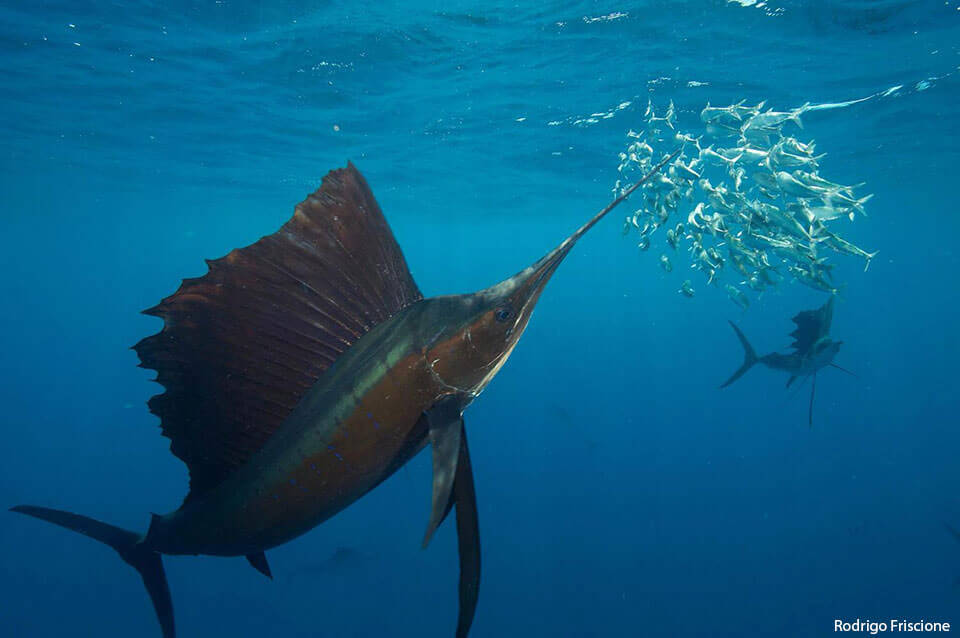
- Sail Display: When hunting, sailfish may raise their distinctive sail-like dorsal fin. While the exact function of this behavior is not fully understood, it is believed that the raised dorsal fin may help in corralling prey or signaling to other members of the hunting group.
- Slashing with Bill: Sailfish have a long, pointed bill or rostrum, which they use as a formidable weapon during hunting. They slash at schools of fish to injure or stun them, making it easier to capture and consume their prey.
- Prey Selection: Sailfish primarily feed on small schooling fish such as sardines, anchovies, and mackerel. They may also target squid. Their diet can vary based on the availability of prey in their habitat.
- Ambushing Prey: Sailfish are known for their ambush-style hunting. They often patrol the edges of schools of fish, using their speed and agility to burst into the school, slashing with their bills and capturing individual prey.
- Swallowing Prey Whole: After incapacitating their prey, sailfish typically swallow it whole. Their sharp bills help them grab and manipulate prey items, and their large mouths allow them to consume relatively large fish.
- Predatory Adaptations: Sailfish possess excellent vision, which aids them in detecting prey in the water. Their large eyes and streamlined bodies contribute to their effectiveness as predators.
Reproduction
Sailfish, like many other billfish species, engage in courtship behaviors as part of the mating process. These behaviors may include swimming in pairs or small groups. During courtship, males may display their sail-like dorsal fins and engage in other visual and physical displays to attract females.
Sailfish reproduce through a means known as broadcast spawning. This is where females release their eggs in the open sea while the males fertilize the eggs externally. Similar to the swordfish, this reproduction strategy enables them to have numerous offspring. Spawning typically occurs in offshore waters. Sailfish are known to migrate to warmer waters for spawning, often following prey species that are part of their diet.
Threats
Sailfish are not left out when it comes to overexploitation and destruction of their habitats. These fish species are commonly captured as bycatch in commercial fishing for other species. Sailfish are only vulnerable when it comes to sportfishing. This form of fishing emphasizes the pursuit of fish species for their incredible speed and acrobatic display.
FAQs
Are sailfish and swordfish the same?
Swordfish and sailfish are not the same fish species. While they share some similar traits and features, they are distinct fish species, each with diverse features, inhabiting different environments as well as having behaviours.
What is faster, a sailfish or a swordfish?
Sailfish are considered to be much faster swimmers than swordfish. Sailfish reach top speeds of about 68 miles per hour (or 110 kilometers per hour), while swordfish reach speeds at about 50 miles per hour (or 80 kilometers per hour).
Why don’t people eat sailfish?
Sailfish are often not commonly consumed because their meat has a strong flavor compared to other popular fish species, and it can be tough if not prepared properly. Additionally, they are often prized more for their sportfishing value than as a food source.
What’s the fastest fish in the ocean?
Sailfish are considered the fastest fish species in the oceans, as they can swim at speeds of up to 68 miles per hour or 110 kilometers per hour.


