

The fish kingdom is full of masters of adaptation, and the letter ‘F’ showcases some of the most impressive examples. This group includes the remarkable Flying Fish, which turns its fins into wings to soar above the waves, and the cunning Frogfish, an ambush predator that uses a built-in fishing lure to tempt its prey.
From the deep-sea Fangtooth with its fearsome teeth to the camouflaged Flounder that vanishes against the seafloor, this guide delves into the fantastic world of fish that start with F, revealing the unique strategies they use to survive.
Common Fish Names That Start With F
This section highlights fish best known by their common names, which often describe their unique abilities or appearance.
Flying Fish (Family Exocoetidae)
Habitat: The surface waters of warm tropical and subtropical oceans around the globe.
Size: Most species are around 12 inches, but some can reach up to 18 inches.
Conservation Status: All species are currently listed as Least Concern (LC) by the IUCN.

A Flying Fish doesn’t truly “fly” but is an expert glider, launching itself from the water after building up incredible speed. Its torpedo-shaped body minimizes drag, while an unevenly forked tail, with a longer bottom lobe, helps propel it powerfully into the air.
Once airborne, it uses its most prominent feature, the huge, wing-like pectoral fins to catch the wind. This allows it to glide for astonishing distances, with the longest recorded flights exceeding 1,300 feet—that’s longer than four football fields.
Frogfish (Family Antennariidae)
Habitat: The seafloor of tropical and subtropical oceans, often perfectly camouflaged among sponges and coral.
Size: Varies greatly, from less than an inch to over a foot long.
Conservation Status: Most species are Least Concern (LC), but their reliance on coral reefs makes them vulnerable to habitat destruction.
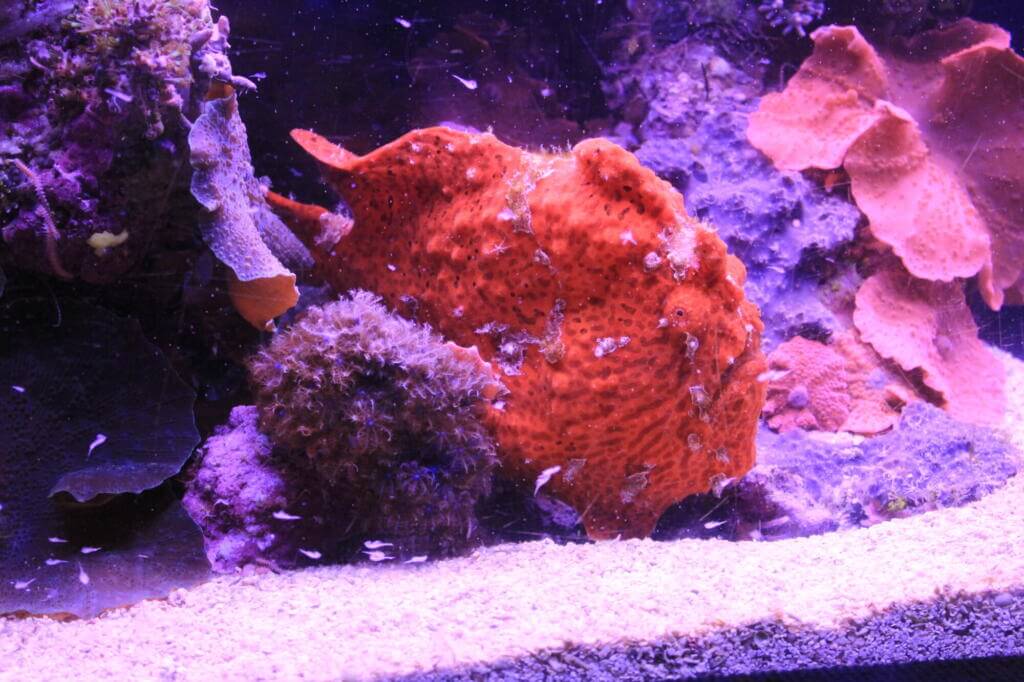
As sedentary ambush predators, Frogfish are masters of aggressive mimicry, changing their color and texture over several weeks to perfectly match their surroundings. Their most famous feature is a modified dorsal fin spine that acts as a built in fishing rod, called an illicium, with a fleshy lure, or esca, on the end, which they wiggle to attract prey.
When a curious victim approaches, they unleash one of the fastest bites in the animal kingdom, capable of expanding their mouth cavity and sucking in prey in as little as 6 milliseconds. This incredible speed is possible because their mouth can expand to 12 times its normal size, allowing them to swallow prey even larger than themselves.
Flounder (Order Pleuronectiformes)
Habitat: Sandy and muddy bottoms of oceans worldwide, with some species entering freshwater.
Size: Varies immensely, from a few inches to over 7 feet for the giant Atlantic Halibut.
Conservation Status: Varies by species.

Flounders undergo a bizarre metamorphosis, starting life as a normal, symmetrical fish before one eye migrates across the top of its skull to join the other. This results in their most striking feature: an asymmetrical, flattened body with both eyes on one side, perfectly adapted for life on the seafloor.
They are masters of camouflage, able to change the color and pattern of their top side to blend in flawlessly with the seabed, while the “blind” side that lies on the bottom remains pale white. When they need to move, they can swim with a surprising burst of speed, propelling themselves with a distinct wave like undulation of their body.
Scientific Fish Names That Start With F
Here, we focus on species or genera where the scientific name is particularly significant.
Fundulus (Topminnows & Killifish)
Habitat: Marshes, estuaries, and coastal waters of North and Central America.
Size: Small, typically ranging from 2 to 6 inches.
Conservation Status: Most species are Least Concern (LC), but some with very specific habitats are endangered.
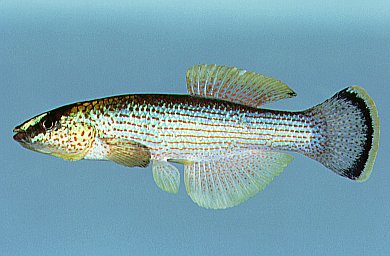
The genus Fundulus has an ironic name, coming from the Latin word for “bottom,” as most species are actually surface dwellers. They are better known as “topminnows” because they have upturned mouths and flattened heads, perfectly adapted for feeding on insects at the water’s surface. This ability to thrive in diverse and challenging environments makes them popular with scientists studying evolution and adaptation.
Their incredible hardiness is best exemplified by the Gulf Killifish, which was the first fish to fly on the Space Shuttle to help study the effects of microgravity. Beyond their scientific value, these fish also play a vital ecological role as a food source for larger fish and wading birds.
Forcipiger (Longnose Butterflyfish)
Habitat: Coral reefs throughout the tropical Indo-Pacific region.
Size: Can grow up to 9 inches in length.
Conservation Status: Least Concern (LC) by the IUCN, as it is widespread and common.
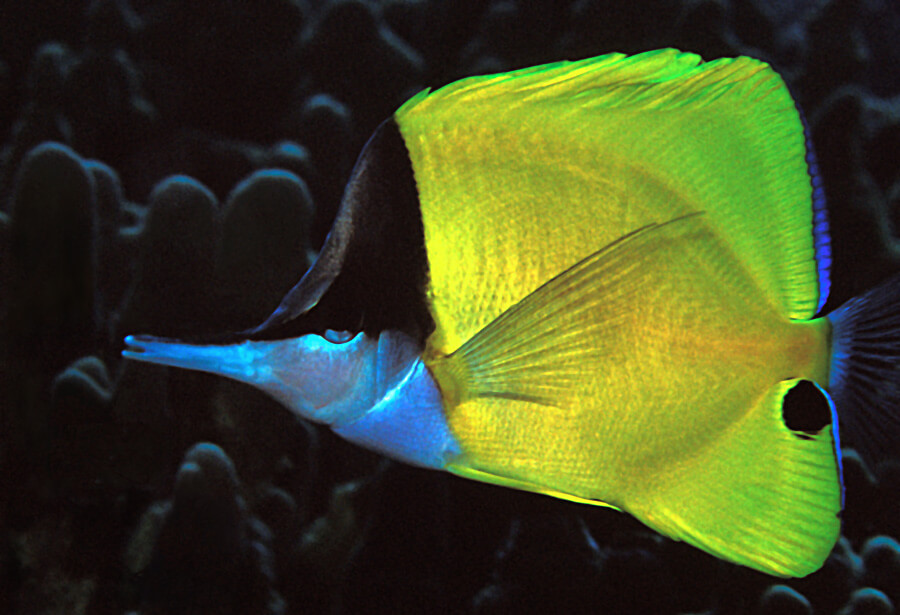
Its genus name, Forcipiger, literally means “forceps bearer,” a perfect description for its most distinctive feature: an exceptionally long snout. This delicate snout is used like a pair of tweezers to probe deep into coral crevices and pluck out small crustaceans and tube worm feet.
This unique tool is part of a brilliant yellow body with a sharp black and white pattern on its head that helps to camouflage its eye. As graceful and precise swimmers, they are often found living in monogamous pairs that defend a shared territory, and when threatened, they can erect the sharp spines of their dorsal fin as a defense mechanism.
Other Fish Species That Start with F
- Fair Cichlid / Fairy Cichlid (Neolamprologus brichardi)
- Fairy Basslet (Gramma loreto)
- False Brotula (Parabrotula plagiophthalmus)
- False Cat Shark (Pseudotriakis microdon)
- False Moray (Kaupichthys hyoproroides)
- False Perch (Sebastes marinus)
- False Trevally (Lactarius lactarius)
- Fang-toothed Fish (Anoplogaster cornuta)
- Fathead Minnow (Pimephales promelas)
- Fathead Sculpin (Cottunculus microps)
- Featherback (Family Notopteridae)
- Featherfin Cichlid (Cyathopharynx furcifer)
- Fiddler Ray (Trygonorrhina fasciata)
- Filefish (Family Monacanthidae)
- Finback Cat shark (Eridacnis radcliffei)
- Fingerfish (Monodactylus argenteus)
- Fire Eel (Mastacembelus erythrotaenia)
- Firebar Danio (Devario maetaengensis)
- Fire Goby (Nemateleotris magnifica)
- Flame Angelfish (Centropyge loriculus)
- Flame Tetra (Hyphessobrycon flammeus)
- Flamefin Cichlid (Protomelas taeniolatus)
- Flag Cichlid (Mesonauta festivus)
- Flagblenny (Emblemaria atlantica)
- Flagfish (Jordanella floridae)
- Flashlight Fish (Family Anomalopidae)
- Flathead (Family Platycephalidae)
- Flathead Catfish (Pylodictis olivaris)
- Flabby Whale fish (Cetomimus gillii)
- Flutemouth (Family Fistulariidae)
- Flying Gurnard (Dactylopterus volitans)
- Florida Gar (Lepisosteus platyrhincus)
- Footballfish (Genus Himantolophus)
- Forcepsfish (Forcipiger flavissimus)
- Four-eyed Fish (Anableps anableps)
- Freckled Dace (Rhinichthys osculus)
- French Angelfish (Pomacanthus paru)
- French Grunt (Haemulon flavolineatum)
- Freshwater Barracuda (Ctenolucius hujeta)
- Freshwater Drum (Aplodinotus grunniens)
- Freshwater Shark (Pangasius sanitwongsei / trade name, not a true shark)
- Frigate Mackerel (Auxis thazard)
- Frilled Shark (Chlamydoselachus anguineus)
- Frogmouth Catfish (Chaca chaca)
- Frontosa Cichlid (Cyphotilapia frontosa)
- Fugu (Pufferfish) (Takifugu spp.)
- Fusilier (Subfamily Caesioninae)
FAQs
Why is the Four-eyed Fish called that? Does it really have four eyes?
The Four-eyed Fish (Anableps anableps) doesn’t actually have four separate eyes. Instead, each of its two eyes is split horizontally by a band of tissue, creating two pupils in each eye. This amazing adaptation allows it to swim at the surface and see perfectly both above and below the water at the same time, watching for predators in the air and food in the water simultaneously.
Do any ‘F’ fish use tools to hunt?
Yes, in a way! The Frogfish is a master of using a “tool” that’s part of its own body. Its modified dorsal spine acts as a fishing rod (illicium) with a fleshy lure (esca) on the end. It dangles and wiggles this lure in front of its mouth to attract smaller fish, which it then swallows in one of the fastest strikes in the animal kingdom.
What are some extreme adaptations of deep-sea fish that start with ‘F’?
Deep-sea ‘F’ fish have evolved incredible tools to survive in total darkness. The Fangtooth has the largest teeth relative to its body size of any fish, ensuring that any rare meal it encounters cannot escape. The Footballfish, a type of anglerfish, and the Flashlight Fish both use bioluminescence, creating their own light to attract prey or communicate in the crushing blackness of the deep ocean.


