

The category of fish that start with P is a study in fascinating extremes. It features the infamous Piranha, a fish whose reputation precedes it, and the potent Pufferfish, which carries one of nature’s deadliest toxins. It also includes the powerful Pike, an apex predator of freshwater lakes, and the peaceful Parrotfish, whose beak-like mouth helps create the sand on tropical beaches.
Power, poison, and personality collide in the world of fish that start with the letter ‘P’. This article dives into the world of these and many other species, exploring the predators, pretenders, and popular pets in this category.
Common Fish Names That Start With P
Let’s explore the popular fish with common names starting with P.
Piranha (Pygocentrus nattereri)
Habitat: Freshwater rivers, floodplains, and lakes of the Amazon River Basin in South America.
Size: Typically 6 to 10 inches long.
Conservation Status: Least Concern (LC) by the IUCN.
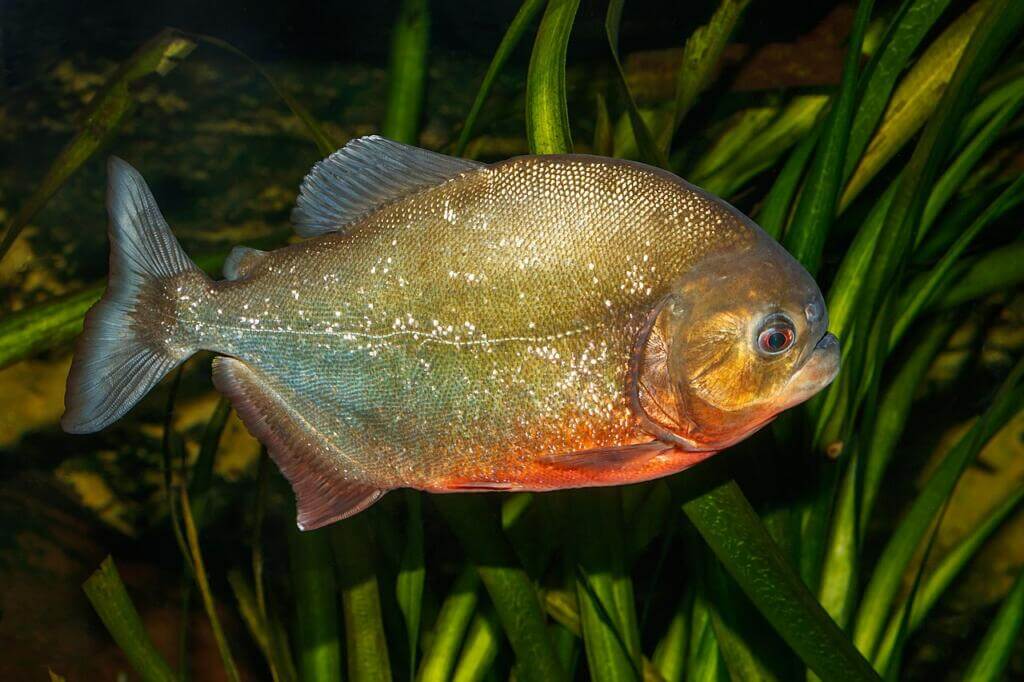
The Piranha has a legendary and largely undeserved reputation as a relentless killer. This fame comes from its most notable feature: a single row of razor-sharp, interlocking teeth in its powerful jaws. While they are capable of inflicting serious bites, piranhas are primarily scavengers and opportunistic foragers, playing a crucial role as the “clean-up crew” of the Amazon. They are far from the mindless killers portrayed in movies.
Contrary to popular belief, their schooling behavior is more of a defensive strategy to protect themselves from larger predators like river dolphins and caimans, rather than a coordinated hunting pack. Piranhas are also surprisingly communicative, making audible “barking” sounds by contracting muscles attached to their swim bladder to warn off rivals or signal aggression.
Pufferfish (Family Tetraodontidae)
Habitat: Mostly found in tropical and subtropical ocean waters, with some species living in freshwater.
Size: Varies immensely, from the 1-inch Dwarf Puffer to the 3-foot Giant Puffer.
Conservation Status: Most species are Least Concern (LC), but some are threatened by pollution and habitat loss.

The Pufferfish is a master of defense, possessing two incredible survival mechanisms. Its most famous trait is its ability to rapidly inflate its elastic stomach with water (or air if out of the water), transforming itself into a large, almost spherical ball that is much more difficult for a predator to swallow. This dramatic change in size is a powerful visual deterrent.
If inflation isn’t enough, the pufferfish holds a deadlier secret: it is one of the most poisonous vertebrates in the world. Its internal organs, and sometimes its skin, contain a potent neurotoxin called tetrodotoxin, which is up to 1,200 times more poisonous than cyanide. This makes it a fatal meal for most would-be predators. They also have unique, fused teeth that form a strong beak for crushing the shells of mollusks and crustaceans.
Pike (Esox lucius)
Habitat: Freshwater lakes, and slow-moving rivers and streams throughout the Northern Hemisphere.
Size: Can grow over 5 feet long and weigh more than 60 pounds.
Conservation Status: Least Concern (LC) by the IUCN.
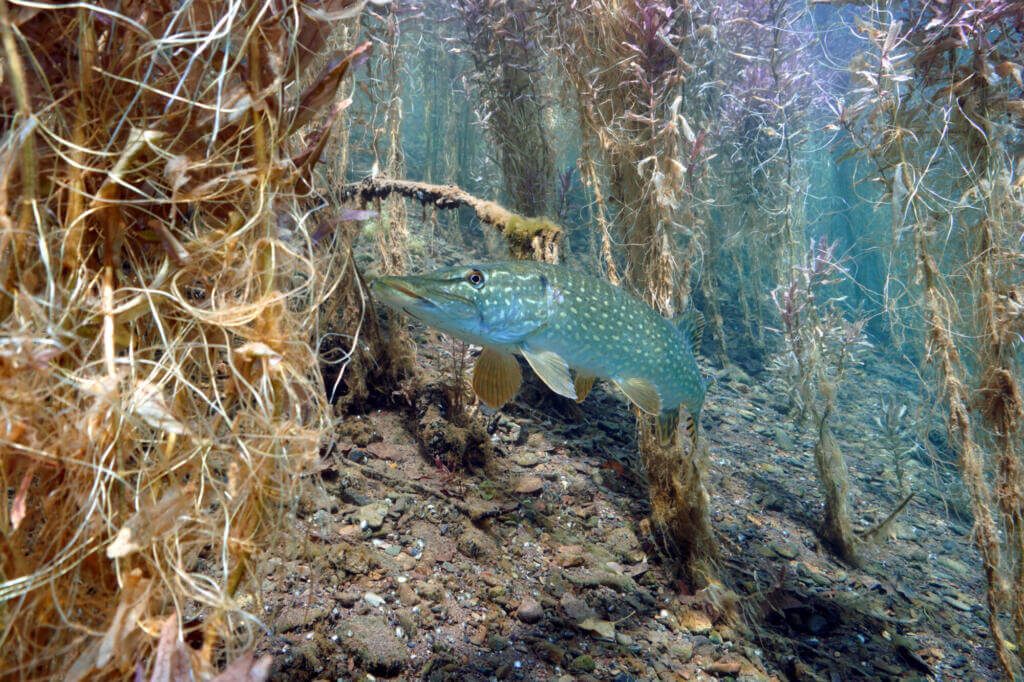
Often called the “water wolf,” the Northern Pike is a formidable apex predator of freshwater ecosystems. It is a classic ambush hunter, using its long, torpedo-shaped body and mottled green coloration to camouflage itself perfectly among aquatic weeds. It will wait completely motionless for an unsuspecting fish or frog to pass by before launching a lightning-fast, explosive attack.
The pike’s mouth is perfectly designed for its predatory lifestyle, with a distinctive duck-bill-like snout that is filled with rows of backward-pointing, needle-sharp teeth. This ensures that once prey is caught, it cannot escape. They are known for their voracious appetite and will eat almost anything they can fit in their mouths, including other pike, a behavior known as cannibalism.
Scientific Fish Names That Start With P
In this section, we explore fish starting with ‘P’, according to their scientific names.
Pomacanthus (Large Angelfish)
Habitat: Coral reefs in the tropical Atlantic, Indian, and Pacific Oceans.
Size: Typically 10 to 15 inches long.
Conservation Status: Most species are listed as Least Concern (LC).
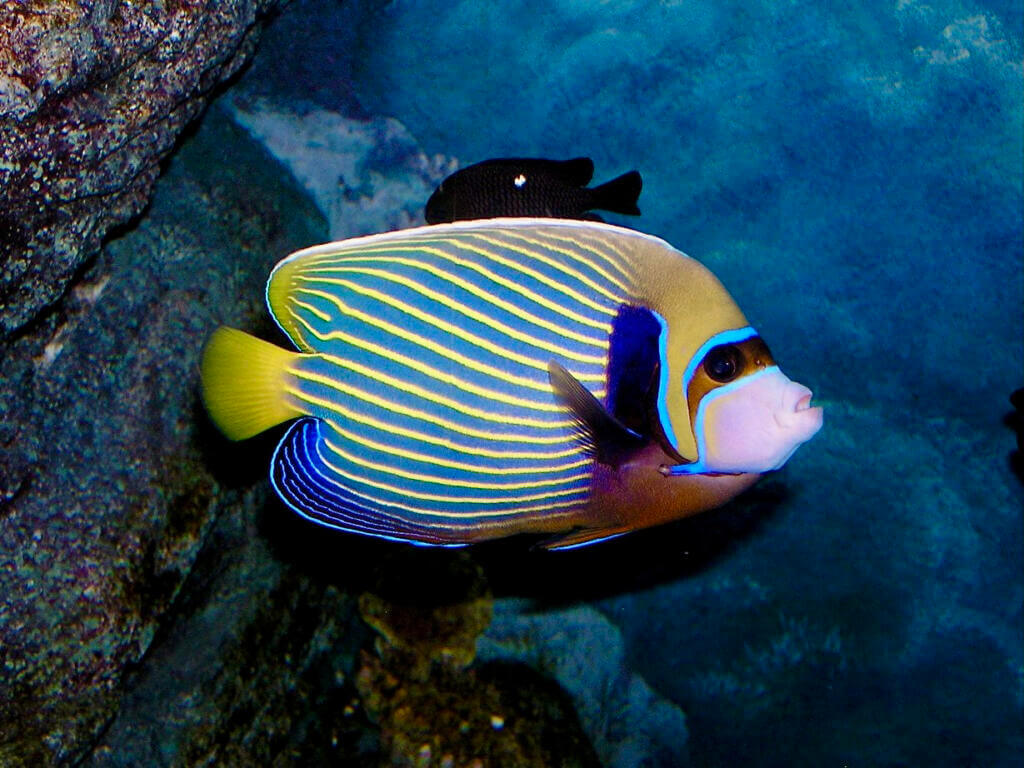
The genus Pomacanthus contains some of the most majestic and colorful fish on the reef. Its name means “spine cover,” referring to the sharp, defensive spine located on its gill cover (operculum), a trait common to all angelfish. The most remarkable feature of this genus is the stunning transformation its members undergo from youth to adulthood. Juveniles have completely different, often dark bodies with electric blue and white rings, a pattern that changes dramatically into the distinct coloration of the adult.
These angelfish have deep, laterally compressed bodies that are perfectly adapted for maneuvering through the complex structures of a coral reef. They are primarily grazers, using their small mouths and brush-like teeth to feed on sponges, algae, and tunicates. Many species are known to form long-term, monogamous pair bonds, with the pair working together to defend a large territory on the reef.
Paracanthurus (Blue Tang)
Habitat: Coral reefs throughout the Indo-Pacific region.
Size: Can grow up to 12 inches in length.
Conservation Status: Least Concern (LC) by the IUCN.
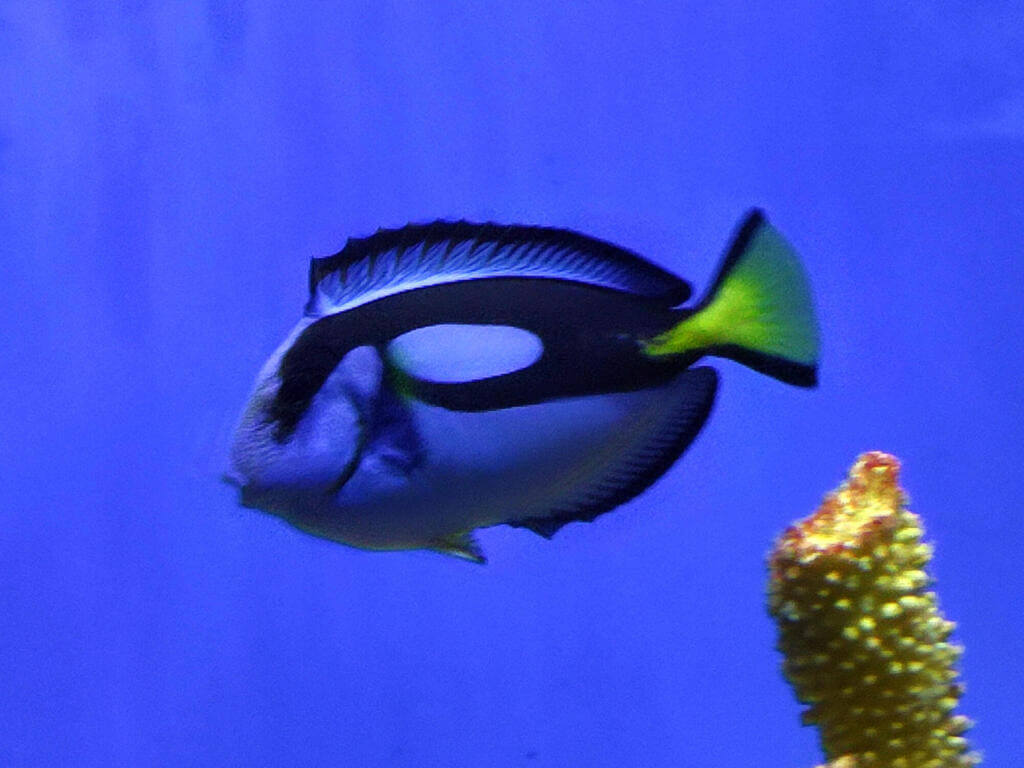
The genus Paracanthurus contains only one species, Paracanthurus hepatus, but it is one of the most recognizable reef fish in the world, largely thanks to its starring role in popular animated movies. Its iconic coloration features a vibrant, electric blue body, a bold black pattern that resembles a painter’s palette, and a bright yellow tail. Its scientific name means “near-Acanthurus,” linking it to its close relatives, the other surgeonfish.
Like all surgeonfish, its primary defense is a pair of razor-sharp, venomous spines located at the base of its tail. These “caudal scalpels” can be flicked outwards to inflict deep cuts on predators. When threatened, the Blue Tang will often dive into a crevice and wedge itself in by extending these spines. As a crucial member of the reef ecosystem, it is an important algae grazer, using its small mouth to keep algae from overgrowing and smothering the coral.
Pterophyllum (Freshwater Angelfish)
Habitat: Slow-moving rivers and floodplains of the Amazon River Basin.
Size: Up to 6 inches long and 10 inches tall (including fins).
Conservation Status: Not formally evaluated, but widespread in the aquarium trade.
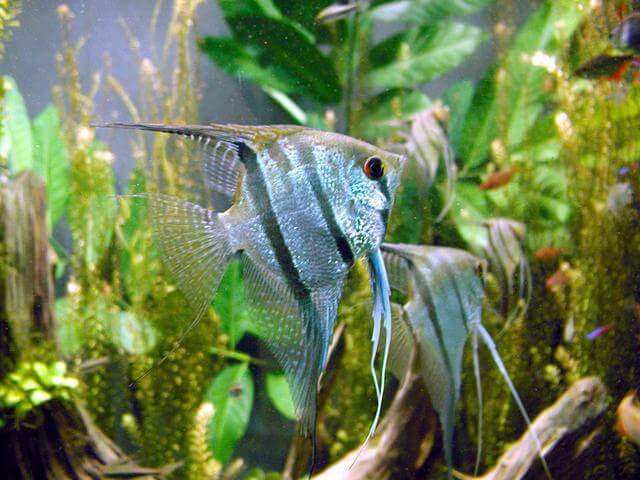
The genus name Pterophyllum is Greek for “winged leaf,” a beautiful and accurate description of this fish’s iconic shape. Its highly compressed, diamond-shaped body and long, graceful dorsal and anal fins give it a leaf-like appearance, allowing it to blend in among aquatic plants. This elegant form has made it one of the most popular and recognizable fish in the aquarium hobby for over a century.
Despite its serene appearance, it is a true cichlid, known for its complex social behaviors. They form long-term, monogamous pair bonds and exhibit dedicated parental care, with both parents cleaning a spawning site and aggressively guarding their eggs and fry. They are ambush predators, using their thin profile to sneak up on small crustaceans and insects.
Other Fish Species That Start with P
- Pacific Albacore (Thunnus alalunga)
- Pacific Fat Sleeper Goby (Dormitator latifrons)
- Pacific Hake (Merluccius productus)
- Pacific Herring (Clupea pallasii)
- Pacific Salmon (Oncorhynchus)
- Pacific Saury (Cololabis saira)
- Pacific Sierra (Scomberomorus sierra)
- Pacific Viperfish (Chauliodus macouni)
- Palembang Pufferfish (Pao palembangensis)
- Pancake Batfish (Halieutichthys aculeatus)
- Panda Corydoras (Corydoras panda)
- Paradise Fish (Macropodus opercularis)
- Parambassis ranga (Glass Fish)
- Parore (Girella tricuspidata)
- Parrot Cichlid (Hoplarchus psittacus or hybrid “Blood Parrot”)
- Parrotfish (Scarus frenatus)
- Pastel Cichlid (Pelvicachromis sacrimontis)
- Peacock Flounder (Bothus mancus)
- Peacock Goby (Tateurndina ocellicauda)
- Pearl Gourami (Trichopodus leerii)
- Pearl Perch (Glaucosoma magnificum)
- Pearl Roach (Rutilus rutilus var.)
- Pearleye (Benthalbella infans)
- Pearlfish (Echiodon rendahli)
- Pelagic Cod (Melanonus gracilis)
- Pelican Eel (Eurypharynx pelecanoides)
- Pepper Tetra (Axelrodia riesei / variant)
- Peters’ Elephantnose Fish (Gnathonemus petersii)
- Pickerel (Esox cisalpinus)
- Pigfish (Bodianus unimaculatus)
- Pike Conger (Congresox talabon)
- Pikeblenny (Emblemaria atlantica)
- Pilchard (Dussumieria acuta)
- Pilot Fish (Naucrates ductor)
- Pineapplefish (Cleidopus gloriamaris)
- Pineconefish (Monocentris japonica)
- Pingi logsucker (Garra pingi pingi)
- Píntano (Abudefduf sordidus)
- Pipefish (Syngnathoides biaculeatus)
- Platydoras armatulus (Talking Catfish)
- Plownose Chimaera (Callorhinchus milii)
- Poacher (Aspidophoroides monopterygius)
- Polli Marbled Bichir (Polypterus polli)
- Pomfret (Brama brama)
- Pompano (Trachinotus carolinus)
- Pompano Dolphinfish (Coryphaena equiselis)
- Ponyfish (Eubleekeria splendens)
- Popeye Catalufa (Pristigenys serrula)
- Porbeagle Shark (Lamna nasus)
- Porcupinefish (Diodon nicthemerus)
- Porgy (Diplodus vulgaris)
- Pasionis Cichlid (Hypsophrys nicaraguensis / uncertain ID)
- Penguin Tetra (Thayeria boehlkei)
- Prickleback (Cebidichthys violaceus)
- Pricklefish (Stephanoberyx monae)
- Prickly Shark (Echinorhinus cookei)
- Prowfish (Zaprora silenus)
FAQs
Are there any ‘P’ fish that can “walk”?
Yes, in a way. The mudskipper genus Periophthalmus is a type of amphibious fish that uses its strong, modified pectoral fins to “walk,” crawl, and hop across mudflats when the tide is out. This allows it to hunt for insects and other invertebrates on land, a truly unique lifestyle for a fish.
Are Piranhas really the most dangerous ‘P’ fish to humans?
No. While a Piranha bite is serious, they rarely attack humans unless provoked or in times of extreme drought. The most dangerous ‘P’ fish to eat is the Pufferfish, which contains a deadly neurotoxin. In terms of unprovoked attacks, the Porbeagle Shark, a relative of the great white, is a large and powerful predator that poses a much more significant, though still very rare, threat.
How do different ‘P’ fish use camouflage to survive?
They use opposite strategies. The Pike is a master of ambush camouflage, using its mottled green coloration to blend in perfectly with aquatic weeds while it waits for prey. In contrast, the Parrotfish uses “disruptive” camouflage; its vibrant, multi-colored patterns break up the outline of its body, making it difficult for a predator to recognize its shape against a complex coral reef
How do different ‘P’ fish protect their young?
They show a wide range of parenting styles. The Peacock Cichlids of Africa are famous mouthbrooders, with the female holding the eggs and young fry in her mouth for protection. In contrast, the Parrotfish offers no parental care at all; it is a broadcast spawner, releasing its eggs and sperm into the water column to drift away and fend for themselves.
Why are some ‘P’ fish so important for the health of their entire ecosystem?
They act as “keystone species.” The Parrotfish is vital for coral reefs because its grazing on algae prevents the coral from being smothered, and its digestion of coral rock creates new sand. In freshwater, the Pike is an apex predator that controls the populations of smaller fish, preventing any one species from becoming overabundant and ensuring the overall balance of the lake’s food web.


