

This is the most exclusive club in the aquatic alphabet, a small but regal cast of characters that each commands attention. It’s home to the stunning Queen Angelfish, a true jewel of the coral reef, and the colossal Queensland Grouper, the largest bony fish on any reef.
Continue reading to explore the rare and remarkable species that make up this quiet corner of ichthyology.
Common Fish Names That Start With Q
This section features fish recognized by their common names, often inspired by their distinctive looks or special traits.
Queen Angelfish (Holacanthus ciliaris)
Habitat: Coral reefs in the warm waters of the Western Atlantic Ocean, from Florida to Brazil.
Size: Can grow up to 18 inches in length.
Conservation Status: Least Concern (LC) by the IUCN.
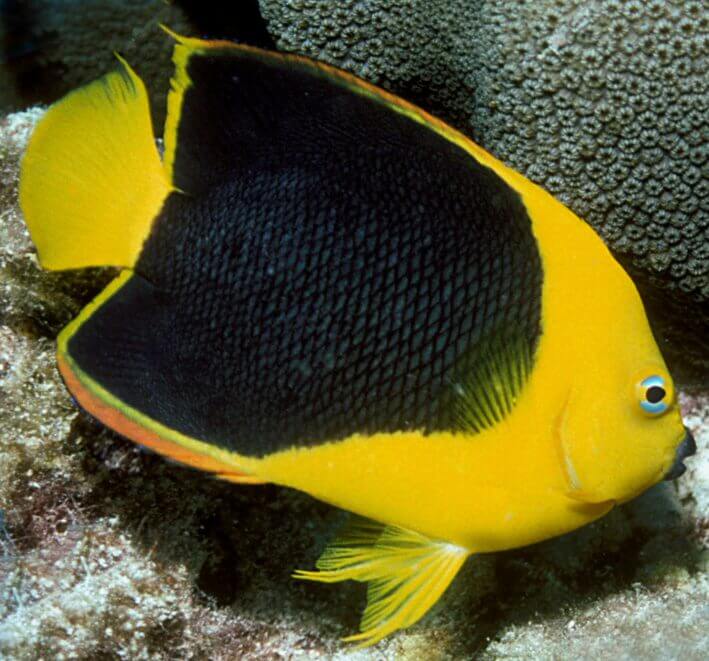
The Queen Angelfish is one of the most beautiful and sought-after fish on the reef, earning its royal title from a distinctive, dark circular spot on its forehead that is ringed in electric blue, resembling a royal crown. Its body is a dazzling mix of vibrant yellow and iridescent blues, making it a breathtaking sight for divers. As a grazer, it plays a vital role in reef health by using its small, brush-like teeth to feed primarily on sponges, which helps prevent them from overgrowing the coral.
This species undergoes a dramatic transformation from youth to adulthood. Juveniles look completely different, with a dark blue body covered in bright, vertical blue bars. Like many large angelfish, they are known to form long-term, monogamous pair bonds, with the pair working together to defend a large territory on the reef. Their deep, laterally compressed body is perfectly adapted for maneuvering with grace and precision through the complex structures of their coral kingdom.
Quillback (Carpiodes cyprinus)
Habitat: Freshwater rivers and lakes, particularly the Mississippi River and Great Lakes basins of North America.
Size: Typically 1 to 2 feet long, weighing 2 to 4 pounds.
Conservation Status: Least Concern (LC) by the IUCN.

The Quillback, also known as the Quillback Carpsucker, gets its name from its most defining feature: a very long, quill-like ray at the front of its dorsal fin. This prominent spine gives the fish a unique silhouette as it moves through the water. As a member of the sucker family, it has a subterminal mouth (located on the underside of its head) which it uses to forage along the riverbed.
This hardy native species plays an important ecological role as a bottom dweller. It sifts through sand and mud, using its protrusible mouth to vacuum up algae, detritus, and small invertebrates. While not a popular sport fish, it is a crucial part of the food web, serving as a food source for larger predators. Its ability to tolerate a wide range of water conditions has allowed it to thrive in many North American river systems.
Queensland Grouper (Epinephelus lanceolatus)
Habitat: Coral reefs, estuaries, and wrecks throughout the Indo-Pacific region.
Size: The largest bony fish on coral reefs, growing up to 9 feet long and weighing over 880 pounds.
Conservation Status: Vulnerable (VU) by the IUCN due to overfishing.
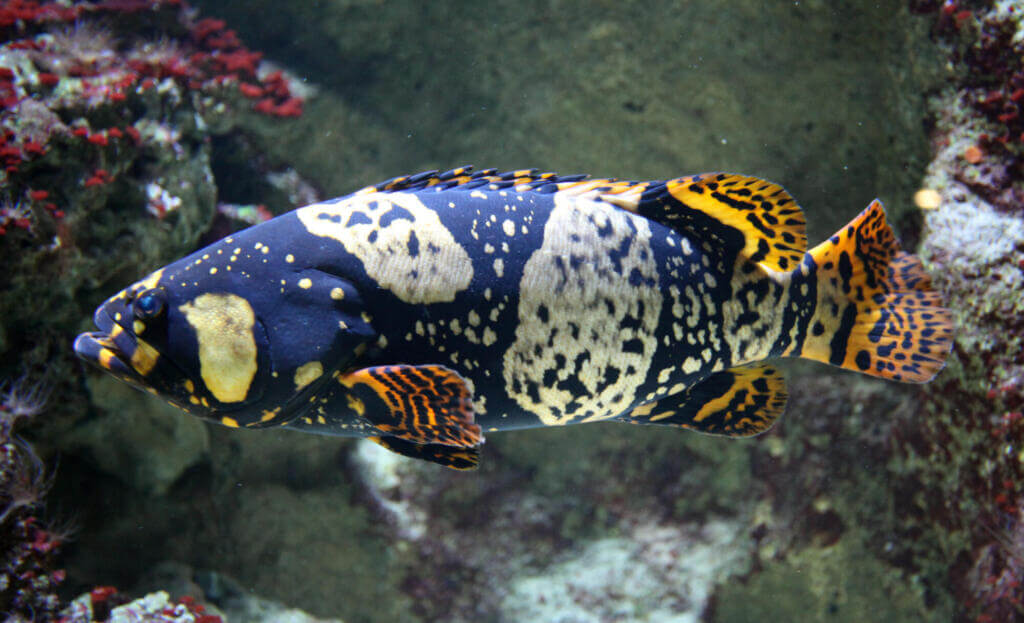
The Queensland Grouper, also known as the Giant Grouper, is a true behemoth and the undisputed apex predator of its reef environment. It has a massive, stocky body and a cavernous mouth capable of swallowing prey, including small sharks and sea turtles, whole. As a classic ambush predator, it often lurks in caves or near wrecks, using its mottled brown and yellow coloration as camouflage before lunging with surprising speed.
This giant’s life history makes it particularly susceptible to population decline. It is extremely slow-growing and long-lived, not reaching sexual maturity for many years. This, combined with its predictable spawning aggregations, has made it an easy target for overfishing, leading to its vulnerable status. As a keystone species, its presence is vital for maintaining the balance of the entire reef ecosystem.
Scientific Fish Names That Start With Q
This is the rarest category of all, as not many scientific genera in ichthyology have been studied that begin with the letter ‘Q’.
Quassiremus (Snake Eels)
Habitat: Sandy and muddy bottoms in shallow, warm waters of the Atlantic and Pacific Oceans.
Size: Typically 1 to 3 feet in length.
Conservation Status: Most species are listed as Least Concern (LC).
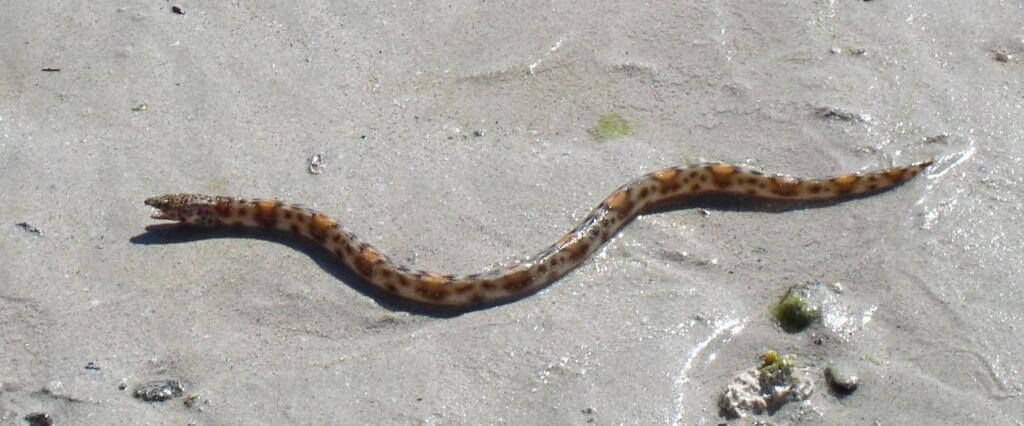
The genus Quassiremus contains a group of eels commonly known as snake eels. Their most remarkable adaptation is their ability to burrow tail-first into the sand with incredible speed. Unlike other eels, they have a hard, pointed tail tip that is free of fins, which acts like a powerful digging tool, allowing them to disappear into the substrate in seconds.
This burrowing skill is central to their survival as nocturnal ambush predators. They spend their days completely hidden beneath the sand, often with their heads and eyes exposed. At night, they emerge to hunt for small fish and crustaceans. Their long, slender, snake-like body is perfectly suited for this cryptic lifestyle, allowing them to navigate through the water and within the sandy seafloor.
Other Fish Species That Start with Q
- Quagga Catshark (Halaelurus quagga)
- Quagga Goby (Knipowitschia cameliae or related species)
- Qianlabeo striatus (Qianlabeo striatus)
- Quadratus nelsoni (Quadratus nelsoni)
- Quen Coris (Coris formosa)
- Queen Danio (Devario regina)
- Queen Loach (Botia dario)
- Queen Parrotfish (Scarus vetula)
- Queen Snapper (Etelis oculatus)
- Queen Triggerfish (Balistes vetula)
- Queensland Blenny (Ecsenius mandibularis)
- Queensland Cusk (Sirembo jerdoni – often cited as Queensland cusk)
- Queensland Deepwater Skate (Zearaja maugeana or related skates)
- Queensland Halibut (possibly Psettodes erumei, name usage uncertain)
- Queensland Lungfish (Neoceratodus forsteri)
- Queensland Mountain Trout (likely local name for Galaxias sp.,)
- Queensland Pygmy Goby (Eviota queenslandica)
- Queensland Sawfish (Pristis zijsron or Pristis microdon)
- Queensland School Mackerel (Scomberomorus queenslandicus)
- Queensland Stinkfish (Callionymus queenslandicus)
- Queensland Triangular Batfish (Platax teira)
- Queensland Trumpeter (Latris lineata)
- Queensland Yellowtail Angelfish (Chaetodontoplus meredithi)
- Quillback Rockfish (Sebastes maliger)
- Quillfin Blenny (Labrisomus conditus)
- Quillfish (Ptilichthys goodei)
- Quilon Electric Ray (Narcine brunnea)
- Quoy’s Garfish (Hyporhamphus quoyi)
- Quoy’s Parrotfish (Scarus quoyi)
- Quetzal Cichlid (Vieja melanurus, sometimes called quetzal cichlid)
- Querimana Silverside (Atherinomorus lacunosus)
FAQs
Why are there so few fish names that start with ‘Q’?
The letter q is one of the least used letters in the English language, which is why very few common names for fish begin with it. It is also rare in the classical Latin and Greek languages used for scientific classification, making genera that start with ‘Q’ extremely uncommon in all fields of biology, including ichthyology.
What is the largest fish that starts with ‘Q’?
The largest fish by far is the Queensland Grouper. It is the biggest bony fish found on coral reefs anywhere in the world, capable of growing to a massive 9 feet in length and weighing over 880 pounds, making it a true giant of the ocean.
Are there any ‘Q’ fish that live in freshwater?
Yes. While the most famous ‘Q’ fish live in the ocean, the Quillback is a hardy fish found in the large river systems of North America. In the aquarium hobby, the Queen Danio from Thailand is also a popular freshwater species known for its active nature and attractive pattern.


