
Sea snakes are a fascinating group of reptiles uniquely adapted to marine life. These serpents prefer warm tropical and subtropical waters worldwide. Sea snakes comprise two distinct groups:
- true sea snakes, which spend most of their lives at sea, and
- sea kraits, which alternate between land and sea.
Though both venomous, sea serpents are typically non-aggressive towards humans and prefer to avoid encounters.
Yellow-Bellied Sea Snake (Hydrophis platurus)
Habitat: Tropical pelagic waters of the Indian and Pacific oceans.
Unique Characteristic: The most widespread oceanic snake, never setting foot on land.

The Yellow-Bellied Sea Snake is a striking marine reptile with a black upper body and vivid yellow underside. Its paddle-shaped tail helps it navigate the open ocean, where it spends its entire life. This moderately-sized snake averages 60 cm but is capable of reaching a meter in length. It is an adept swimmer and diver, often found drifting on currents or hunting among floating debris.
While its venom is potent, it’s generally docile towards humans. Occasionally, sick individuals wash ashore, their distinctive coloration making them easy to identify. Like most sea snakes, they give birth to live young, ensuring the continuation of their pelagic lineage.
Olive Sea Snake (Aipysurus laevis)
Habitat: Coral reefs of the Indian and Pacific Oceans.
Unique Characteristic: Light sensors on its tail keep this night hunter hidden during daytime.
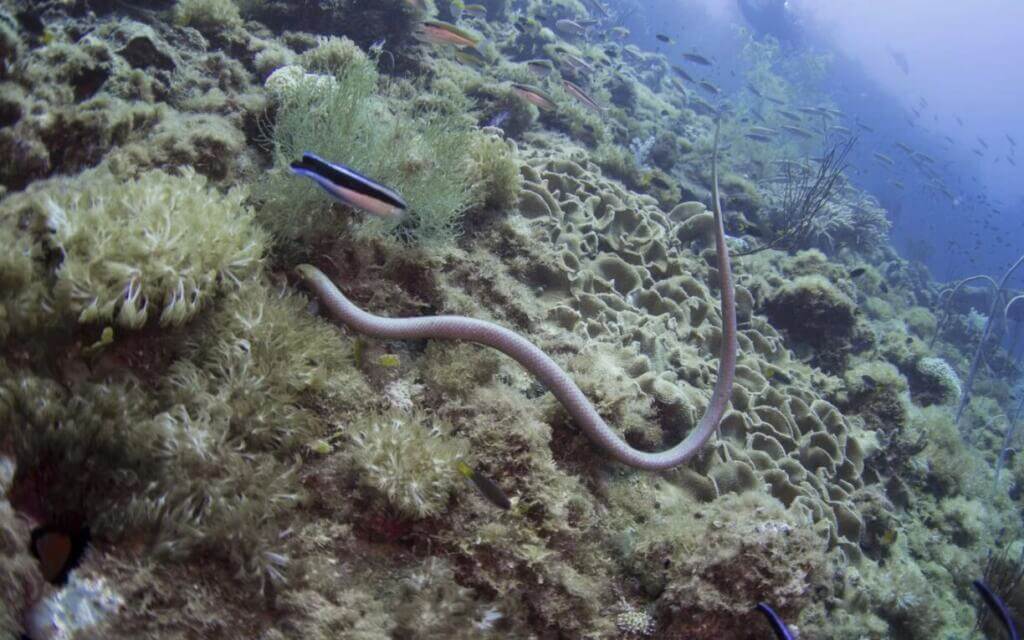
The Olive Sea Snake is endemic to the coral reefs of the Indian and Pacific Oceans in Western Australia, Papua, Maluku, New Caledonia, and Papua New Guinea. It reaches up to 2 meters in length and blends seamlessly with its surroundings. It is nocturnal in nature, hunting small to medium-sized fish, prawns, and crabs. During the day, it retreats to its hiding places, emerging only for occasional breaths.
It can dive to over 70 meters deep, but typically resides in shallower reef flats. It gives birth to live young, which are darker in color than adults. Interestingly, it sheds its skin by rubbing against coral or rocks, aiding growth and removing marine organisms.
Spine-Bellied Sea Snake (Hydrophis curtus)
Habitat: Coastal areas between Exmouth and Broome in Western Australia.
Unique Characteristic: Found in freshwater habitats as it occasionally travels up rivers.
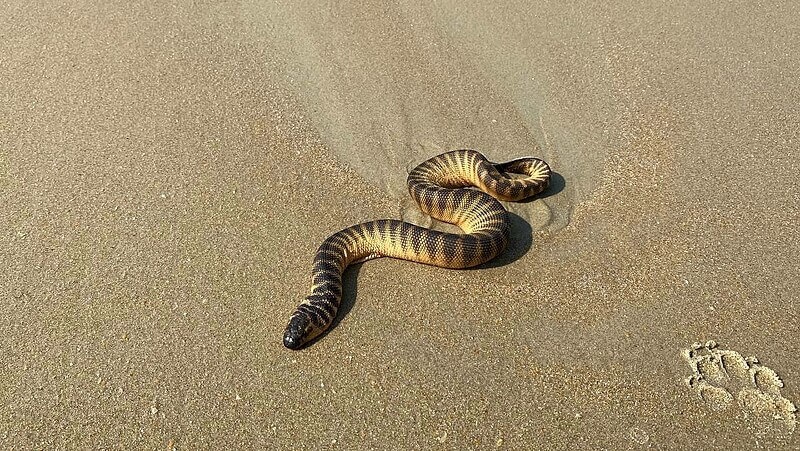
The Spine-Bellied Sea Snake is recognized by its unique spiny belly scales and a distinctive banded pattern. It’s pale to dark olive-grey body contrasts with a cream underside. It exhibits significant size dimorphism, with females growing larger than males. Though venomous, this species is generally non-aggressive towards humans.
It can be found in shallow tropical waters of the Indian and Pacific Oceans, preferring sheltered habitats such as gulfs, bays, estuaries, and seagrass beds near coral reefs. Pregnant females are known to congregate in sheltered areas like bays and estuaries during specific seasons. An opportunistic feeder, it preys on fish, squid, and crustaceans, typically at depths of 4 to 40 meters, though it has been observed as deep as 55 meters.
Black-Banded Sea Krait (Laticauda semifasciata)
Habitat: Tropical waters of the Western Pacific Ocean, favoring coastal areas, coral reefs, and rocky shorelines.
Unique Characteristic: The most aquatic of the amphibious sea kraits.
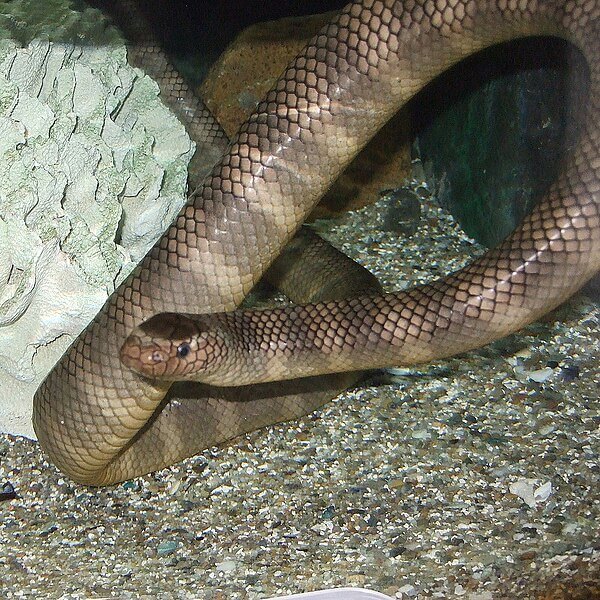
The Black-Banded Sea Krait, unlike most sea snakes, is amphibious and ventures ashore to lay its eggs. It inhabits warm tropical waters of the Western Pacific Ocean, favoring coastal areas, coral reefs, and rocky shorelines within the Coral Triangle and the Sea of Japan.
These sea kraits are nocturnal predators, primarily feeding on fish families such as Rubyfishes, Surgeonfishes, and Damselfishes. They are slow swimmers and rely on ambush tactics within coral reefs to capture their prey. Notably, they sometimes engage in coordinated communal hunting with other sea kraits and fish species like Yellow goatfish and Bluefin trevally.
Black-banded sea kraits are highly venomous, with venom ten times stronger than a cobra’s. However, they are generally docile and avoid confrontation unless provoked.
Beaked Sea Snake (Hydrophis schistosus)
Habitat: Throughout the tropical Indo-Pacific in diverse shallow-water habitats.
Unique Characteristic: Produce large litters and are active during the day and night.

The Beaked Sea Snake is a highly venomous and widespread sea snake found throughout the tropical Indo-Pacific. It thrives in diverse shallow-water habitats, including estuaries, mangrove forests, and coral reefs. They are active during the day and night. While they are venomous and known to be aggressive, most bites occur when they are accidentally caught in fishing nets.
They have a distinctive elongated snout and are typically dark grey above with whitish undersides. Younger individuals may exhibit black bands across their bodies. They are large, growing over 1 meter in length. They are prolific breeders, with females capable of producing large clutches of up to 30 or more offspring. Their diet consists mainly of fish, particularly catfish.
Turtle-Headed Sea Snake (Emydocephalus annulatus)
Habitat: Tropical waters of the Pacific and Indian Oceans, typically less than 15 meters deep.
Unique Characteristic: Completely black in areas with high levels of industrial pollution.

The Turtle-Headed Sea Snake inhabits the tropical waters of the Pacific and Indian Oceans. It prefers shallow coastal waters, typically less than 15 meters deep, though it has been observed at depths up to 40 meters. It has a short and blunt head, resembling that of a turtle. It is typically black or dark grey with creamy white to yellow bands. Interestingly, in polluted areas like New Caledonia, most individuals are entirely black, possibly due to industrial pollution.
Its diet consists almost exclusively of fish eggs, particularly those of blennies, gobies, and coral fish. It locates these eggs by scent and carefully navigates through coral reefs in search of its prey. Using enlarged scales on its upper lip, it scrapes fish eggs off from coral and rocks. Often living in groups, these oceanic snakes may congregate at specific coral outcrops, sometimes alongside other sea snake species.
Brown-Lined Sea Snake (Aipysurus tenuis)
Habitat: Northwestern Australian coast from Dampier to Broome.
Unique Characteristic: Historical range may have included the Arafura Sea.
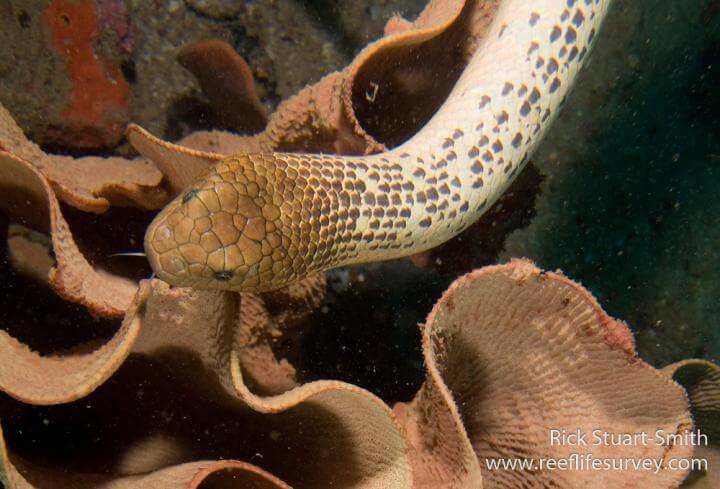
The Brown-Lined Seasnake (formerly known as the Arafura Sea Snake), is distinguished by its brown head, paler body, and dark brown pattern across its body. It reaches up to 1.3 meters in length and typically feeds on fish and fish eggs.
While its historical range may have included the Arafura Sea, current understanding suggests its distribution is limited to the northwestern Australian coast from Dampier to Broome. Not much is known about this species which is listed as “Data Deficient” on the IUCN Red List of Threatened Species.
Spiny-Headed Sea Snake (Acalyptophis peronii)
Habitat: Coastal waters of northern Australia and Southeast Asia.
Unique Characteristic: Irregular head scales and spiny projections above eyes.
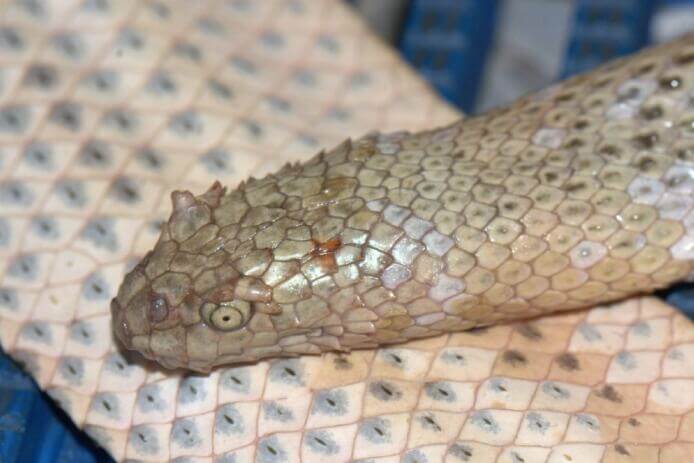
The Spiny-Headed Sea Snake is moderately built, growing up to one meter in length. Its body coloration varies from cream and grey to pale brown, adorned with 25-30 dark cross-bands. The head shields are irregular and fragmented, with the scales above the eyes forming prominent spines, a characteristic more pronounced in adults.
This oceanic snake has a wide but disjunct distribution, occurring in both the northern and southern hemispheres. It inhabits the coastal waters of northern Australia and Southeast Asia. This species prefers soft, sandy habitats near coral reefs and can be found in both shallow waters and depths of up to 60 meters. They are often observed foraging on the seafloor for their primary prey, gobies, which they extract from their burrows.
Short-Nosed Sea Snake (Aipysurus apraefrontalis)
Habitat: Coastal areas between Exmouth and Broome in Western Australia.
Unique Characteristic: Twilight zone offers refuge from shallow-water threats.
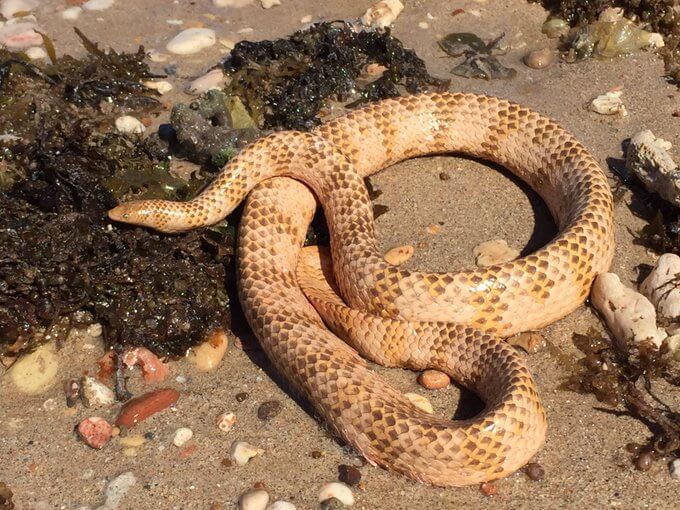
The Short-Nosed Sea Snake is a small to medium-sized species, reaching up to approximately 1 meter in length. Its light brown body is marked with darker crossbands, and its pointed snout is a key identifying feature. They feed mostly on small fish and eels, foraging in coral reefs and other shallow-water habitats.
It was once believed to be restricted to the shallow waters of Ashmore and Hibernia Reefs. Although historically abundant, it is now considered locally extinct in those areas due to habitat degradation and other factors. However, it is now known to inhabit coastal areas between Exmouth and Broome in Western Australia. The status of the newly discovered coastal populations remains uncertain, but they appear relatively abundant in trawl fishery bycatch in the Exmouth Gulf.
Annulated Sea Snake (Hydrophis cyanocinctus)
Habitat: Coral reefs across the Indian and Pacific Oceans.
Unique Characteristic: Breathes through its forehead to deliver oxygen to its brain.
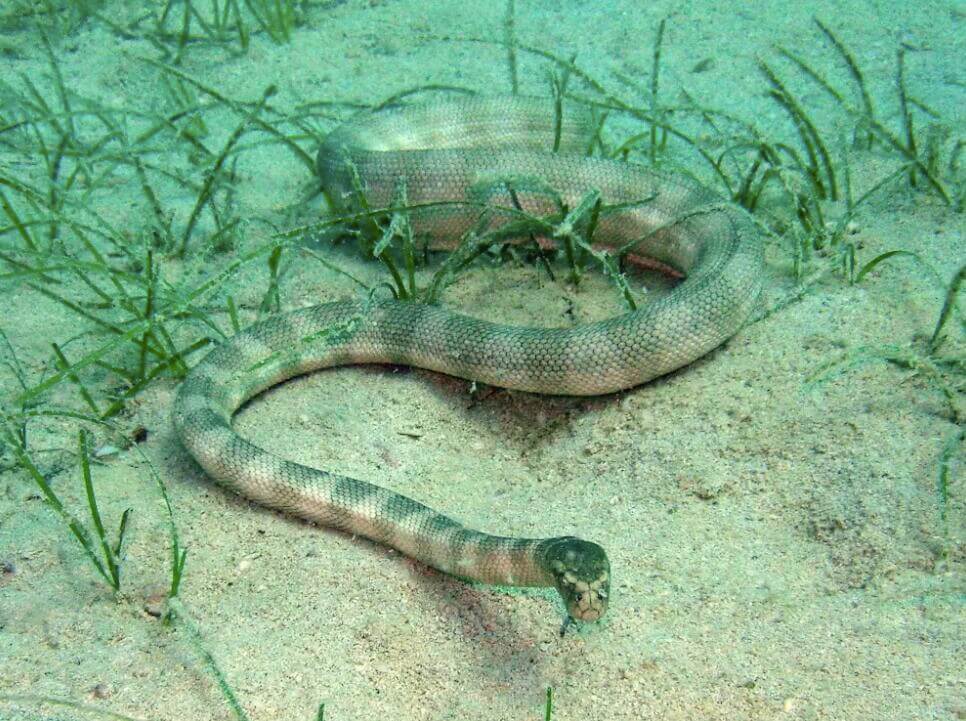
The Annulated Sea Snake is a large species capable of reaching lengths of up to 3 meters. It is recognized by thick, dark bands that run down the length of its cream-to-brown body. It inhabits coral reefs across the Indian and Pacific Oceans, including the Arabian Gulf east to Indonesia, the Philippines, and possibly Japan, reaching south to northern Australia and Papua New Guinea.
It prefers shallow seas with muddy bottoms, at depths not exceeding 30 meters. It is often observed in turbid water and has been documented in mangrove swamps during the monsoon season. This species mainly feeds on eels, though its diet also includes gobies and marine invertebrates. It’s behavior and habits remain largely elusive.
Ocean Insights: Hear From Our Experts

By Dr. Rabiah Ryklief
Principal Scientist and Lecturer of Marine Science, with a PhD in Zoology
Sea snakes face a unique challenge in their marine habitat: they can't drink seawater. Some species, like sea kraits, seek out freshwater on land, drinking from puddles or licking raindrops from leaves. However, a more interesting adaptation involves exploiting a temporary phenomenon known as "freshwater lenses". After a rain shower, these temporary layers of freshwater form on the ocean surface, offering a vital source of hydration. Sea snakes then actively seek out and drink from these lenses before they dissipate into the surrounding saltwater.
FAQs
Do sea snakes breathe underwater?
Sea snakes must surface periodically to breathe air, but adaptations allow them to stay submerged for long periods. These include large lungs, the ability to absorb some oxygen through their skin, and specialized blood vessels in some species that may help extract more oxygen from the water. While most surface every 30 minutes or so, some can remain underwater for up to eight hours.
Can sea snakes see color?
While most land snakes can only see blue, green, and sometimes ultraviolet light, new research suggests that sea snakes have evolved the ability to perceive a wider range of colors. This enhanced color vision likely developed in response to their bright and colorful marine environment, allowing them to better navigate, find prey, and interact with their surroundings.
How venomous is a sea snake?
Sea snakes are highly venomous, and some species rank among the most venomous snakes on Earth. As an example, the Beaked Sea Snake is considered the most venomous snake in the world. A mere 1.5 milligrams of its venom is estimated to be lethal enough to kill 22 people.
How are sea snakes different from terrestrial snakes?
Terrestrial snakes live on land and are adapted for movement on solid surfaces, while sea snakes are specialized for life in water, with paddle-like tails for swimming and the ability to hold their breath for extended periods. Sea snakes are also highly venomous and primarily prey on fish, whereas terrestrial snakes have a more varied diet and habitat.


