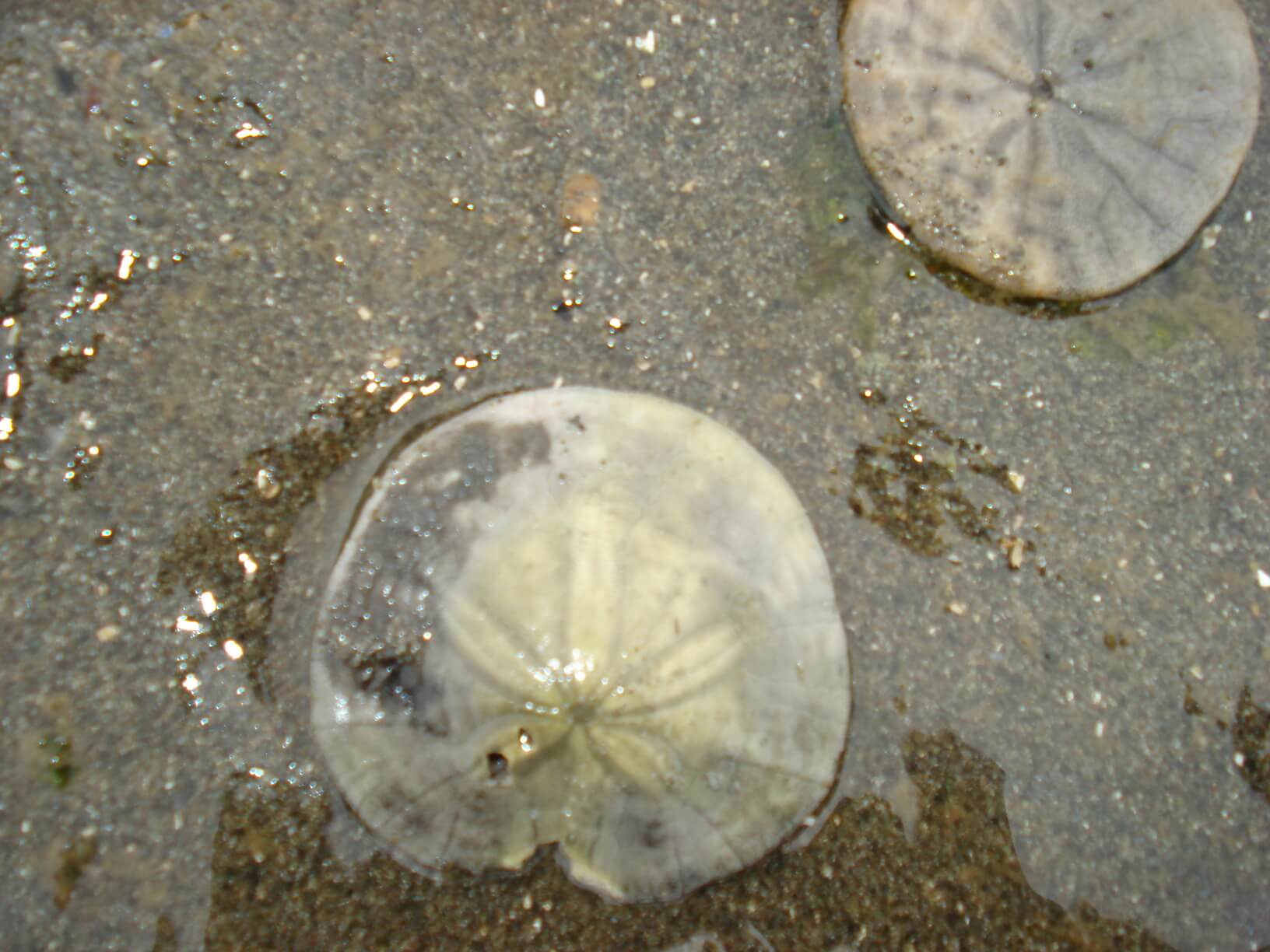

Dendraster excentricus, commonly known as the eccentric sand dollar, Western sand dollar, Pacific sand dollar, Biscuit-urchin, or irregular echinoid, is found in bays of the northeast Pacific coast, from Alaska to Baja California and as far south as San Francisco.
It is part of the Echinoidea class, which includes its cousins in the marine world, the sea urchins (also called the regular echinoids) and sea cucumbers.
Let’s set sail to unlock the captivating secrets of Dendraster excentricus.
Appearance
Sand dollars have a flattened dome covered in tiny spines. They have five arms that are elongated and covered with small, spiny, tube-like feet called pedicellariae. They use these structures to move across the sand (also known as locomotion), attach to surfaces, and capture and manipulate their prey.
The sand dollar is known for its irregular and asymmetrical arm arrangement, which gives it a somewhat lopsided appearance. Their color varies varies from pale grey or tan to shades of purple, green, and brown; the oral side is typically white or light-colored. The arms are also covered with small, overlapping plates that give it a rough, sandpaper-like texture.
They can be aged by counting growth rings on the plates of the test or by counting the pores in a petal of the petalidium
Their mouth includes a small Aristotle’s lantern. The food grooves, anus, and mouth are on the aboral side.

The surface of the sand dollar is adorned with small flower petals, which are areas densely packed with tube feet. These petals not only add to the creature’s unique appearance but also play a crucial role in respiration. The tube feet extract oxygen from water. These creatures display unique behavior, often positioning themselves at an angle with heavy sand grains to stabilize themselves against strong currents.
A fascinating ability to change shape and size
One of their interesting external features is the ability to change shape and size. When buried in the sand, this species can flatten itself out to increase its surface area and make it easier to move through the sand. At the same time, it can also contract its arms and raise its circular body off the sand to create a bowl-shaped carapace that protects it from ocean currents. It has a water-vascular system from the internal cavity that connects with tube feet. Eggs are pale orange and are covered by a thick jelly coat which keeps adults from eating the eggs.
Habitat
Dendraster excentricus is commonly found in open coastal areas. It prefers shallow waters (intertidal zone) and sandy bottom habitats and can be found at a depth of 30 to 90 meters.
Since it’s a burrowing species, it prefers sandy habitats and can be found in places with fine and coarse sand. It’s often found in areas with moderate to intense wave action, and you can see them well during low tide. Due to this, large storms or high temperatures and desiccation can cause mass mortality for the pacific sand dollar.
Interestingly, Dendraster excentricus is the only sand dollar found along the Pacific coast of North America. This distinguishes it from other similar species found in different parts of the world.

Besides, it can tolerate a range of salinity levels. This species can also be found in areas with seagrass beds or kelp forests, where it may feed on small invertebrates that live among the vegetation.
Pacific sand dollars have a heavier skeleton compared to similar species. This denser structure provides stability and helps it stay anchored in sandy or muddy substrates. Unlike many other echinoids, Dendraster excentricus spends its entire life on or under the substrate rather than floating in the water column. This behavior allows it to avoid predators and makes it uniquely adapted to its benthic lifestyle.
Diet
Pacific sand dollars are suspension feeders and an important predator in the intertidal ecosystem.
Their diet primarily consists of algae and plankton, and they also feed on detritus, diatoms, crustacean larvae, small copepods, and small invertebrates such as clams, snails, and other tiny organisms that live in the sand or nearby vegetation.
Their diet can vary depending on the availability of prey in their habitat. In areas with abundant prey, it may consume large numbers of clams or snails. On the other hand, it may feed on a broader range of small prey in other areas.
Predators
Sea gulls and seastar pisaster brevispinus are some of the predators of Dendraster excentricus, particularly during the sand dollar’s juvenile rudiment stage. The juvenile sand dollars, due to their smaller size and softer shells, are more vulnerable to predation than their adult counterparts.

Reproduction
Like other sea stars, Dendraster excentricus mainly reproduces sexually. Parent groups are found as large groups. During late spring and early summer, they reproduce by releasing eggs and sperm into the water through tiny genital pores or gonophores.
During sexual reproduction, males and females release their gametes (sperm and eggs) into the water to form an embryo. Fertilization occurs externally when the female Dendraster discharges the eggs through her gonopores and it is fertilized by the male, who protrudes his genital papilla from his body wall.
The first larval stage of Dendraster excentricus resembles tiny crustaceans and is called prism. After this stage, the embryo develops two arms, transforming into an echinopluteus larva. As they mature, they undergo metamorphosis and develop into the familiar disk-like shape of adult sand dollars. The developed larvae settle on the sea floor. These nektonic larvae then undergo metamorphosis and develop into adult sand dollar form, reaching sizes of up to 20 cm in diameter.
They reach sexual maturity between one and four years of age and can undergo multiple reproductive cycles during this time, producing hundreds of offspring.

Threats
Despite their hard shells, sand dollars are not immune to harm. Predators such as crabs pose a threat, especially to young and dead individuals that lack the protection of live adults.
They face a variety of other threats that impact their survival and abundance. The main causes of death of Dendraster excentricus include:
- Habitat destruction: The destruction of intertidal habitat due to human activities such as development, beach grooming, and dredging directly impacts their population.
- Pollution: Pollution from sources such as oil spills and sewage discharge have toxic effects on the species and their prey.
- Overfishing: Overfishing of the sea star’s prey species can impact the availability of food and negatively affect the sea star population.
- Climate change: Climate change and associated impacts such as ocean acidification, warming waters, and sea level rise disrupt the intertidal ecosystem and impact the distribution and abundance of this creature.
- Disease: Dendraster excentricus is susceptible to wasting, which can cause mass mortality and reduce the species’ population.
Despite the threats it faces, Dendraster excentricus remains an essential component of the intertidal ecosystem and is a fascinating species to observe and study.
6 Curious Facts About the Pacific Sand Dollar
- The growth rings on the plates of a sand dollar symbolizes every year of life. The number of rings increases with body size, meaning the bigger the sand dollar, the older it must be.
- This is the only species of sand dollar found in Washington and Oregon.
- They have very few edible parts because of their hard skeleton. This saves them from having too many predators.
- The species faces various threats that impact its survival and abundance, including habitat destruction, pollution, overfishing, climate change, and disease.
- Dendraster excentricus is found along the western coast of North America, from Alaska to California.
- This species can grow up to 20 centimeters in diameter and has a flattened body with a distinct five-pointed star shape.
FAQs
How can one distinguish between a living and a deceased sand dollar?
Living sand dollars are usually found in the water and have a skin of velvety spines covering their hard shells. If you turn a live sand dollar over, you’ll see these spines moving. On the other hand, deceased sand dollars, often found washed up on the beach, lack this layer of spines and are bleached white or light gray by the sun. The absence of movement and the loss of color are key indicators that the sand dollar is no longer alive.
Can Dendraster excentricus be kept as a pet?
While Dendraster excentricus may be fascinating to observe and study, they are not typically kept as pets. They require specialized environments, feeding regimens, and care. Additionally, collecting them from the wild can negatively impact their populations and the health of the intertidal ecosystem.
Are Dendraster excentricus populations in danger?
Dendraster excentricus populations face various threats that impact their survival and abundance. Some are habitat destruction, pollution, overfishing, climate change, and disease. While the species is not currently listed as endangered or threatened, continued conservation efforts are needed to protect it and the intertidal ecosystem it inhabits.
How do sand dollars filter their food from water?
Sand dollars have tiny, hair-like structures called cilia on their body surface and spines. These cilia move in coordinated waves, creating a current that directs organic particles towards the sand dollar’s mouth located at the center of its body. The food particles are then caught in a sticky mucus layer and the cilia transport these trapped particles along the grooves present on the sand dollar’s body to its mouth.