Feather stars are widespread across the world’s oceans, from shallow reefs to deep-sea environments. They belong to the class Crinoidea, with over 600 species identified. They exhibit remarkable diversity and adaptability, thriving in various marine habitats. Their prevalence underscores their ecological importance, as they contribute significantly to the biodiversity and health of ocean ecosystems.
Known for their delicate, feathery arms that radiate from a central body, they contribute to the underwater aesthetic with their vibrant colors and intricate patterns. Due to their sensitivity to water quality and temperature, feather stars can serve as bioindicators, helping scientists assess the health of marine ecosystems.
Appearance
Feather stars have a unique shape and can be easily identified. These somewhat creepy-looking sea creatures have a central body known as a calyx. The calyx is cup-shaped and holds the mouth of the feather star on the upper side.
On the underside of the calyx, there is an array of tiny arms/ feet known as cirri. These cirri are used to cling to sea sponges, coral, or other hard substrate. The feather star grows feather-like arms with pentameral symmetry, meaning that these arms grow in symmetrical patterns of five, or multiples of five.
Crinoids that remain attached to the sea floor by a stalk in their adult form are commonly called sea lilies, while the unstalked forms, called feather stars.
Although some feather stars have only five arms, some species have many more, with some growing up to 200 individual feathery arms. Each arm is covered in tiny pinnules, which gives it its fern-like appearance. These pinnules are what the organism uses for feeding and movement.

Typically growing between 10-20 cm, but reaching up to 35 cm or more in the largest species (Heliometra glacialis), feather stars can be found in colors ranging from purple, red, black, green, white, orange, yellow, brown, as well as multi-colored individuals.
They form part of a great number of species, and therefore, the physical characteristics can and do differ across the class. They are reasonably vulnerable and rely significantly on their ability to retract their arms and hide in small crevices.
Habitat
They can be found in almost all oceans. They are most commonly spotted in the waters of the Atlantic, Antarctic (Southern Ocean), Indian, and Pacific oceans, but can also be spotted in the tropical waters of the Carrabiean Sea.
The depth range of the feather star is large, with some species making their homes in shallow waters close to the shoreline, while others can be found at depths down to approximately 300,000 feet, extending their range well beyond the continental shelf and into the abyssal zone.

Most of the Comatulida order are benthic and can be found on or close to the seabed, attached to coral and other suitable substrates. There are also pelagic feather star species that live in the open ocean, spanning various depths along the water column.
They tend to hide in cracks and crevices during the daytime, coming out at night to feed. With the deeper species that are found just beyond the continental shelf, individuals can be spotted attached to features such as seamounts, ridges, and underwater caves.
Diet
Feather stars are primarily nocturnal animals that hide from potential predators during the day by attaching themselves to coral reefs with their cirri.
When night falls, these fern-like marine animals crawl out of their hiding spots and extend their feathery arms into the passing currents to capture food.
As suspension feeders, feather stars rely on passing plankton and other micro-organisms to filter through their pinnules, which are covered in mucus that assists with the prey’s capture.
When their prey becomes attached to their pinnules, the animal will retract the arm towards its mouth and remove the organisms before extending its arm again to continue the process.
Although feather stars are mostly stationary, or crawl short distances, they are able to swim by fanning out their arms in a rhythmic pattern. This gives them an alien-like appearance that is captivating to just about anyone who comes across them.
Reproduction
Unlike other echinoderms such as sea stars, feather stars reproduce sexually, and not through cloning. Feather stars and other crinoid species are found in either males or females, with their reproductive organs situated on their pinnules, usually closer to the calyx.

Reproductive gametes are released into the environment where they are fertilized, although some species hold their eggs in sacks or bond them to their arms, although this is most common in species found in colder environments.
When the eggs hatch, free-swimming larvae are released into the water and, after a short period, attach themselves to the ocean floor, where they undergo metamorphosis and develop into stalked juveniles.
The juveniles are fixed to the substrate and are unable to move until they develop into adults. When feather stars reach sexual maturity, they lose their stalks and develop the ability to move along the sea floor and swim.
It takes approximately 12 to 18 months for feather stars to reach sexual maturity and have a life span of several years, with some individuals living for over 15 years, although this will vary depending on the species, as well as their habitat.
Threats
Feather stars don’t have many natural predators. This is mostly due to their calcium carbonate composition (the same that makes up the skeletal structure of coral), which is unappealing to most marine species.
Above their unappealing taste, feather stars are often found at great depths, where other marine life becomes more scarce, thus reducing the number of potential predatory species.
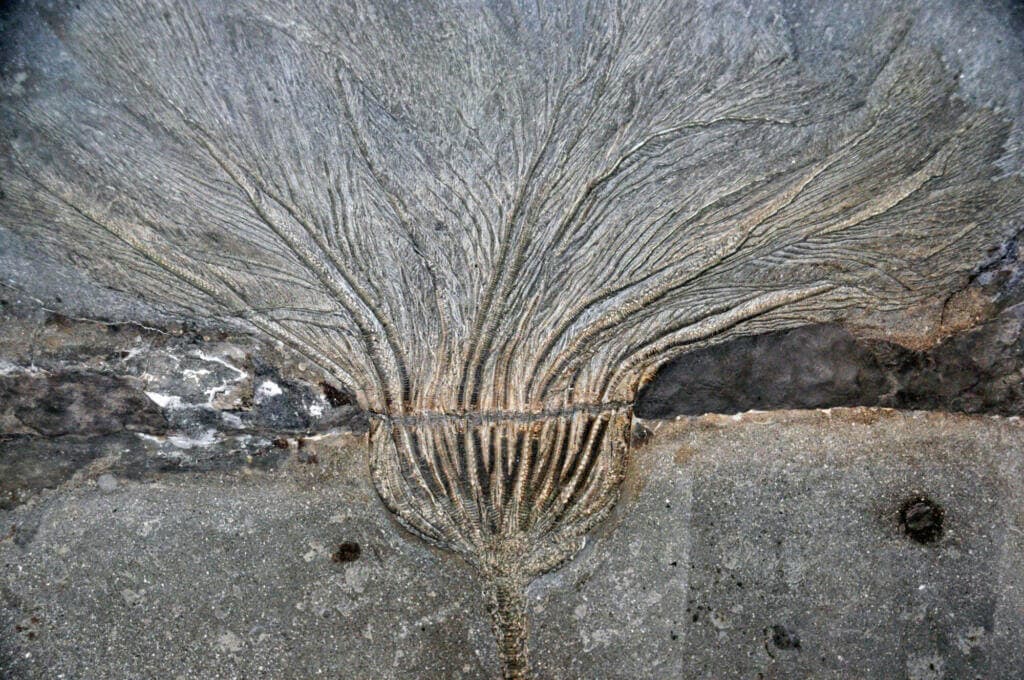
Some predators include sea stars, octopus, squid, nudibranchs, some species of crustations, sea urchins, and fish such as pufferfish, butterflyfish, and wrasse.
6 More Facts About the Feather Star
- Feather stars boast an evolutionary history spanning over 500 million years.
- Their delicate arms, resembling feathers, serve both as graceful extensions and tools for suspension feeding.
- These marine invertebrates often host a variety of small marine organisms, such as shrimp and fish, which find shelter among their arms, benefiting from protection and access to food.
- These marine stars possess impressive regenerative capabilities, able to regrow damaged or broken arm segments, enhancing their resilience in marine ecosystems.
- They are part of Phylum Echinodermata, along with sea urchins, sea stars, brittle stars and sea cucumbers.
- Feather stars are one of the oldest living echinoderms, with origins dating back over 450 million years.
FAQs
Are feather stars related to starfish?
Yes, both feather stars and starfish belong to the phylum Echinodermata, although feather stars belong to the Crinoidea class and have different behaviors and body structures.
Are feather stars important for the marine ecosystem?
Yes, they play a role in nutrient cycling and are part of the biodiversity in coral reefs and deep-sea environments.
Can feather stars be kept in home aquariums?
Feather stars are challenging to keep in home aquariums due to their specific habitat requirements, such as specific water temperatures, light availability, and food sources. That said, they are kept in public research aquariums where the conditions can be closely monitored.
Can feather stars change color like some other marine animals?
Yes, feather stars can exhibit color variation, influenced by their environment, which can serve as a form of camouflage. It is common to see their color fade in the species that are found in deeper oceanic zones.