
The frilled shark, often referred to as a “living fossil,” is a deep-sea predator with an ancient lineage dating back millions of years. Known for its eel-like body and distinctive frilled gills, this elusive creature inhabits the dark depths of the ocean, rarely seen by humans.
Its unique appearance, complete with a long, slender body and rows of needle-like teeth, makes it a fascinating subject for marine biologists. Despite its fearsome look, the frilled shark remains one of the ocean’s most mysterious and intriguing inhabitants, offering valuable insights into the evolution of sharks.
Appearance
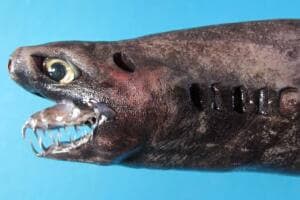
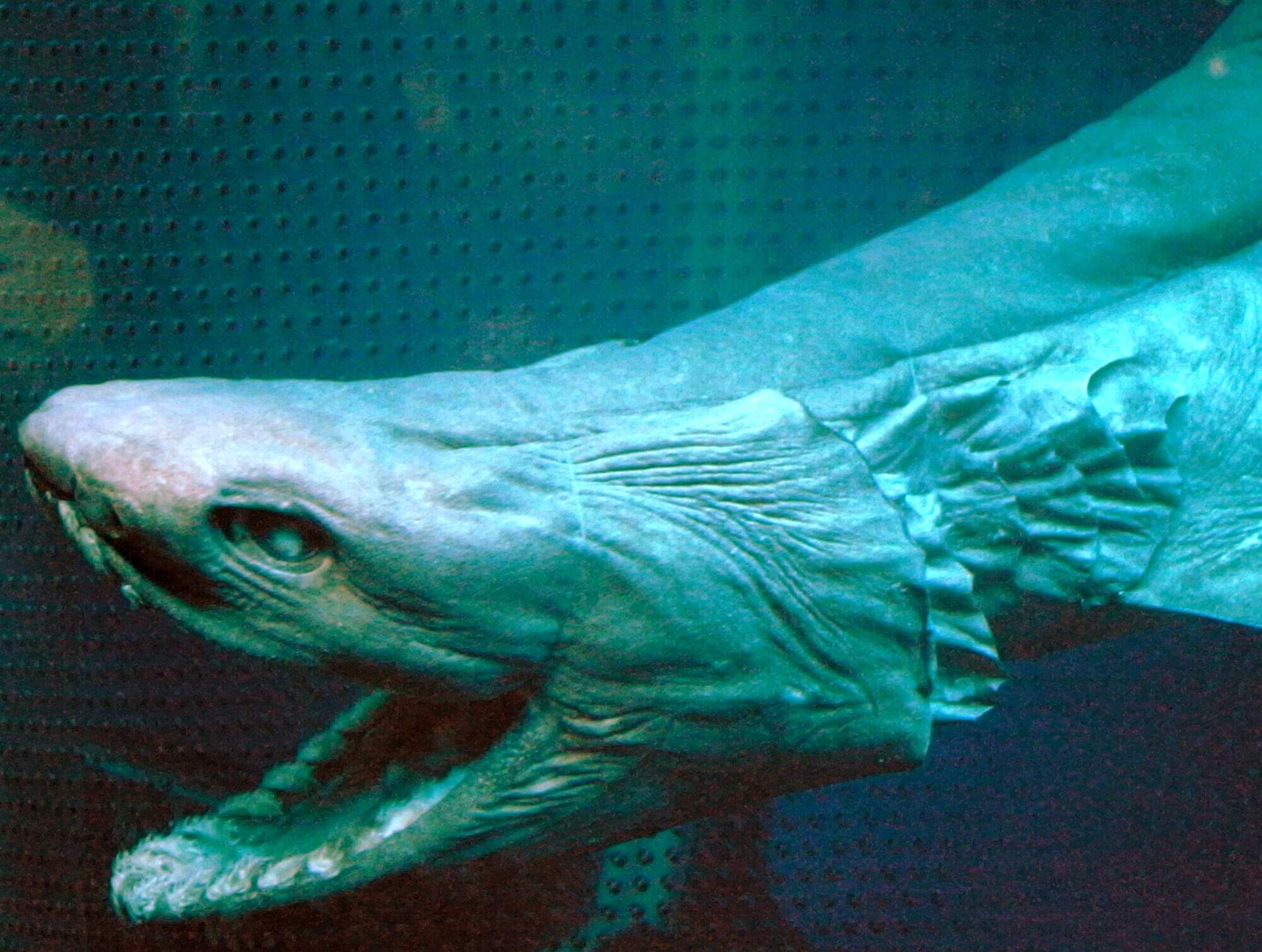
The frilled shark, also known as Chlamydoselachus anguineus has an eel-like body that’s dark brown to grey and amphistyly, referring to the articulation of the jaws to the head. The specimens analyzed by scientists are around 2 meters or 6.6 feet in length. Its pectoral fins are smaller than its pelvic fins.
The name comes from the shape of the six pairs of gill slits along the shark’s throat.
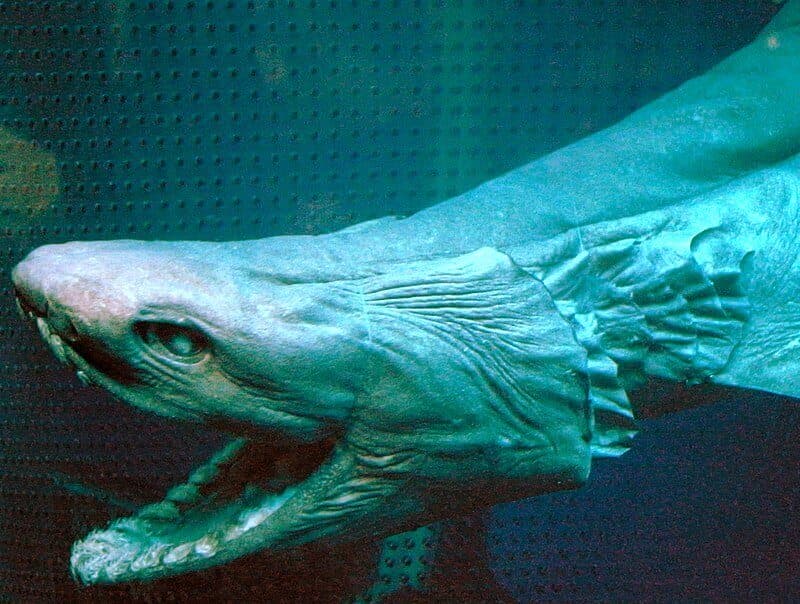
The largest specimen ever discovered was a 6.6 foot long female and 5.6 foot long male.
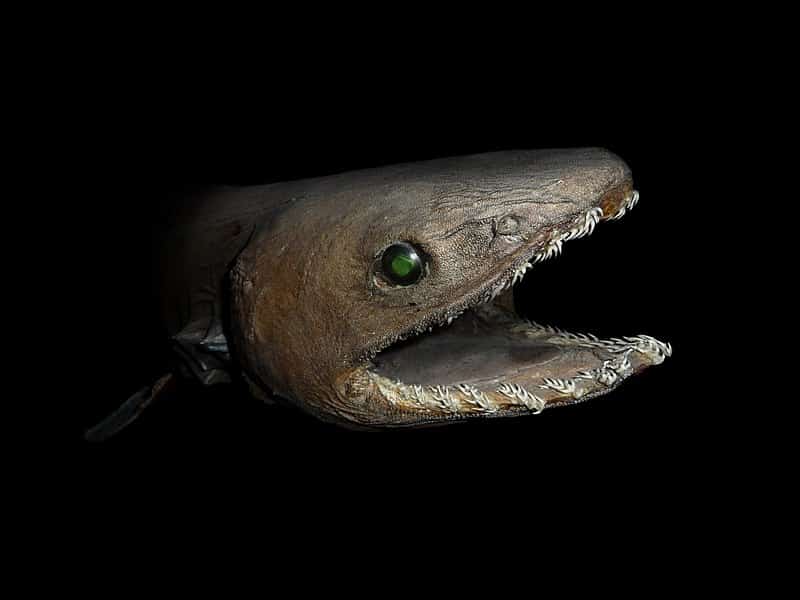
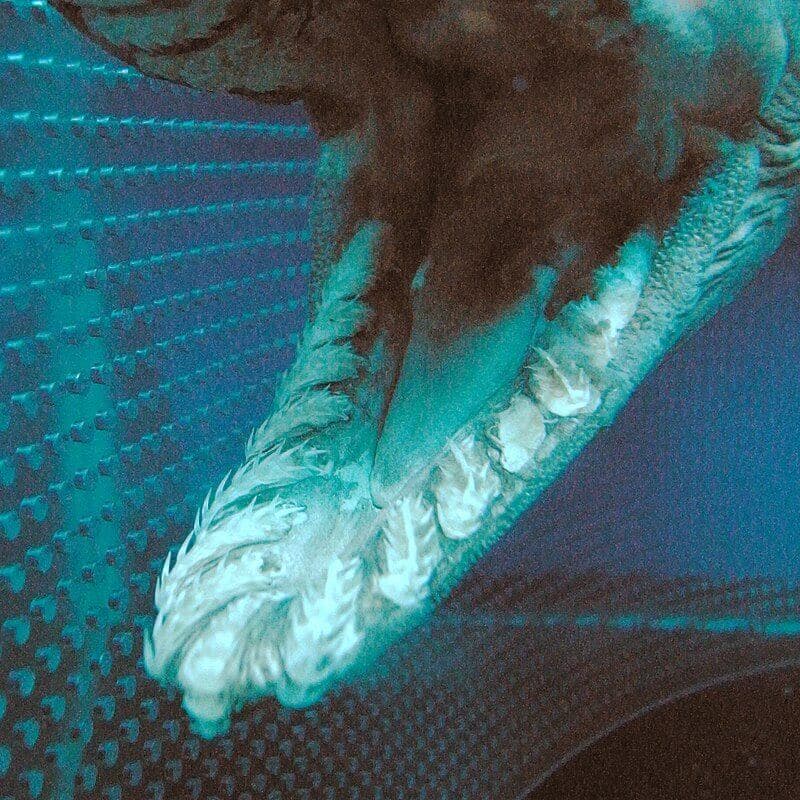
Their heads are flat and broad, with a rounded snout noted for its vertical nostril slits. Their eyes are moderately large, and they have a protective third eyelid. Their teeth are widely spaced, with between 19 and 28 in the upper jaw and 21 to 29 in the lower jaw.
The gill filaments are the feature that gives the sharks their name. They have a frilling, fringed appearance.
Frilled sharks have short and round paddle-shaped pectoral fins, a small dorsal fin, and large anal fin. Their underside features folds of skin that are separated by a groove. Their function is as of yet unknown.
There are two extant species of this shark in the family Chlamydoselachidae.
Habitat
There are two species of frilled shark distributed throughout the Atlantic and Pacific oceans. They are usually found in waters of the outer continental shelf and upper continental slope. They live near the ocean floor and biologically productive areas.
Their natural habitat is near constant food sources. They usually swim toward the surface to feed at night. In one of the best-known areas where frilled sharks are spotted, the Surge Bay off the coast of Honshu, Japan, the sakes are usually at a depth of 50–200 m (160–660 ft). That is until the temperature warms and the sharks swim to deep water where it’s cooler.
Populations occur on the outer continental shelves and upper continental slopes off Norway, northern Scotland and western Ireland, and south as far as northern Namibia. Other populations occur in the eastern Pacific off southern California and northern Chile; in the west Pacific, off south-east Japan, eastern Australia and New Zealand; and also possibly in the western Indian Ocean, off South Africa.
More recently, the sharks have been spotted off the coast of New England and Georgia in the United States.
Diet
Frilled sharks eat primarily smaller sharks, bony fish, and squid (such as the cock-eyed squid and the flying squid). They also eat cephalopods. When hunting, their large jaws are capable of devouring prey whole. This is especially effective when it comes to cephalopods and squid.
They don’t have the same strong bite as other sharks. Instead, they have to make do with their relatively weak bite due to the limited leverage of their long jaws. Some scientists have suggested that the frilled shark hunts with its jaw open. The inside of its mouth has an interesting dark and light arrangement, allowing it to lure its prey in.
Reproduction
Males reach maturity when it is 3.3–3.9 ft long, while the female reaches maturity when it is 4.3–4.9 ft long. The mature female shark has two ovaries and a uterus.
After fertilization, the embryos develop within the female’s uterus, receiving nourishment from a yolk sac. The baby shark is born from an encapsulated off retained in the mother’s uterus. When the embryos are 6–8 cm or 2.4–3.1 in long, the mother shark expels it. It is also at this time that the baby shark’s gills are developed.
A litter consists of two to fifteen pups, with the average being six. The gestation period can last as long as 3.5 years.
Threats
Unfortunately, frilled sharks can be caught up in a process known as bycatch, where fishermen bring in untented creatures in their large nets. This often happens while the sharks are hunting. They are often caught up in gill nets used in Japan and meant for sea bream and gamefish.
In 2016, the IUCN designated the frilled shark as under near threat of extinction because of the loss of food sources due to commercial overfishing. Today, they are currently classified differently by different countries. The IUCN red list classifies them as “least concern,” and the New Zealand Threat Classification System lists them as “At risk—naturally uncommon,” meaning that they are not easily found.
7 More Cool Facts About Frilled Sharks
- They were discovered in the 19th century by German ichthyologist Ludwig H.P. Döderlein.
- It is sometimes referred to as a “living fossil.”
- Their bite is relatively weak compared to other sharks.
- Frilled sharks give birth to live young after a gestation period that may last up to three and a half years.
- They glide through the deep sea with an eel-like motion.
- In captivity, they show the behavior of swimming with their mouth open.
- Their caudal fin is asymmetrical.
FAQs
Are frilled sharks dangerous to humans?
Frilled sharks pose no threat to humans. They inhabit deep ocean waters, often residing at depths of 500 to 1,200 meters, far from human activity. Their elusive nature and preference for the deep sea mean that encounters with humans are extremely rare, making them harmless in terms of direct interaction.
How long have frilled sharks existed?
They have been around for about 80 million years, making them one of the oldest known shark species. This ancient lineage provides a unique window into the evolutionary history of sharks, as they have retained many primitive features that have remained unchanged over millennia.
Why are they called “living fossils”?
The term “living fossil” is used to describe frilled sharks because they exhibit characteristics that have persisted for millions of years without significant evolutionary change. Their anatomy closely resembles that of ancient shark species, offering scientists a rare opportunity to study traits that have endured since the time of the dinosaurs.
How often are frilled sharks seen?
These sharks are rarely seen due to their deep-sea habitat. They typically dwell at depths ranging from 500 to 1,200 meters, where light barely penetrates. This makes them difficult to study and observe, contributing to their mysterious reputation and limited scientific understanding.