
The Mariana Trench reaches 1,580 miles and 2,550 kilometers and a maximum width of 69 kilometers or 43 miles. The maximum known depth is 10,984 meters or 36,037 feet. The water pressure at the bottom of the trench is incredible, more than 1,071 times the normal atmospheric pressure at sea level. Living in this excellent habitat are some of the world’s most exciting and surprising animals. Explore a few of them below.
Dumbo Octopus
Interesting fact: It is the deepest known living octopus
Depth range: 9,800 to 13,000 feet (2,990 to 3,960 meters)

The Dumbo octopus is also known as the Grimpotheuthis octopus. The name originates from the creature’s resemblance to the character Dumbo from the 1941 Disney film of the same name. The Dumbo octopus was first discovered around 1883, but the first specimen was not seen until the 1990s after the first deep-sea submersible vessels were invented.
The octopus’s gelatinous body is uniquely suited to the crushing pressure of the deep sea. They live close to the seafloor at extreme depths of 9,800 to 13,000 feet. This pressure is essential for its survival, and a sudden change in depth could prove fatal.
Black Seadevil Anglerfish
Interesting fact: It has a bioluminescent lure on the top of its head to attract prey
Depth range: 15,000 feet (4,570 meters)
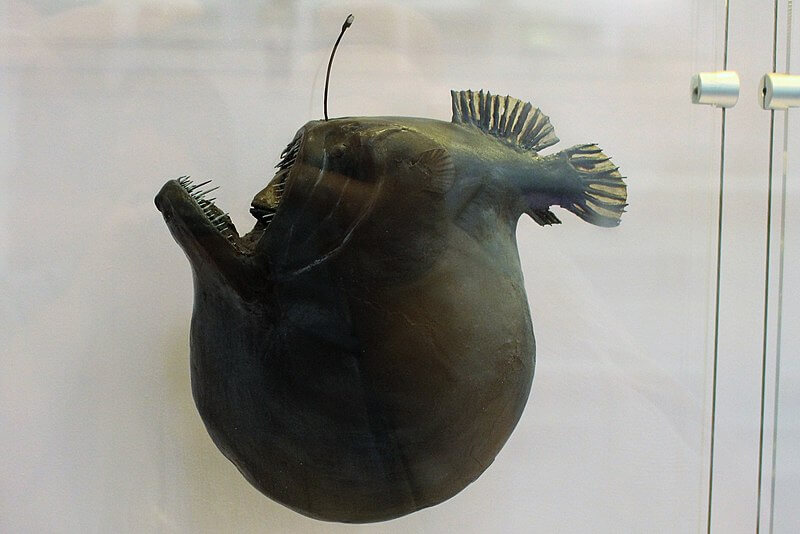
The Black Seadevil anglerfish, true to its name, is a bizarre creature with a hellish appearance featuring a misshapen body and razor-sharp teeth. These fish exhibit extreme sexual dimorphism, with tiny males fusing themselves to the much larger females, essentially becoming a sperm bank.
Like other anglerfish, the Black Seadevil uses a bioluminescent lure to attract prey, which it captures with its huge jaws, sometimes consuming creatures larger than itself.
Frilled Shark
Interesting fact: This species is over 80 million years old
Depth range: 4,900 feet (1,500 meters)

The Frilled shark is a truly unique creature, with an eel-like body and a flattened, dinosaur-like head. This ancient species, reaching up to 6 feet (1.8 meters) in length, possesses six rows of frilly gills and over 20 rows of trident-shaped teeth. Preferring the deep ocean, Frilled sharks are rarely observed and often die when brought to the surface.
While previously thought to swim and hunt like eels, researchers now suggest they may strike prey more like a snake. They live near the ocean floor, such as in and around the Mariana Trench, and biologically productive areas.
Goblin Shark
Interesting fact: Its pale pink skin helps it camouflage in the ocean depths
Depth range: 800 to 3,000 feet (240 to 915 meters)

The Goblin shark is a rare, deep-sea shark with a truly unique appearance. Its most striking feature is its long, flat snout, which combined with its pale pink, semi-transparent skin, gives it an almost prehistoric look. Even more bizarre is its jaw, which extends rapidly outward when catching prey.
Goblin sharks can grow up to 18 feet (5.5 meters) long, but they are rarely seen by humans as they prefer the deep ocean, often residing at depths of up to 3,000 feet. Much about their biology and behavior, including their reproduction, remains a mystery to scientists.
Telescope Octopus
Interesting fact: Its near-transparent making it appear almost invisible
Depth range: Depths greater than 6,500 feet (1,981 meters)

The Telescope octopus is a rare, deep-sea creature that is truly a sight to behold. Its most notable feature is its near-transparency, making it appear almost invisible in the dark depths of the ocean. This ghostly octopus has eight long, webbed arms and uniquely tubular eyes that rotate, providing a wide field of vision in its deep-sea home.
Unlike most octopuses, it drifts vertically through the water column at depths greater than 6,500 feet, possibly as a camouflage tactic. First documented in 1885, the Telescope octopus remains a mysterious species with much of its biology and behavior still unknown.
Zombie Worms
Interesting fact: They target the fat that is inside the bone to eat
Depth range: 10,000 feet (3,050 meters)
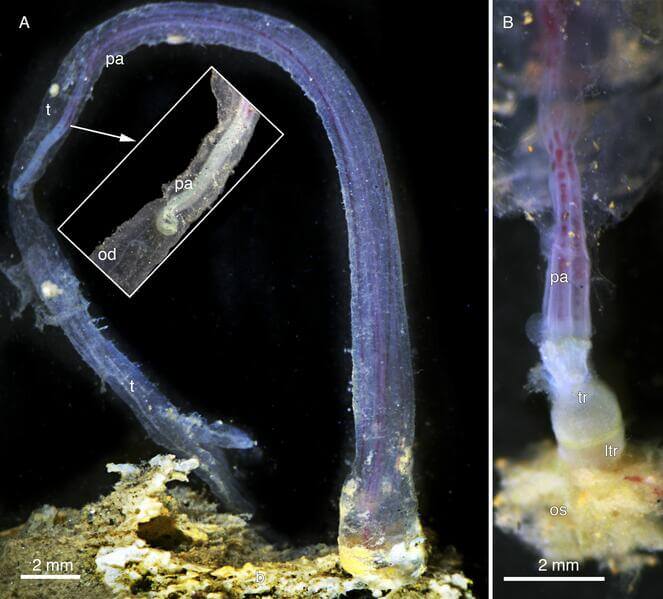
The Zombie worm, formally known as Osedax, is a fascinating deep-sea creature. This worm has the remarkable ability to consume the fat contained within the rock-hard bones of deceased whales. It achieves this by secreting acids to access the bone’s interior, then utilizing symbiotic bacteria to convert bone proteins and fats into nutrients.
While the females can grow up to 2 inches (5 centimeters) long, the males are microscopic and live in harems on the females’ bodies. Osedax worms play a crucial role in the deep-sea ecosystem by cleaning up whale carcasses.
Barreleye Fish
Interesting fact: It has a transparent skull to see potential predators above it
Depth range: 2,000 to 2,600 feet (610 to 795 meters)

The Barreleye Fish, with its unique upward-pointing, barrel-shaped eyes and transparent head, is a peculiar inhabitant of the Mariana Trench. In this deep, dark environment, where light is scarce, the Barreleye has evolved extraordinary adaptations to maximize its vision.
Its tubular eyes are perfectly suited for detecting the faintest glimmers of light filtering down from above. This allows it to spot potential prey silhouetted against the dim background. The transparent head, a rare feature in the animal kingdom, may further enhance its light-gathering abilities.
Deep-sea Dragonfish
Interesting fact: They can see their own light, using it to communicate with each other
Depth range: 700 to 6,000 feet (213 to 1,830 meters)
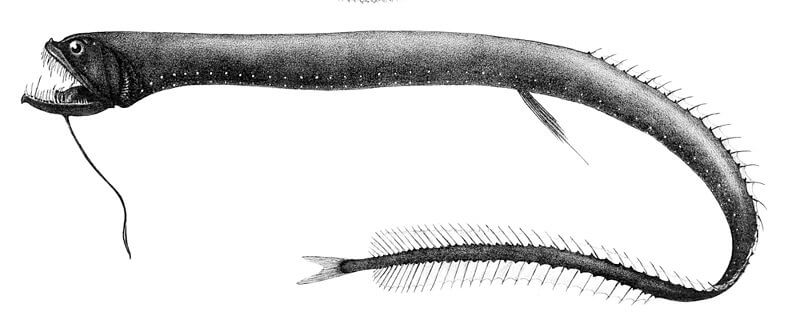
The Deep-sea Dragonfish is a scaleless predator of the Mariana Trench that embodies the darkness of the abyss. This fish, with its oversized teeth and eel-like skin, uses bioluminescence for a variety of functions. Its eerie glow can attract prey, provide camouflage, and even facilitate communication with other Dragonfish
Remarkably, some Dragonfish have evolved the rare ability to produce a red glow, potentially used for signaling or illuminating prey before an attack.
Sea Pig
Interesting fact: Sea cucumbers comprise the majority of sea life on the deep-sea floor, and breathe through their anus
Depth range: 1,800 to 22,000 feet (550 to 6,705 meters)

In the deepest parts of the Mariana Trench, where the seafloor is a world of perpetual darkness and immense pressure, lives the peculiar Sea Pig. This pink-hued creature, resembling a tiny piglet, is actually a type of sea cucumber uniquely adapted to this extreme environment. It has tube feet located on its underbelly, back, and around its mouth. This allows it to navigate the muddy sediments and scavenge for food.
The Sea Pig plays a crucial role in the Mariana Trench ecosystem, feeding on decaying organic matter that falls from the surface layers. Sea Pigs gather in hordes to consume the nutrient-rich sediments.
Mariana Snailfish
Interesting fact: It has a gelatinous body with transparent, unpigmented skin
Depth range: 19,685 feet (6,000 meters)

The Mariana Snailfish is uniquely adapted to withstand the immense pressure and frigid temperatures of the Mariana Trench. Their gelatinous bodies and lack of swim bladders help them cope with the crushing pressure. They also exhibit a range of physiological adaptations, such as changes in cell membranes and protein structures, to survive in the cold, dark depths.
Despite their prevalence in the hadal zone, much remains unknown about these peculiar creatures. Scientists are actively studying snailfish to understand their evolutionary history, genetic adaptations, and ecological role in this unique ecosystem.
Ocean Insights: Hear From Our Experts

By Dr. Rabiah Ryklief
Principal Scientist and Lecturer of Marine Science, with a PhD in Zoology
New research on the Mariana Trench, the deepest place on Earth, reveals a surprising level of complexity and a vastly expanded hadal ecosystem. While previously considered a single, continuous habitat, the Mariana Trench is now understood to comprise five isolated areas, each potentially harboring unique life forms. This discovery, coupled with the realization that the hadal zone extends beyond the trenches to encompass a much wider area, underscores the need for continued exploration in this extreme environment. Understanding the Mariana Trench's intricate ecosystems is crucial not only for discovering new species and understanding biodiversity, but also for responsible ocean management and comprehending its role in global processes.
FAQs
Do any animals live in the Mariana Trench?
Yes, many different animals live in the Mariana Trench. Most of these are rarely seen by human beings and have different, interesting attributes.
Is the Mariana Trench toxic?
Deep in the Mariana Trench, there are still examples of human-caused pollution. For example, scientists have discovered mercury pollution there.
Does Megalodon exist in Mariana Trench?
It is very unlikely that Megalodon still exists. But, if it did, it would live in the upper part of the water over the trench rather than in its depths.


