
The monkfish, also known as goosefish, all-mouth, or sea devils, are large predatory fish in the genus Lophius. In the past, when monks asked for unused fish, they were given the monkfish, thus their name. They are mainly found in the North Atlantic, Pacific, and Indian Oceans and occur in seven distinct species.
These fish are well known for their somewhat unappealing appearance and impressive size. They are apex predators with huge, gaping mouths and a bioluminescent lure that attracts unsuspecting prey.
Despite their appearance, they are a delicacy in many parts of the world. Their meat is sweet and tastes like lobsters. Since they are sold for much less than lobsters, they are frequently called “the poor man’s lobster.”
These fish species have unique appearances with odd-looking features. They are said to be unattractive, thus their name, sea devils.

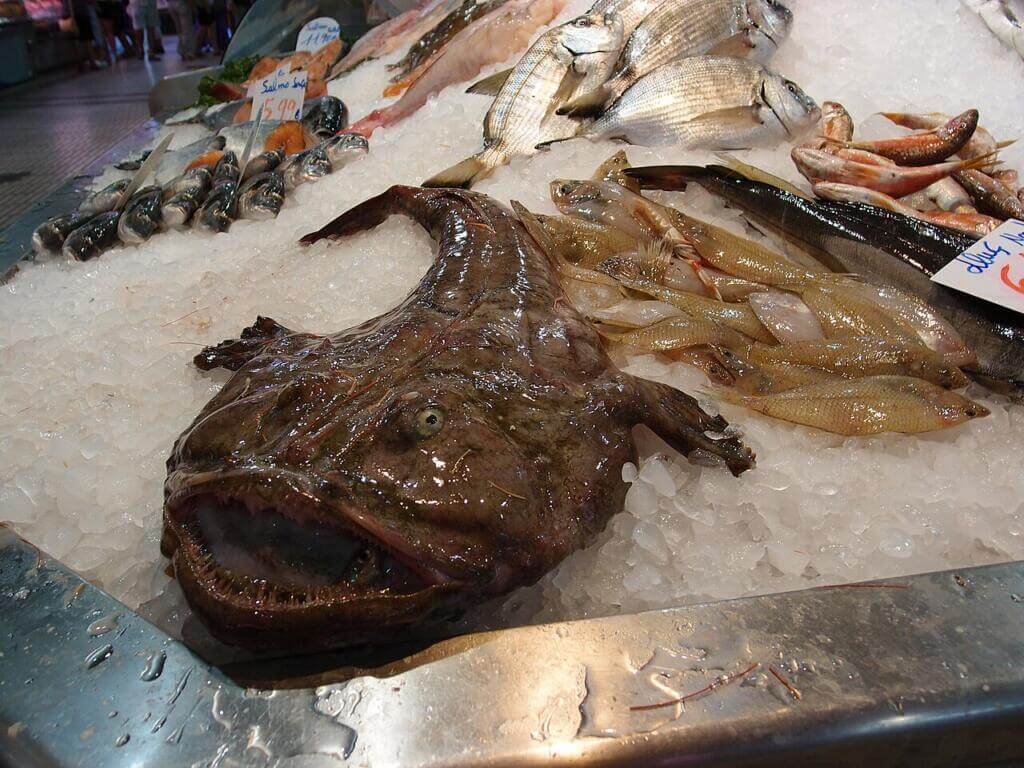
One of their striking features is their head, which is large and makes up half of their body. The head is flattened and wide, with a large mouth that extends almost the full width of the head. The mouth is filled with rows of sharp, pointed teeth well-suited for catching and holding onto prey.
Their body is relatively flat, and their skin lacks scales. They are usually dark brown with small, irregularly shaped bumps. This texture helps them blend seamlessly into their environment.
Additionally, they have a large, triangular dorsal fin that extends down the length of their back and two pectoral fins that resemble wings. They also have two huge bulging eyes.
Further, adult monkfish have a body length of more than 1.5 meters and weigh up to 50 kilograms. However, they typically average around 1 meter long and weigh around 14 kilograms. Females tend to be longer in size than males.
Habitat
Monkfish are mainly found on the continental shelf, inhabiting muddy and sandy floors. They are widely distributed across the North Atlantic continental shelf, ranging from the coast of Canada and the United States to Western Europe. They also inhabit the Mediterranean Sea, Africa’s Atlantic coast, and China to Japan and Korea in the Pacific.

They are benthic species and prefer habitats with soft, muddy, or sandy ocean floors. They predominantly occur at depths ranging from 14-1000 meters.
They are also highly migratory. They are known to migrate between their spawning and feeding areas seasonally.
Diet
Monkfish are carnivorous. They are voracious feeders and eat most things that cross their path. Some people describe them as formidable opportunistic feeders since they prey on whatever they catch.
While hunting, they sit still on the seafloor, disguised, waiting for unsuspecting prey to approach and ambush them. Herring, haddock, sea raven, mackerel, and flounder are some of their prey. Due to their wide mouths, they ingest prey much larger than themselves.
They ambush their prey by attracting them with a specialized lure on their head. This lure resembles a small fish or worm and acts as a bait for smaller fish and other prey.
Their preferred prey depends on their age. They feed on plankton as larvae and crustaceans and small fish as juveniles. At their adult stage, they prey on larger fish such as cod, haddock, seabirds, and crustaceans.
Reproduction
Compared to other fish species, monkfish have a relatively longer life span. However, their lifespan varies depending on their sex. Females tend to have a longer lifespan compared to males. On average, females live for at least 13 years, while males live up to 7 years.

Reproduction in monkfish involves external fertilization. During breeding, females release between 300,000 and 2,800,000 eggs in a long gelatinous string. Males then follow to fertilize the eggs externally.
The eggs float on the ocean surface for around three weeks before hatching. Once they hatch, they become independent, with no parental care. The hatched eggs are pelagic and move into the benthic waters after they become juveniles.
The breeding period is usually between February to October, with females breeding only once per year.
Notably, their maturity depends on their size rather than their age. Males reach sexual maturity at about 14-16 inches, and 16-20 inches for females.
Threats
Due to the high demand for their meat and liver in global culinary recipes, monkfish are highly overfished. They are fished by bottom trawling, which is ecologically destructive and negatively affects their habitats. This unsustainable method also causes incidental catch and harm or kills other untargeted species.
Although monkfish are nearly threatened, there is little concern about their rapidly declining population. They are caught extensively in gillnets and longlines as bycatch, causing a rapid decline in their population.
Climate change is also a contributor to their declining population. Ocean acidification and rising temperatures detrimentally affect the seabed ecosystem, disrupting their feeding and breeding habitats.
Further, the lack of efficient management measures to ensure their conservation adds to the worsening state of monkfish populations. As a result, monkfish are vulnerable to potentially becoming threatened if not adequately managed.
5 More Surprising Facts About Monkfish
- They hunt by staying motionless and waiting for their prey, which they swallow whole.
- Their enormous mouths and expandable stomachs allow them to swallow prey nearly as large as themselves.
- Monkfish can tolerate a wide range of temperatures and environmental conditions.
- They are masters of camouflage, blending into the seafloor and using their lures to attract unsuspecting prey.
- Their first dorsal fin is modified into a lure, which they use as bait to attract prey.
FAQs
Are monkfish and Anglerfish the same?
Monkfish and Anglerfish are not exactly the same. However, they are related in that monkfish are members of the order Lophiiformes, commonly known as Anglerfish. Over 300 species are classified under the order Anglerfish. These species are well known for their characteristic predation mode of using a luminescent lure. Therefore, all monkfish are Anglerfish, but not all Anglerfish are monkfish.
What part of the monkfish is edible?
Monkfish tail flesh is consumed. It is sweet and has a texture and flavor that tastes like a lobster. Their liver is also edible, though most people prefer eating its tail. It is a low-fat, low-cholesterol source of protein and vitamins. Their flesh is also cut into fillets.
Are monkfish a threat to humans?
Monkfish are not a threat to humans. Their hunting prowess is only used on smaller fish, and they do not target humans. Given that they are benthic dwellers, encounters with them are extremely rare. Even when encountered, they are unlikely to pose any danger to humans.
Can giant monkfish camouflage?
Monkfish are masters of camouflage. While they don’t change their appearance, they are able to blend into the ocean floor thanks to their dark brown skin. This makes it harder for predators to spot them. Their ability to camouflage also aids in their hunting, allowing them to lie in wait and ambush their prey.


