
The Yellowtail Amberjack, also known as Kingfish, is a powerful and prized fish found in warm-temperate waters across the Pacific Ocean. A significant species for both commercial and recreational fishing, Yellowtail Amberjack also plays a unique role in aquaculture and even sparks some taxonomic debate. This blog will explore all aspects of the Yellowtail Amberjack’s natural history.
Appearance
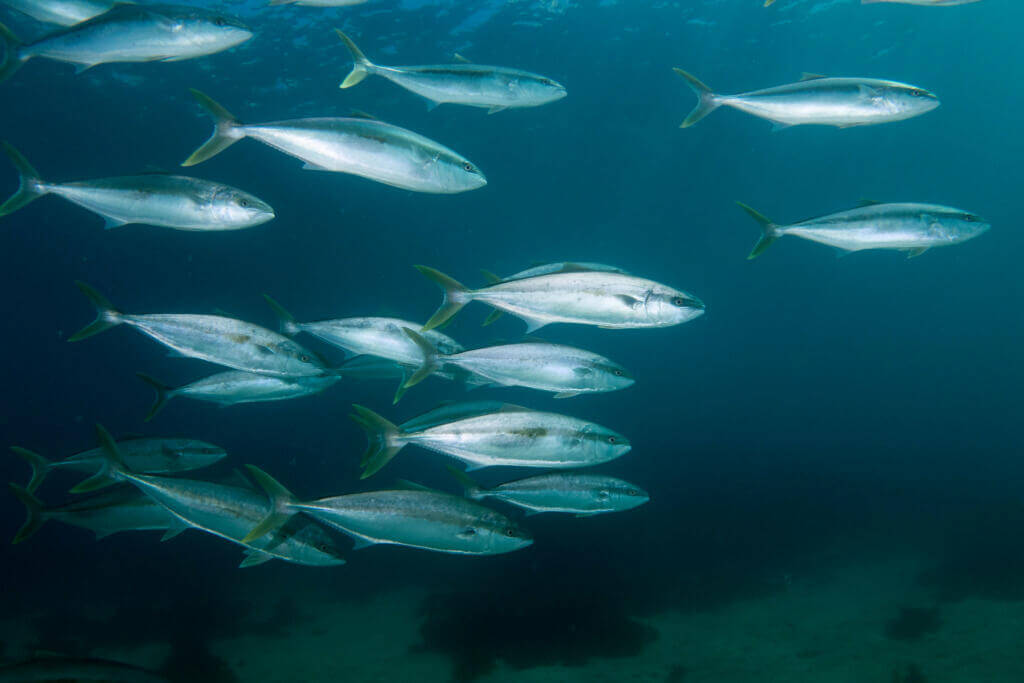
The Yellowtail Amberjack is easily distinguished by its bright yellow fins. Its body is streamlined and torpedo-shaped, allowing for swift movements in the water. The upper body is a stunning bluish-green, while the underside is a silvery-white. A distinctive yellow-to-bronze stripe runs along its side, further enhancing its appearance.

They can grow to an impressive size, reaching up to 8.2 feet (2.5 meters) in length and weighing as much as 155 pounds (70 kilograms). Unlike other jacks, the Yellowtail Amberjack lacks scutella (small, bony plates or scales) on its caudal peduncle. It has 5-6 dorsal spines, 33-35 dorsal soft rays, 2-3 anal spines, and 20-21 anal soft rays.
Diet
The Yellowtail Amberjack is a swift predator that attacks prey using its agility. Its diet consists of planktonic crustaceans and fish such as sardines, herring, mackerel and anchovies. They also target squid, especially at night when these cephalopods ascend from the depths to the surface, drawn to the moonlight.
Habitat
This globally distributed species is found in subtropical and temperate seas across the Indo-Pacific, Eastern Pacfic, and the Eastern Atlantic oceans. They are typically found in coastal and oceanic waters , frequenting areas with kelp beds, rocky reefs, and islands . Occasionally, they may even venture into estuaries.

While young Yellowtail Amberjack often form large schools in offshore waters, particularly near or beyond the continental shelf, adults tend to be more solitary or found in smaller groups. Whilst they prefer warmer waters, they can tolerate cooler temperatures.
Reproduction
Yellowtail Ambrjack typically spawn during the austral spring and summer months when water temperatures exceed 17°C. Spawning behavior involves courtship rituals, including high-speed chases and nipping, culminating in the release of gametes in frenzied circling.
Fertilized eggs are buoyant and develop rapidly, with hatching time influenced by water temperature. While higher temperatures accelerate hatching, they may not necessarily lead to larger larvae at the onset of first feeding.
Threats
Yellowtail Amberjacks fall prey to larger marine predators. These include marine mammals like seals, larger fish like tuna, and seabirds.
It is a popular sportfish and has minor commercial importance. While there have been no observed declines in populations due to fishing, the species is caught using various methods, including seines, bottom trawls, and hook-and-line. Currently, there are no specific conservation measures in place for this species. However, its range overlaps with numerous marine protected areas, which could indirectly contribute to its conservation.
Facts about the Yellowtail Amberjack
- They use countershading to blend into their environment.
- They prefer warmer water temperatures, typically between 18-24°C
- They are known for their speed and agility, making them efficient predators.
- Marine Protected Areas are only useful if it’s located within a spawning area.
- They are highly migratory, always searching for food and optimal water conditions.
FAQ
Are Yellowtail Amberjack dangerous to humans?
They are not harmful to people, no. Trypanorhynch plerocerci, a worm that is present in the Yellowtail Amberjack, is not dangerous. However, eating the Yellowtail that contains the aforementioned worm may result in some unpleasant side effects.
What is another name for Yellowtail Amberjack?
The term Amberjack refers to a group of fish species that are members of the Seriola genus and family Carangidae. Other names for the Yellowtail Amberjack include Amberjack, Yellowtail Jack, Coronado, White Salmon, Forktail, and Hiramasa.
How fast can a Yellowtail Amberjack swim?
The Amberjack can swim at 31 mph. They move so quickly, making it difficult to catch them. If you wish to capture them, make careful to keep them away from the reefs because if you do, a large, sharp rock might cut your fishing line. Fun fact, the Sailfish is the world’s fastest fish, swimming four times faster than the Yellowtail Amberjack.


