

The letter ‘C’ represents a cornerstone of the fish kingdom, covering a spectacular range of species crucial to ecosystems and human cultures. This diverse group includes the charismatic Clownfish, a star of the coral reef, and the Catfish, a giant of freshwater rivers. It also features the common Cod, a fish that has fed nations for centuries, and the ocean’s apex predator, the great white shark, known scientifically as Carcharodon carcharias.
Join us as we explore the captivating world of fish that start with C, uncovering the unique stories and surprising facts behind these remarkable creatures.
Common Fish Names That Start With C
This section highlights fish best known by their common names, often reflecting their appearance or cultural significance.
Clownfish (Amphiprioninae subfamily)
Habitat: Sheltered lagoons and warm, shallow coral reefs in the Pacific and Indian Oceans.
Size: 3 to 4.5 inches in length.
Conservation Status: Most species are Least Concern (LC).

Instantly recognizable by its iconic bright orange and white bands, the Clownfish is most famous for its symbiotic relationship with sea anemones, whose stinging tentacles protect it from predators. This unique partnership is possible because a special layer of mucus on the clownfish’s skin makes it immune to the anemone’s potent sting.
All Clownfish are born male; they are sequential hermaphrodites, and if the dominant female of a group dies, the largest male changes sex to take her place. Beyond its visual appeal, clownfish are also surprisingly noisy fish, communicating with their family group through a series of distinct pops and chirps.
Cod (Gadus morhua)
Habitat: Cold, deep waters of the North Atlantic Ocean, from Greenland to North Carolina.
Size: Typically 2 to 3 feet long, but weigh over 200 pounds.
Conservation Status: Vulnerable (VU) by the IUCN.

The Atlantic Cod is a voracious predator, equipped with a huge mouth to swallow a wide variety of prey. To aid its hunt, it can change its color from greenish-brown to reddish-brown to blend in with its environment, and it uses a single, whisker-like barbel on its chin that is embedded with taste buds, allowing it to “taste” the seafloor for food.
Known for its flaky, low-fat white flesh, this fish has been a culinary staple worldwide and one of the most important commercial species in history, supporting entire economies for over a thousand years. Its success is also tied to being a prolific spawner, with a single large female capable of releasing several million eggs in a single season.
Catfish (Order Siluriformes)
Habitat: Extremely diverse, found in freshwater environments on every continent except Antarctica.
Size: Varies immensely, from tiny 1-inch species to giants like the Mekong Giant Catfish, which can exceed 9 feet and 600 pounds.
Conservation Status: Varies by species; many are common (Least Concern), while others are Critically Endangered.
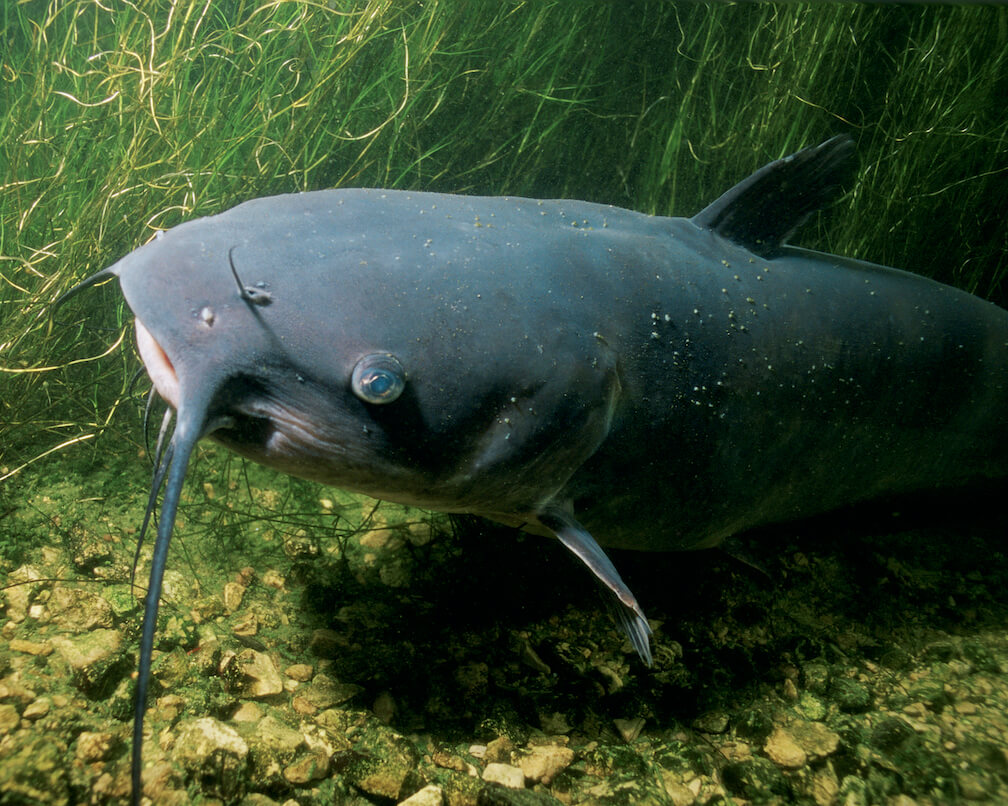
The name “Catfish” comes from the prominent barbels, or “whiskers,” around their mouths, which are covered in taste buds and used to feel and taste for food, a perfect adaptation for their generally nocturnal, bottom-dwelling lifestyle.
This massive and diverse order contains over 3,000 known species, many of which have thick, leathery skin or are covered in bony plates called scutes instead of scales. For protection, certain species also possess a sharp, venomous spine in their dorsal and pectoral fins. Some have even developed incredible abilities, like the Walking Catfish, which can use its fins to “walk” across dry land for short distances.
Scientific Fish Names That Start With C
Here, we focus on species or genera where the scientific name holds particular significance.
Carcharodon carcharias (Great White Shark)
Habitat: Coastal and offshore waters in temperate oceans across the globe.
Size: Averages 11 to 16 feet, with large females exceeding 20 feet.
Conservation Status: Vulnerable (VU) by the IUCN, threatened by overfishing and being caught as bycatch.

As masters of the ambush, Great Whites often attack prey from below with a powerful, high-speed rush, and can even roll their eyes backward into their sockets for protection during the final moments of an attack. This powerful bite is fueled by its partially warm-blooded nature, which keeps its muscles ready for explosive action.
Its scientific name, meaning “sharp tooth,” is fitting for a predator armed with up to 300 serrated, triangular teeth arranged in several rows. Long before the attack, however, it uses extraordinary senses to locate its victims: it can detect a single drop of blood in 25 gallons of water and, with a specialized organ called the Ampullae of Lorenzini, it can sense the tiny electrical fields of muscle contractions from prey up to a third of a mile away.
Corydoras (Cory Catfish)
Habitat: Small streams, ponds, and marshes in slow-moving South American rivers.
Size: Typically small, ranging from 1 to 4 inches.
Conservation Status: Most species are Least Concern (LC), but many have restricted ranges, making them vulnerable to habitat degradation.
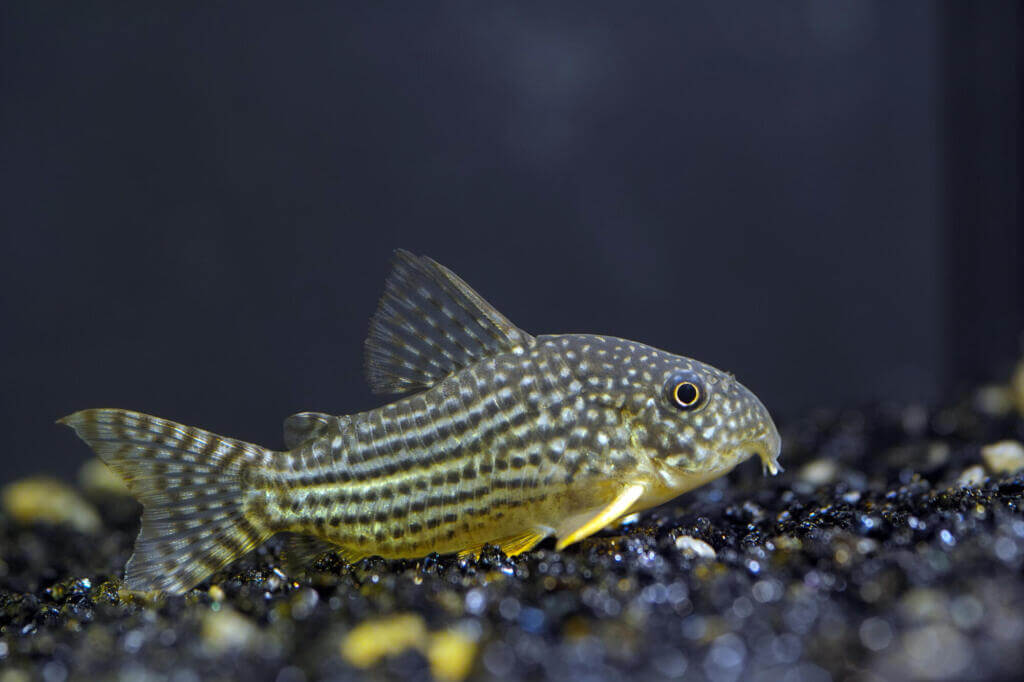
As one of the most popular genera in the aquarium hobby, Corydoras are beloved for their peaceful, social nature. Often called “armored catfish” because their bodies are covered in overlapping bony plates or scutes, they also possess a sharp, mildly venomous spine for defense.
In the aquarium, they constantly sift through the sand with their sensitive barbels searching for food, and they have the unique ability to survive in low-oxygen water by quickly darting to the surface to gulp air. Because they are highly social schooling fish, they are most comfortable and active when kept in groups of six or more.
Other Fish Species That Start with C
- California Grunion (Leuresthes tenuis)
- California Halibut (Paralichthys californicus)
- California Sheephead (Semicossyphus pulcher)
- Callorhinchus milii (Ghost Shark)
- Canary Rockfish (Sebastes pinniger)
- Candiru (Vandellia cirrhosa)
- Capelin (Mallotus villosus)
- Cardinal Tetra (Paracheirodon axelrodi)
- Cardinalfish (Family Apogonidae)
- Cat Shark (Family Scyliorhinidae)
- Cavefish (e.g., Astyanax mexicanus)
- Celebes Rainbowfish (Marosatherina ladigesi)
- Cero Mackerel (Scomberomorus regalis)
- Chain Pickerel (Esox niger)
- Channel Catfish (Ictalurus punctatus)
- Char (Genus Salvelinus)
- Checkerboard Cichlid (Dicrossus filamentosus)
- Cherry Barb (Puntius titteya)
- Cherry Salmon (Oncorhynchus masou)
- Cheilopogon (Cheilopogon pinnatibarbatus californicus) – Flyingfish
- Chimaera (Order Chimaeriformes)
- Chinese Algae Eater (Gyrinocheilus aymonieri)
- Chinook Salmon (Oncorhynchus tshawytscha)
- Chocolate Cichlid (Hypselecara temporalis)
- Chub (e.g., Squalius cephalus)
- Chub Mackerel (Scomber japonicus)
- Chum Salmon (Oncorhynchus keta)
- Cichlid (Family Cichlidae)
- Cisco (Coregonus artedi)
- Climbing Gourami (Anabas testudineus)
- Clown Loach (Chromobotia macracanthus)
- Clown Triggerfish (Balistoides conspicillum)
- Clownfish (Amphiprioninae)
- Cobia (Rachycentron canadum)
- Coelacanth (Genus Latimeria)
- Coffee-bean Wrasse (Thalassoma lutescens)
- Coho Salmon (Oncorhynchus kisutch)
- Coley (Pollachius virens)
- Collared Butterflyfish (Chaetodon collare)
- Combtooth Blenny (Family Blenniidae)
- Common Carp (Cyprinus carpio)
- Conger Eel (Conger conger)
- Convict Blenny (Pholidichthys leucotaenia)
- Convict Cichlid (Amatitlania nigrofasciata)
- Cookiecutter Shark (Isistius brasiliensis)
- Copperband Butterflyfish (Chelmon rostratus)
- Coral Trout (Plectropomus leopardus)
- Cornetfish (Family Fistulariidae)
- Cowfish (Genus Lactoria)
- Cownose Ray (Rhinoptera bonasus)
- Crappie (Genus Pomoxis)
- Creek Chub (Semotilus atromaculatus)
- Creek Perch (Perca fluviatilis)
- Crevice Kelpfish (Gibbonsia montereyensis)
- Crestfish (Family Lophotidae)
- Croaker (Family Sciaenidae)
- Crocodile Icefish (Family Channichthyidae)
- Crocodile Shark (Pseudocarcharias kamoharai)
- Crucian Carp (Carassius carassius)
- Cuckoo Wrasse (Labrus mixtus)
- Cusk-eel (Family Ophidiidae)
- Cutlassfish (Family Trichiuridae)
- Cutthroat Eel (Family Synaphobranchidae)
- Cutthroat Trout (Oncorhynchus clarkii)
FAQs
What is a “Cichlid” and why are they so popular?
A Cichlid is a member of the massive family Cichlidae, which contains over 1,600 species. They are incredibly popular in the aquarium hobby due to their stunning diversity of colors, interesting behaviors, and the complex parental care they exhibit, with many species diligently guarding their eggs and young.
What makes the Coelacanth a famous ‘C’ fish?
The Coelacanth (Latimeria genus) is a legendary “living fossil.” It was thought to have gone extinct with the dinosaurs 66 million years ago until a live specimen was discovered in 1938. It has fleshy, lobe-like fins that are the evolutionary precursors to the limbs of land animals.
Is the Cookiecutter Shark really as scary as it sounds?
While not dangerous to humans in the way a great white is, the Cookiecutter Shark (Isistius brasiliensis) is a terrifying parasite. It uses its suctorial lips and saw-like teeth to latch onto much larger animals—like tuna, dolphins, and even whales—and carve out a perfectly round “cookie” of flesh before swimming away.
What’s the difference between a Carp and a Cod?
They are completely different types of fish. Carp (like the Common Carp, Cyprinus carpio) are typically robust freshwater fish belonging to the family Cyprinidae and are related to minnows. Cod (like the Atlantic Cod, Gadus morhua) are primarily saltwater fish from the family Gadidae, known for their flaky white meat.
How do Clownfish survive in a stinging anemone?
Clownfish have a protective layer of mucus on their skin that is based on sugars rather than proteins. This makes the anemone unable to recognize the clownfish as food or a threat, so it doesn’t fire its stinging cells, or nematocysts, allowing the clownfish to live safely within its tentacles.


