
Africa is a continent of diverse landscapes and is home to some of the world’s most impressive river systems. These waterways carve their paths through deserts, jungles, and savannas, shaping the ecosystems and cultures they encounter. From providing vital resources to sustaining diverse wildlife, Africa’s rivers are essential lifelines. Let us take a look at the top 5 longest rivers in Africa.
Ubangi-Uele River
Runs Through: Democratic Republic of Congo (DRC).
Length: 1,410 miles (2,270 km).

Similar to other longest rivers in Africa, the Ubangi serves as both a crucial freshwater resource and a vital transportation artery for local communities. The Uele River, originating from the convergence of the Dungu and Kibali rivers in the Democratic Republic of the Congo, eventually merges with the Mbomou River to form the Ubangi.
The Ubangi River, with the Uele as its largest tributary, partially delineates the border between the Central African Republic and the Democratic Republic of the Congo. Continuing southwest, it also forms part of the boundary between the Democratic Republic of the Congo and the Republic of the Congo before ultimately joining the Congo River at Liranga District.
Zambezi River
Runs Through: Zambia, Angola, Namibia, Botswana, Zimbabwe and Mozambique.
Length: 1,599 miles (2,574 km).

Also known as the “Great River,” it is a lifeline for African wildlife like elephants, buffalo, hippos, antelope and crocodiles. It also sustains the communities nestled along its course, from its humble beginnings in the Zambian highlands to its grand finale at the Indian Ocean, traversing parts of Angola, Namibia, Botswana and Zimbabwe.
The Zambezi River powers some of Africa’s most significant hydroelectric projects. The Kariba Dam powers Zambia and Zimbabwe, while the Cahora Bassa Dam powers Mozambique and South Africa. However, the Zambezi’s crown jewel is undeniably Victoria Falls, also equipped with a small power station. This Natural Wonder of the World stretches over a mile wide (1.7 km) and plunges 360 feet (108 meters), claiming the title of the largest waterfall on Earth.
Niger River
Runs Through: Benin, Guinea, Mali, Niger and Nigeria.
Length: 2,600 miles (4,180 km).

The Niger River is one of the longest rivers in West Africa and carves a distinctive arc across the continent. The Benue River, its principal tributary, significantly contributes to its flow, resulting in a discharge of approximately 197,374 cubic feet of water per second. The Niger’s unusual shape and flow direction initially perplexed early explorers and has been attributed to the merging of two ancient rivers. Starting near the Atlantic, it flows inland towards the Sahara Desert before turning southward to the Gulf of Guinea.
Today, the Niger River is a vital resource for the region. Over 75% of its length facilitates commercial shipping, and Mali, Niger, and Nigeria have constructed dams along its course to harness its hydroelectric potential and create artificial lakes for fishing and irrigation. The river also supports diverse wildlife, including the Nile Crocodile and the massive Nile Perch.
Congo River
Runs Through: Democratic Republic of Congo, Congo-Brazzaville, Cameroon, the Central African Republic, Burundi, Tanzania, Zambia and Angola.
Length: 2,922 miles (4,700 km).
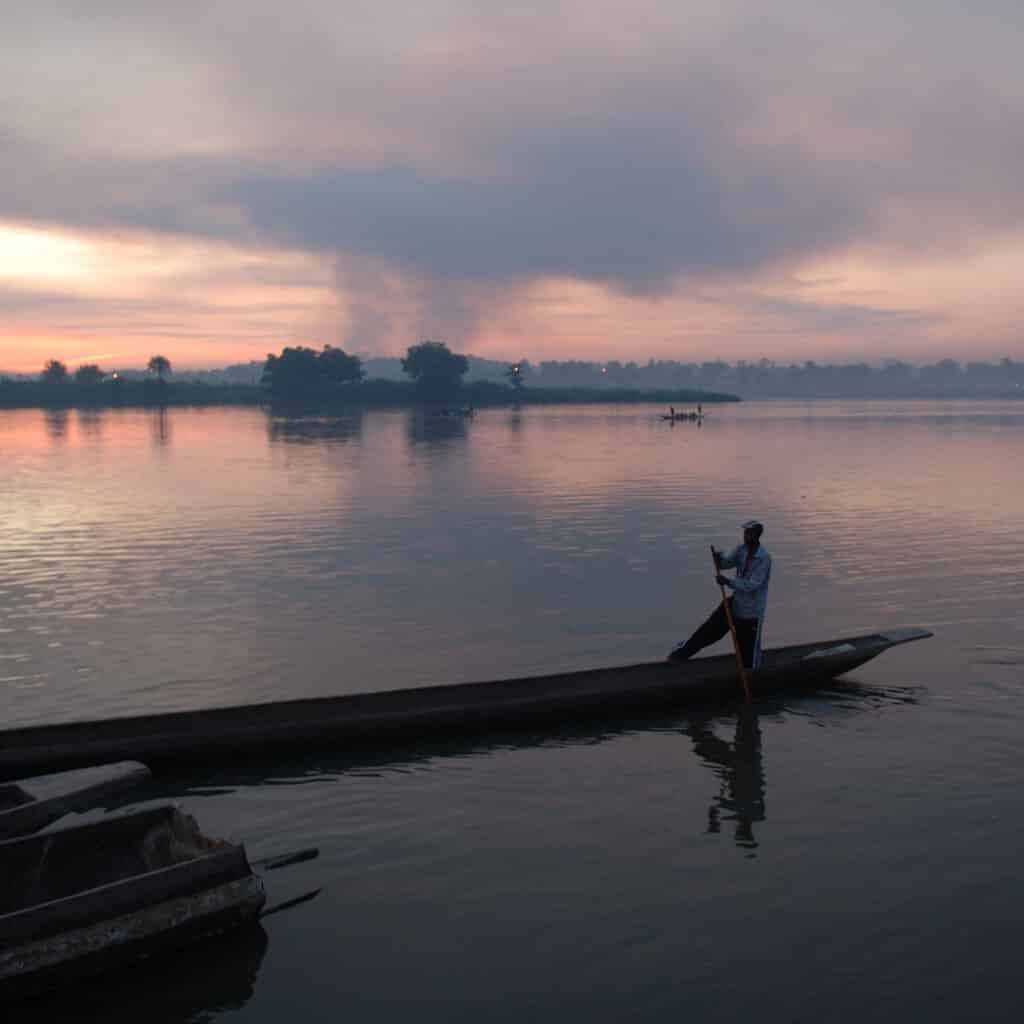
The Congo River, previously known as the Zaire River, is also the world’s ninth-longest river as well as the deepest river globally. Its journey begins in the Katanga Plateau in Zambia, tracing a counter-clockwise arc across nine countries in West-Central Africa before emptying into the Atlantic Ocean. Its vast basin is the second-largest in the world, encompassing 13% of Africa and nurtures the second-largest tropical rainforest.
This rich ecosystem supports an estimated 75 million people and a staggering array of biodiversity, with many species found nowhere else on Earth. The Giant Tigerfish is one of many creatures that call the Congo River home, alongside the Nile Crocodile, Dwarf Crocodile and African Manatee.
Nile River
Runs Through: Egypt, Ethiopia, Eritrea, Kenya, Rwanda, Burundi, Tanzania, Uganda, Sudan, South Sudan and the Democratic Republic of the Congo.
Length: 4,130 miles (6,650 km).

The Nile River is the longest river in both Africa and the world discharging an average of 99,941 cubic feet of water per second. Its flow traces a remarkable path from its origins in the White Nile near Lake Victoria and the Blue Nile from Lake Tana, southward through eleven East African countries, to its final destination in the Mediterranean Sea. The Nile provided fertile soil and a crucial trade route which enabled the ancient Egyptians to establish one of the earliest advanced civilizations. Even today, the river remains a vital lifeline, with 95% of Egyptians living near its banks.
Like many other African waterways, the Nile River is home to numerous wildlife. The most notorious is the widely feared Nile Crocodile. Other notable inhabitants include the Hippopotamus, Nile Soft-Shell Turtle, Nile River Snake and the African Tigerfish.
Ocean Insights: Hear From Our Experts

By Dr. Rabiah Ryklief
Principal Scientist and Lecturer of Marine Science, with a PhD in Zoology
The vibrant colors of fast fashion are coming at a devastating cost to some African rivers, where untreated wastewater from textile factories is turning the water blue. Countries like Tanzania, Ethiopia, Lesotho, and Madagascar are failing to comply with pollution control standards, allowing toxic dyes, metals, and other pollutants to contaminate vital waterways. While major brands like Adidas, H&M, and Zara benefit from Africa's lower production costs, the environmental burden falls on local communities. The textile industry, a significant contributor to these countries' economies, relies heavily on water resources, leading to pollution, soil degradation, and unsustainable waste management practices. This pollution, coupled with the "disposable" nature of fast fashion and the increasing volume of textile waste, poses a serious threat to Africa's water resources and the livelihoods they support.
FAQs
What is the river of death in Africa?
Known as “the river of death,” the Mara River in East Africa plays a crucial, yet dangerous role in the Great Migration, the largest mammal migration on the planet. Millions of zebras and wildebeest follow the rains, instinctively driven to cross the Mara River in search of fresh grazing lands. However, the river’s steep banks and lurking crocodiles make the crossing perilous, with countless wildebeest losing their lives in their desperate scramble to reach the other side.
What is the longest river in Southern Africa?
The longest river in Southern Africa is the Orange River. It rises in the Drakensberg Mountains in Lesotho and flows westward through South Africa to the Atlantic Ocean, covering a distance of 2,432 km (1,511 miles). The Orange River Basin extends into Namibia to the north. This vital river provides water for agriculture, including vineyards in South Africa, and is used for both crop irrigation and power generation.
Which is longer, Amazon or Nile?
While the Amazon River boasts the largest volume of water in the world, the Nile River is generally considered to be the longest river. The Nile stretches over 6,650 kilometers (4,130 miles) from central Africa, northward through northeastern Africa, and finally to the Mediterranean Sea. The Amazon, flowing through South America, measures around 6,400 kilometers (3,976 miles).


