

The letter K introduces a kingly cast of aquatic characters, known for their brilliant colors, powerful presence, and unique survival strategies. This category is home to the iconic Koi, a living jewel of garden ponds, and the lightning-fast King Mackerel, a ruler of the open ocean.
It also includes the vibrant Killifish, masters of adaptation with incredible life cycles, and the transparent Kryptopterus catfish that offers a clear window into its own anatomy. This guide explores the types of fish that start with K.
Common Fish Names That Start With K
This section features popular fish recognized by their common names that perfectly capture their most remarkable traits.
Koi (Cyprinus rubrofuscus)
Habitat: Freshwater ponds and decorative water gardens worldwide.
Size: Typically 1 to 3 feet, but can grow larger.
Conservation Status: Least Concern by the IUCN.

The Koi is a domesticated variety of the Amur Carp, a fish with immense cultural significance, especially in Japan and China, where it symbolizes luck, prosperity, and perseverance. They are most famous for their specific and beautiful color patterns, which have been refined through centuries of selective breeding. These patterns have formal names, such as the white and red Kohaku, the tricolored Sanke, and the black, red, and white Showa.
Beyond their beauty, Koi are known for their remarkable longevity, with many living for 25 to 35 years and some legendary specimens reportedly living for over a century. They are intelligent and personable fish that can learn to recognize their owners and be hand fed. As omnivores, they use their sensitive, whisker-like barbels to forage along the bottom of their ponds for algae, insects, and plant matter.
King Mackerel (Scomberomorus cavalla)
Habitat: Open waters of the tropical and subtropical Atlantic Ocean.
Size: Commonly 3 to 5 feet long and 10 to 30 pounds.
Conservation Status: Least Concern (LC) by the IUCN.

The King Mackerel, often called the “Kingfish,” is a true monarch of the coastal seas, renowned for its incredible speed and power. It has a long, streamlined body shaped like a torpedo, which allows it to chase down its prey with explosive bursts of acceleration. Its mouth is filled with razor-sharp, blade-like teeth that can easily slice through smaller fish like sardines and anchovies.
As a highly successful predator, the King Mackerel is a crucial part of the offshore ecosystem. They are schooling fish, often migrating in huge groups that follow baitfish populations along the coast. This behavior, combined with their powerful fight, makes them one of the most popular and sought-after game fish for sport anglers throughout their range.
Killifish (Order Cyprinodontiformes)
Habitat: Extremely diverse, found in freshwater and brackish streams, ponds, and pools on every continent except Australia and Antarctica.
Size: Most are small, typically 1 to 2 inches, with the largest species reaching 6 inches.
Conservation Status:
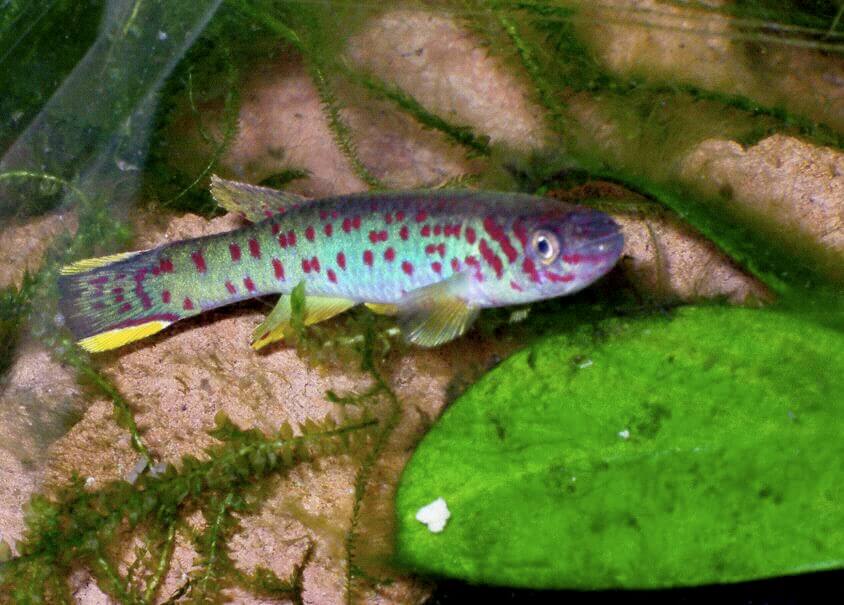
Killifish are a massive and incredibly diverse group of fish, cherished in the aquarium hobby for their brilliant coloration and fascinating life histories. They exhibit extreme sexual dimorphism, with males displaying spectacular, jewel-toned patterns while females are typically much duller in color. This vibrancy is used in elaborate courtship displays where males compete for the attention of females.
Perhaps their most remarkable trait is the annual life cycle of many species that live in temporary, seasonal pools. These “annual” killifish lay incredibly hardy, drought-resistant eggs in the mud before their pond dries up. These diapause eggs can remain dormant for months or even years, waiting for the next rains to trigger them to hatch, thus continuing the species’ lineage in an otherwise impossible environment.
Scientific Fish Names That Start With K
Here, we focus on species or genera where the scientific name is particularly significant.
Kryptopterus (Glass Catfish)
Habitat: Slow-moving, murky freshwater rivers in Southeast Asia.
Size: Typically 2.5 to 4 inches long.
Conservation Status: Most species are listed as Least Concern (LC).
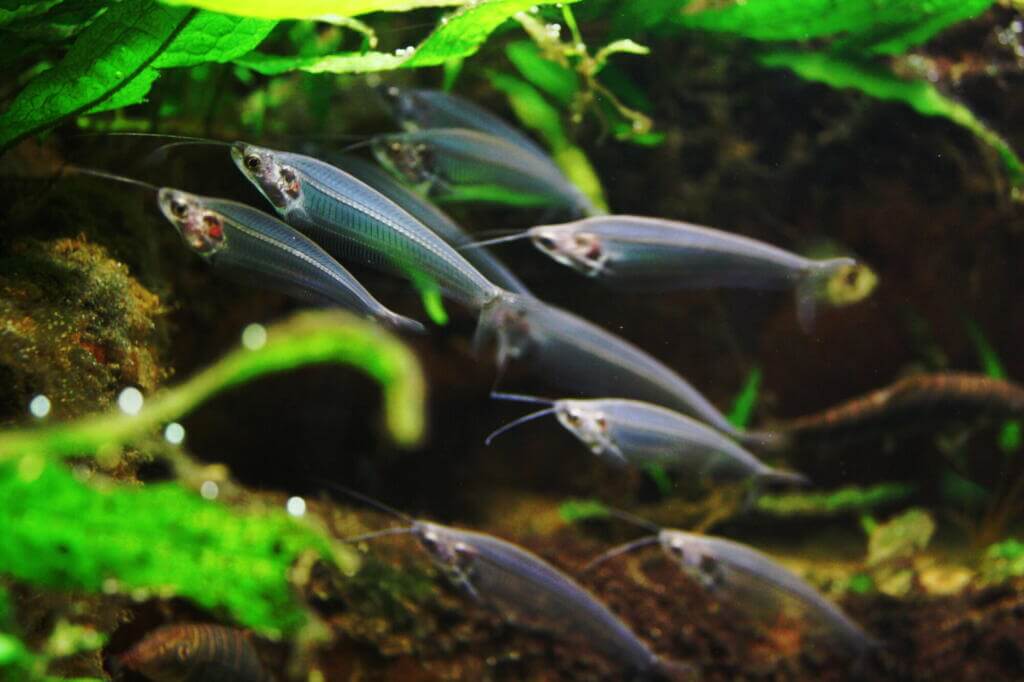
The genus Kryptopterus is famous for containing the Glass Catfish, a fish renowned for its almost perfectly transparent body. This is not a trick of the light; their skin and flesh lack normal pigment, offering a clear view of their internal skeleton and organs, which are packed into a small, silvery pouch behind the head. This transparency serves as a highly effective form of camouflage, making them incredibly difficult for predators to spot in the murky water.
These are highly social, shoaling fish that must be kept in groups to feel secure. A lone Glass Catfish will become stressed and timid, often refusing to eat. They have two long, whisker like barbels on their upper jaw that they use to sense their environment and locate food. As delicate fish, they are also very sensitive to water quality and require stable, clean conditions to thrive in an aquarium.
Other Fish Species That Start with K
- Kahawai (Arripis trutta)
- Kafue Pike (Hepsetus cuvieri)
- Kaluga (Huso dauricus)
- Kelp Perch (Kyphosus spp.)
- Kelpfish (Family Kyphosidae)
- Kessler’s Gudgeon (Romanogobio kesslerii)
- Keyhole Cichlid (Cleithracara maronii)
- Kikusui (Fundulus heteroclitus variety)
- King Dory (Cyttus traversi)
- King-Salmon (Trachipterus altivelis)
- Kingklip (Genypterus capensis)
- Kingfish (Menticirrhus saxatilis / Scomberomorus spp.)
- Kimberley Grunter (Syncomistes kimberleyensis)
- Kissing Gourami (Helostoma temminckii)
- Knifejaw (Oplegnathus spp.)
- Knifefish (Order Gymnotiformes)
- Knight Goby (Stigmatogobius sadanundio)
- Kokanee (Oncorhynchus nerka)
- Kokanee Salmon (Oncorhynchus nerka)
- Kokopu (Galaxias spp.)
- Kooliad barb (Barbus tetrazona)
- Kiver (Lepomis gibbosus)
- Kuhli Loach (Pangio kuhlii)
- Kutum (Rutilus kutum)
- Kyphosus (Sea Chubs, Genus Kyphosus)
FAQs
What is the largest fish that starts with ‘K’?
The Kaluga Sturgeon (Huso dauricus), a close relative of the Beluga Sturgeon, is a true river giant. Found in the Amur River basin, it is one of the largest freshwater fish in the world, capable of reaching lengths of over 18 feet and weighing more than 2,200 pounds.
Are there any venomous fish that start with ‘K’?
Yes, though they are not aggressive. The Kingklip, a deepwater eel-like fish, has a venomous bite, though it is not dangerous to humans. More commonly, many species of Kelpfish have sharp, venomous spines in their dorsal fins that they use purely for self-defense against predators.
How can a fish live in a puddle that completely dries up?
This incredible survival skill belongs to the “annual” Killifish. Before their temporary puddle dries up, they lay special, hardy eggs in the mud. These “diapause eggs” enter a state of suspended animation and can survive for months or even years in the dry dirt. When the rains finally return and fill the puddle, the eggs sense the water and hatch, completing a truly remarkable life cycle.
What sea monster starts with ‘K’?
While not a mythical beast, the Kaluga Sturgeon (Huso dauricus) is a true river monster. As one of the largest freshwater fish on Earth, it can grow over 18 feet long and weigh more than 2,200 pounds. This ancient, armor-plated giant is the apex predator of the Amur River basin, making it a legendary and fearsome creature in its own right.


