

We live in a truly astonishing world. Although we often pay great tribute to the genius creations of our species, we tend to overlook the numerous phenomena that the natural world brings us. Among these curious natural creations comes the development and comparison of unique coastal environments such as tombolo vs sandbar.
Although both tombolos and sandbars are natural developments that form in much the same way, there are key differences that set the two apart, both from a physical perspective, how they tie into the life of the marine species that they support, as well as the lives of humans that reside in the immediate area.
Together we are going to look deeper into these two coastal landscapes and how they compare to each other.


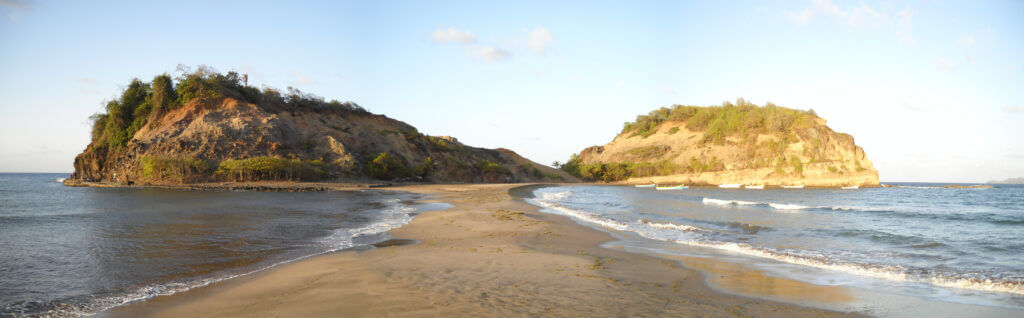
Credit: Credit: Pigelle – Flickr (Left), Stiven Rivera (Right)
Tombolo vs Sandbar: Key Differences
Tombolos and sandbars are coastal formations with distinct features: tombolos connect islands to other landmasses through accumulated sediments, while sandbars form parallel to shorelines.
Some of the major differences between the two formations are:
- Location: Tombolos form as narrow strips connecting islands to the mainland or other islands, whereas sandbars develop in shallow waters near coastlines or rivers.
- Connection to Landmass: Tombolos physically connect islands to land, while sandbars remain separate entities, often submerged
- Geological Process: Tombolos form through sediment deposition and accumulation between landmasses, while sandbars result from sediment deposition in shallow water.
- Shape and Orientation: Tombolos typically have a linear shape, connecting landmasses, while sandbars may be elongated or irregular, running parallel to the shoreline.
- Recreational Use: Tombolos offer opportunities for beachcombing, birdwatching, and fishing, while sandbars are often used for swimming, surfing, and boating.
- Vulnerability to Erosion: Tombolos are susceptible to erosion from waves and sea level rise, whereas sandbars face similar threats but may shift or change shape with water currents.
- Cultural Significance: Tombolos can have cultural significance as natural bridges between islands and the mainland, while sandbars may be valued for their scenic beauty and recreational activities.
Tombolos
Tombolos are natural marine landscapes that are created by the intricate interplay between tides, winds, and currents.
These geological formations represent narrow strips of sand or gravel that have built up to eventually connect an island to the mainland or another island.

This can be seen as a natural bridge between two land masses.
Tombolos come in various shapes and sizes, some so small and narrow that they barely brink the surface of the water, while others such as Adams Bridge, are large enough to be spotted by satellite.
How are Tombolos Formed?
Tombolos are formed through a variety of complex processes and interactions between several environmental movements.
Winds, constructive waves, tidal changes, and local currents work together to deposit sediment such as sand and small stones along the coastline of an island or mainland.
When prevailing winds and local currents move along a coast, sediment is picked up and deposited at an endpoint.
This creates a friction point for other sand and sediment to be deposited by moving tides and ocean storms, forming a small outcrop.
Slowly this outcrop expands into the ocean, forming what is known as a sand split.
When a sand split grows to a point where it is connected to another mass of land, it becomes known as a tombolo.
Although this sounds like a fairly simple process, a lot is at play in the construction of tombolos.
Marine Life and Ecology of Tombolos
Not only do they create unique connections between the mainland and an island, tombolos contribute largely to the wider ecosystem of not only the area but of the vast ocean.
Sediment buildup around the tombolo works as a barrier against harsh ocean weather, creating a sheltered nursery where juvenile fish, seagrass, and coral reefs can form and thrive on the shallow seabed.
Among the vast life that can be found around tombolos are sea turtles, reef sharks, dugongs, and reef fish such as angelfish, clownfish, groupers, anemones, and more, depending on the general climate and water conditions of the tombolo’s location.
Potential Threats to Tombolos
Tombolos are part of a natural process that involves sediment deposition and debris buildup, we should then expect that process to continue and break down the sandbank as time goes on.
As you pay more and more attention to the world around you, you will notice how everything is moving; there is constant change, a subtle, but definite, ebb and flow, as if nature itself is breathing in and out.
In the same way, tombolos, sandbanks, and other marine habitats rise and fall.
This can happen through a variety of means, such as harsh ocean storms, changing currents, natural disasters, or rising sea levels.
Although these can and do occur naturally, human interaction has sped up the process, as well as added a few of its own problems.
Climate change, leading to quickly rising sea levels and a change in weather patterns has had devastating effects on tombolos and the habitat that they support.
Sandbars
Sandbars are another interesting artwork of sediment deposition found in bodies of water, including coastal areas, rivers, and streams.
These marine landforms form submerged or partially exposed elongated ridges or banks of sand that are developed through the process of deposition.
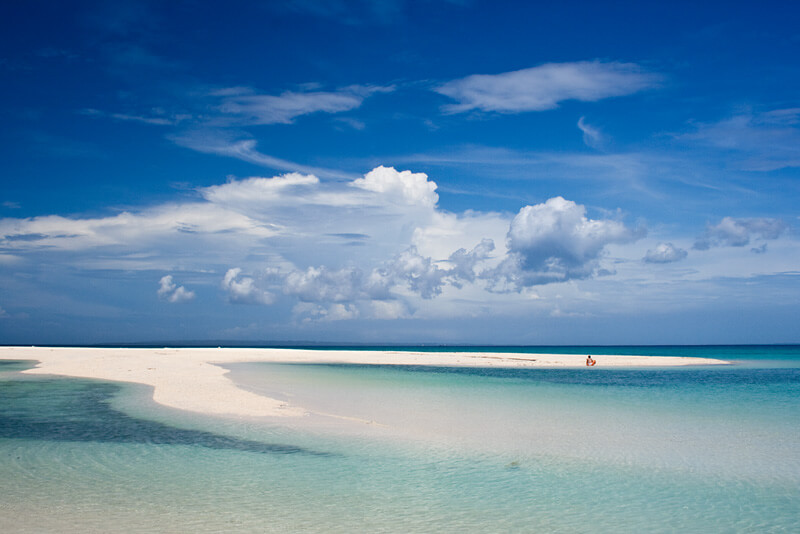
Deposition can happen in a variety of ways, due to numerous factors, but the general idea is that sediment carried by water settles in a particular location due to a loss of energy.
Sandbars, unlike tombolos and sand splits, can form off the coast and do not seemingly need to be connected to the mainland.
How are Sandbars Formed?
As mentioned above, sandbars are formed through sediment and debris deposition, but it is how the debris is deposited that pulls them apart from their similar cousins, the tombolo.
There are numerous factors and processes that influence when, and where a sandbar forms, as well as the size of it and how long it lasts.
Although it’s a complex process, the following 5 key points will help you gain a general understanding.
- Wave Action and Sediment Transport: Wave action is caused by winds and disturbances on the seabed uplift sediment where it is suspended and transported to an alternative location.
- Deposition in Shallow Waters: In areas where the water becomes shallower, the wave energy decreases. As the wave energy diminishes, the water loses its capacity to keep sediment suspended. Consequently, the sediment settles and accumulates on the seafloor. Over time, this builds up to become a noticeable sandbar.
- Longshore Drift: When waves hit an island or point at an angle, they wrap around, resulting in a movement of water and sediment parallel to the shoreline. This is known as longshore drift and is the same process that begins the formation of a tombolo. This longshore drift can lead to the gradual accumulation of sediment in certain areas, forming sandbars.
- Tidal and River Influences: Tidal movements in estuaries and coastal areas can contribute to the movement of sediment. Similarly, discharge in river mouths, often brings with them sediment from the river path, contributing to the debris accumulation off the coast, and aiding in the development of sandbars.
- Vegetation Influence and Geological Processes: The underlying topography of the seafloor or riverbed can influence the distribution and accumulation of sediment, impacting sandbar formation. Submerged features like sandbanks or shoals can influence sediment dynamics and further contribute to deposition. In some cases, coastal vegetation, like seagrasses, can help stabilize sediment and contribute to the formation and maintenance of sandbars.
Marine Life and Ecology of Sandbars
Just like tombolos, sandbars support diverse ecosystems, providing habitats for various marine and freshwater species. They serve as nurseries and feeding grounds for fish, crustaceans, and other aquatic organisms.
These moving land deposits play an important role in ocean nutrient cycling as benthic animals are provided with a safe sheltered space to produce and thrive.
Although these conditions create protected areas, much like tombolos, because they are constantly moving with the currents and tides, coral reefs are not commonly found thriving along sandbars.
That said, a sandbar that has remained in place for a prolonged period could attract zooxanthellae and eventually begin a coral colony.
Potential Threats to Sandbars
Sandbars are naturally dynamic structures, and their reshaping, sizing, and moving of location are common.
That said, these marine environments still face many of the same threats as tombolos.
Alterations to natural water flow patterns and sediment transport can disrupt sandbar formation processes, leading to their degradation or disappearance.
This can happen naturally through changing tides and seawater levels or influenced by human-provoked changes such as global warming, coastal development, and dredging.
FAQs
When does a sandbar become a tombolo?
For a sandbar to become a tombolo one end will need to be attached to a mass of land (forming a sand split). When this split reaches and connects to another mass of land, the sandbar can be referred to as a tombolo.
How are sandbars relevant to humans?
Sandbars play crucial roles in coastal and riverine environments, influencing water quality, sediment transport, and shoreline stability. They also provide recreational opportunities such as swimming, surfing, fishing, and boating.
How are tombolos relevant to humans?
Tombolos offer opportunities for recreation, including beachcombing, birdwatching, and fishing. Additionally, tombolos can serve as natural barriers, protecting coastal areas from erosion and storm damage. Furthermore, tombolos have given opportunities for development on islands that were previously limited due to the oceanic gap.
Do tombolos and sandbars have cultural significance?
Yes, tombolos and sandbars often have cultural significance for coastal communities, serving as landmarks, fishing grounds, and recreational areas. They may also feature in local myths, legends, and traditional practices, showing their relevance and importance in human societies throughout time.


