
Humans are, without a doubt, the most intelligent animal species. But that doesn’t mean we are the only intelligent animal out here. According to research, wild animals are far more intelligent than we give them credit for.
Intelligence in animals comes in different forms. Some animals demonstrate intelligence through the use of tools, others can solve complex puzzles, while others have a unique ability to communicate.
Although there is no comparison between human and animal intelligence, some animals are more brilliant than their counterparts.
In this article, we take a closer look at the most intelligent marine animals.
Bottlenose Dolphins
Habitat: Found in tropical and temperate oceans across the world, inhabiting environments such as bays, estuaries, lagoons, and open waters.
Intelligence Level: Bottlenose dolphins exhibit advanced social behavior, problem-solving skills, self-recognition, and communication through a complex system of clicks, whistles, and body movements.

Bottlenose Dolphins top the list of the most intelligent marine animals. They are adorable, fun-loving, and brilliant animals.
A dolphin’s brain is larger and more complex than most animals, including the human brain. Their brain weighs about 3.5 pounds, about 0.9% of their total body weight. But size isn’t everything. They have complex clusters of neurons which are responsible for self-awareness, decision-making, and problem-solving abilities.
They also have a complex social language, using clicks and whistles to communicate. They use this language for coordinated hunting.
Bottlenose Dolphins also have a remarkable social memory. They can remember the calls of other dolphins for up to 20 years. They can also remember the location of food sources and navigate long distances to find them.
On top of that, they are also capable of problem-solving and using tools. For example, they have been observed using sponges to protect their noses while foraging. They also show compassion by caring for injured, sick, and elderly within their pod. And are known to even mourn their own dead.
Orcas
Habitat: Orcas are found all over the world’s oceans, from the polar regions to tropical waters.
Intelligence Level: Orcas exhibit problem-solving skills, the ability to communicate through various vocalizations, and create their own social system.
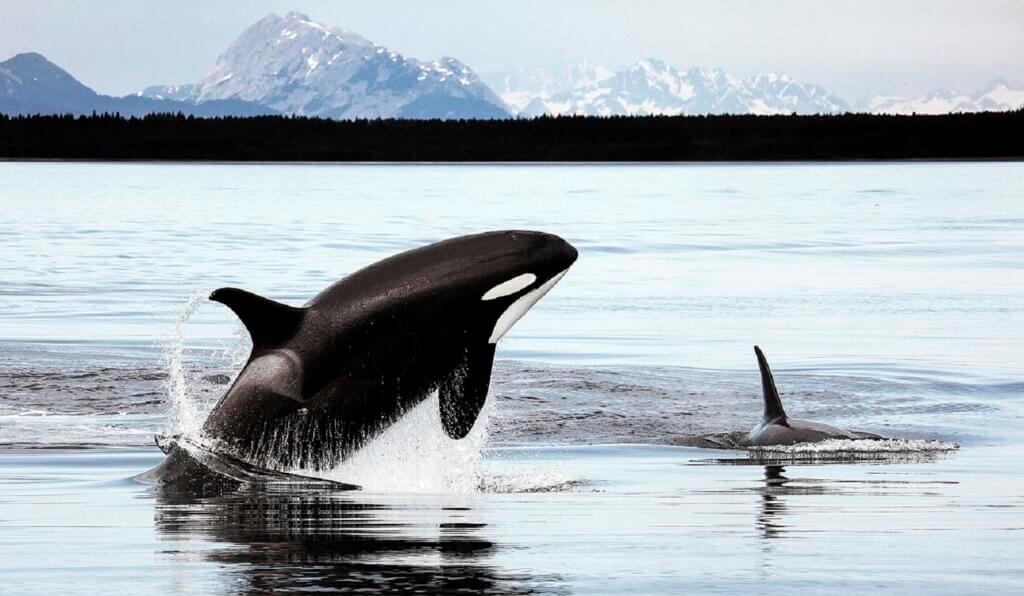
Orcas, also known as Killer Whales, have enormous brains – nearly four times the size of a human’s. This allows them to store memories, navigate expertly, and analyze their environment with remarkable skill.
Their intelligence shines through in their complex social behaviors, strong family bonds, and ability to pass knowledge down through generations. They communicate using diverse vocalizations and unique dialects, and can even mimic new sounds.
Orcas engage in various social rituals and exhibit impressive problem-solving and hunting skills. They employ cooperative tactics, like creating waves to dislodge prey, and display a high degree of self-awareness to develop unique hunting strategies.
Sea Otters
Habitat: Sea Otters are found in temperate waters, commonly inhabiting rocky shorelines and kelp forests in the North Pacific Ocean.
Intelligence Level: They are known to use tools such as rocks to crack open shellfish for food.

Sea Otters have developed skills that allow them to use tools like rocks to crack open shellfish. Recent research shows that Sea Otters started using tools millions of years ago.
These intelligent marine animals actively search for food by flipping over boulders on the sea floor. In addition, they are the only marine animal to that catches fish with their forepaws, not their mouth.
Sea Otters also have an impressive memory, which helps them locate their favorite hunting spots. They have also evolved into excellent swimmers, using their intelligence to navigate and survive in marine environments.
Octopuses
Habitat: Octopuses are most abundant in warm tropical and sub-tropical waters around the world.
Intelligence Level: Octopuses can solve puzzles, open jars, untie knots, and also exhibit self-awareness.
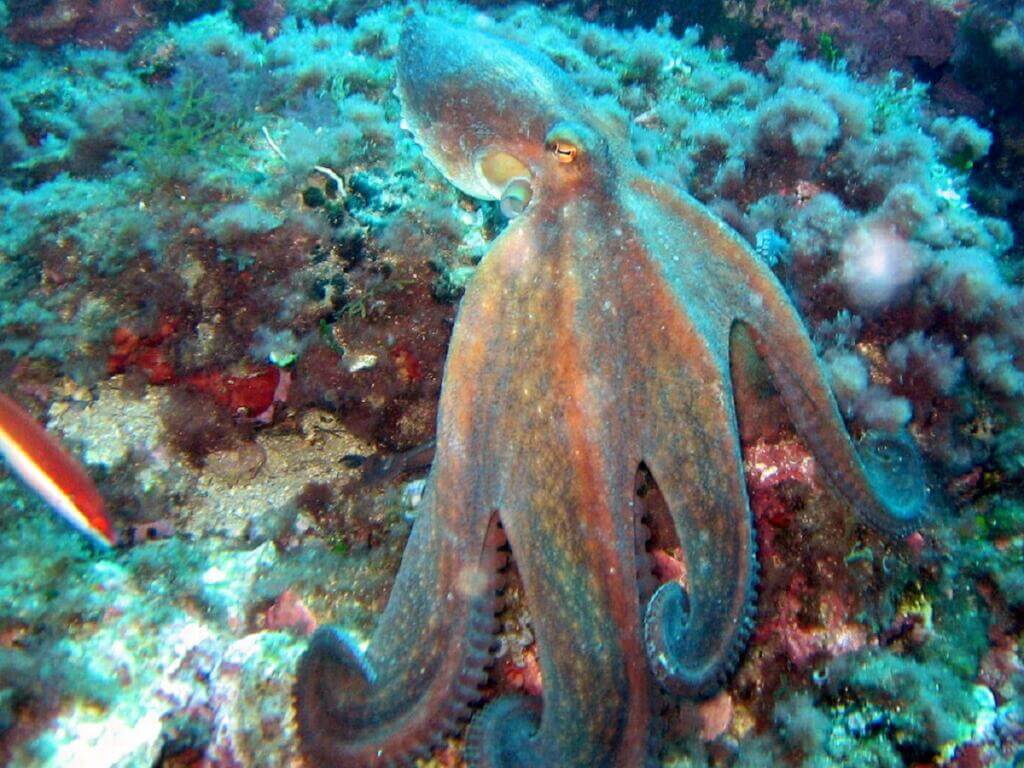
When it comes to intelligence, vertebrates generally outdo invertebrates. But the octopus is proof that you don’t need a backbone to have a big brain. So, octopuses have a large brain and an extensive nervous system, with two-thirds of their neurons located in their eight arms.
Their intelligence is comparable to that of dogs, and their brilliant problem-solving skills have been widely documented. For instance, octopuses in captivity have been observed to use water jets to turn out lights they find annoying. They have also been observed to sneak into neighboring tanks to steal fish.
Using their intelligence, octopuses use tools to solve problems. For example, they can steal tentacles from jellyfish and use them as weapons, or even hitch rides on jellies, steering them for protection against threats.
Another revelation of octopuses’ intelligence is their complicated use of camouflage. They copy elaborate textures or imitate other animals to keep off predators. They are also able to recognize individual people, enjoy playing with toys, and can solve mazes too.
Manta Rays
Habitat: Manta Rays live in tropical to temperate waters, and are commonly found in the open ocean, as well as in estuaries, inlets, and bays.
Intelligence Level: They have remarkable learning abilities and impressive memory. They also display emotional intelligence and form unique individual relationships with each other.
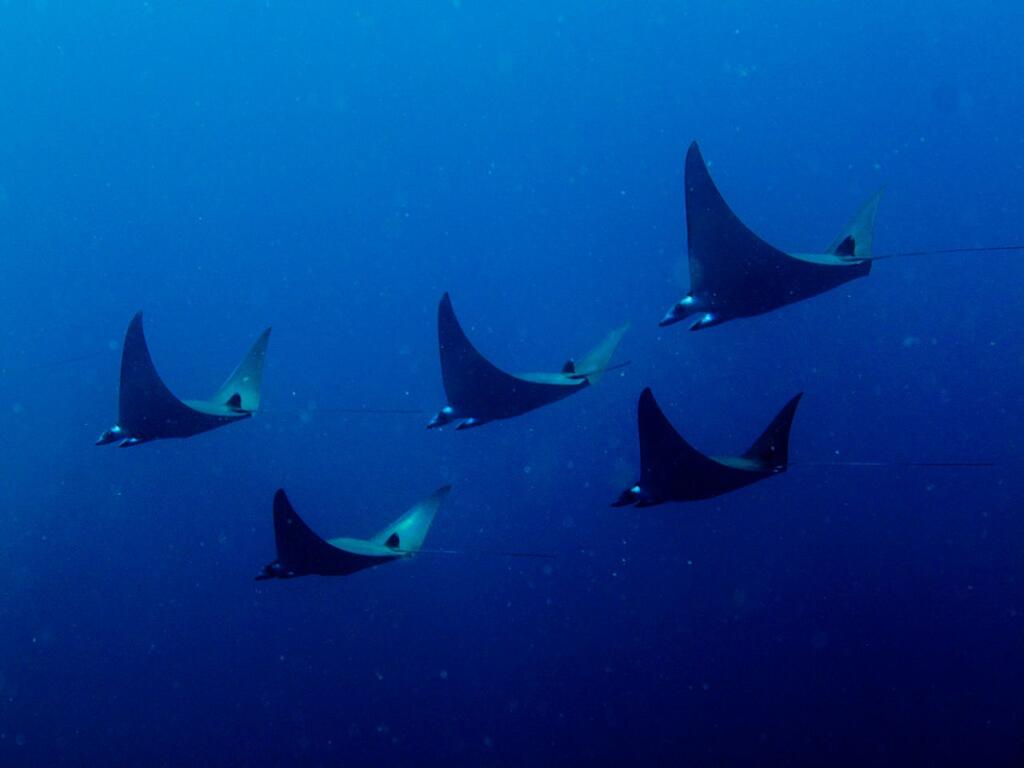
While Manta Rays may not have advanced abilities like dolphins or octopuses, they still showcase impressive intelligence. They’re adaptable and have remarkable memory, enabling them to recall specific feeding grounds. Their social interactions are sophisticated, demonstrating recognition and cooperation with other Manta Rays.
Manta Rays also exhibit navigation skills, using sight and smell to map their surroundings. Their large, complex brains, the biggest of any fish, are particularly developed in areas linked to learning, problem-solving, and communication.
Further proof of their intelligence lies in their ability to communicate through body language, collaborate during hunting, and display curiosity and playfulness around humans.
Sea Lions
Habitat: Sea Lions live in shallow tropical to and subpolar waters across the globe, excluding the Northern Atlantic Ocean.
Intelligence Level: They have remarkable skills for social learning, problem-solving, effective communication, and an impressive memory.

Sea Lions are highly intelligent marine animals. They show great ability for social learning. They can learn from each other’s behavior and communicate effectively using barks and growls. They use these vocalizations to identify themselves, organize group hunting, and take care of their young ones.
They also demonstrate problem-solving skills, the ability to recognize their own reflection in mirrors, and the ability to use tools to solve problems. They can also be trained to perform certain tasks and are often used in areas such as military and rescue operations.
Penguins
Habitat: Penguins primarily live in the Southern Hemisphere, except the Galapagos Penguin.
Intelligence Level: They are incredibly good at creating mental maps, recognize individual calls, and employ coordinated hunting strategies.

Adding to our list of the most intelligent marine animals are penguins. One fascinating aspect of their intelligence is their ability to create mental maps. This is because of their great memory and their ability to use visual cues such as hills and rivers. For example, Adelie and Chinstrap penguins can locate the same nesting spot they’ve been using for years.
Another aspect that makes penguins one of the smartest sea creatures is their ability to hunt in groups and work together as a team to increase their chances of catching prey. And despite their nearly identical looks, King Penguins can recognize their mates and offspring in a colony of hundreds.
Penguins are known to use a range of vocalizations, such as loud noises and barking, to communicate and identify one another. They also have problem-solving abilities as they know how to get around obstacles in their surroundings.
Great White Sharks
Habitat: Great White Sharks are found in temperate and sub-tropical coastal waters all over the world.
Intelligence Level: They are highly curious, display complex social interactions, exceptional hunting skills, and remarkable cognitive abilities.

Great White Sharks are apex predators and one of the most feared animals in the ocean. But how intelligent are they?
They are highly inquisitive and social creatures. They engage in diverse interactions with one another, from displays of dominance to cooperative hunting. They also undertake vast migrations across oceans demonstrating their adaptability and resilience.
Great White Sharks have a remarkable brain that coordinates its highly developed senses. This allows them to outsmart intelligent prey like seals and dolphins, showcasing their impressive cognitive abilities. Their ability to learn quickly and adapt their strategies further challenges the traditional perception of them as mindless predators.
Ocean Insights: Hear From Our Experts

By Dr. Rabiah Ryklief
Principal Scientist and Lecturer of Marine Science, with a PhD in Zoology
Scientists think that when marine mammals moved from living on land to living in the ocean, it greatly affected how their brains worked. Because they had to rely on sound and touch underwater, they developed special ways of thinking. This is shown by their ability to learn by watching others. The connection between how complex their brains are and how smart they are is really interesting, and scientists want to use brain scans to learn more. While more research is needed to fully understand how intelligence compares across different species, this study gives us important clues about how marine mammals think.
FAQs
What is the most intelligent animal in the world?
Although multiple factors come into play when measuring intelligence, bottlenose dolphins have often been cited as the most intelligent animals in the world, after humans. They exhibit advanced social behavior, problem-solving skills, self-recognition, and a complex communication system. Close competitors for the title include chimpanzees, elephants, parrots, and crows.
Can marine animals express emotions?
Marine animals demonstrate a wide range of emotional expression, including feelings like fear, joy, stress, and grief. For instance, dolphins exhibit caregiving behaviors towards sick group members, and mothers mourn their deceased offspring. Whales, who communicate through vocalizations, likely express their emotions through these sounds as well. Researchers have also confirmed that fish experience a variety of emotions, including pain and pleasure, challenging previous assumptions that they were incapable of such feelings.
Which marine animals can remember humans?
Bottlenose Dolphins and Sea Lions have impressive memory and can remember humans they have interacted with. Orcas have also been observed to remember human voices and distinguish between different trainers.


