
It’s easy to mistake seas and oceans for one another. You can’t tell the difference by looking at them, leading most to falsely assume that they’re the same thing. Commonly ocean and sea is used interchangeably to refer a big body of salt water. But there’s a difference between the two terms when speaking of geography.
To end the “Sea vs Ocean” debate once and for all, this article highlights the four main differences between them.

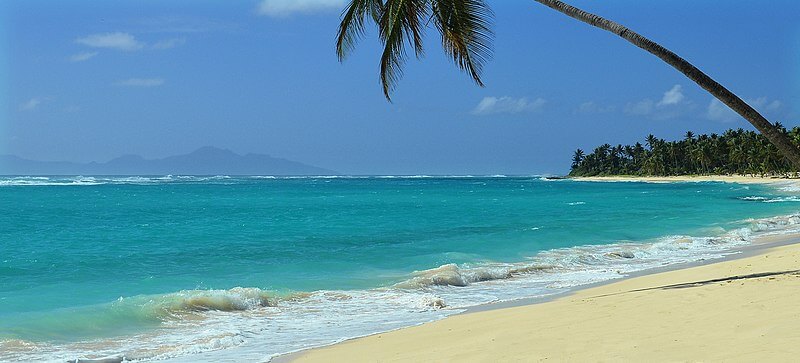
Credit Left: Tiago Fioreze, CC BY-SA, Right : Kijan Ay, CC BY 3.0
Sea Vs Ocean: Main Differences
There are four main differences that make the “Sea vs Ocean” question easy to answer:
- Size: Oceans are much larger than seas.
- Location: Most seas are partially surrounded by land, while oceans are not. Seas can be located within oceans.
- Depth: Oceans are much deeper than seas.
- Quantity: There are 28 seas and only five oceans in the world.

What is a Sea?
A sea is a large body of saltwater that partially borders a landmass. Most seas, like the Mediterranean Sea, are only partially surrounded by land. There are also some seas, like the Caspian Sea, that are “landlocked” or surrounded by land. Some bodies of water are entirely surrounded by land, but are big enough to be considered seas, such as the Black Sea.
However, not all bodies of water fit neatly into specific categories, and there are exceptions and anomalies. For instance, the Sargasso Sea, a relatively calm area of the Atlantic Ocean, is not enclosed by land but is defined by its position within ocean currents. Additionally, not every body of water classified as a sea has “sea” in its name; the Gulf of Mexico and the Bay of Bengal meet the criteria for seas. Hudson Bay is also considered an inland sea. Conversely, not every body of water with “sea” in its name is actually a sea.
The Concept of the Seven Seas
Throughout history, various cultures, including Hindu, Chinese, Persian, and Roman, have mentioned the Seven Seas. These seas often represented significant trade routes or symbolized distant and exotic places.
The concept of the Seven Seas has changed over time. Today, it commonly includes the five major oceans, with some distinctions. The Pacific Ocean is divided into the North Pacific and South Pacific, and the Atlantic Ocean is divided into the North Atlantic and South Atlantic. The Indian Ocean, the Southern (or Antarctic) Ocean, and the Arctic Ocean are also part of this modern interpretation.
Some famous seas are:
- Mediterranean Sea: 1,144,800 square miles
- Caribbean Sea: 1,049,500 square miles
- South China Sea: 895,400 square miles
- Bering Sea: 884,900 square miles
- Gulf of Mexico: 615,000 square miles
- Okhotsk Sea: 613,800 square mile
- Red Sea: 174,000 square miles
Size
There is no official minimum size for a sea, but seas are always smaller than oceans.
Seas come in very different shapes and sizes. For example, at 137,000 square kilometers in size, the Adriatic Sea is the smallest in the World. At over 5.5 million square kilometers in area, the Philippine Sea is the World’s largest sea!
Location
Seas can be found connecting all of the planet’s seven continents. Most seas are found on the coastline and are actually a part of the ocean.
Depth
Seas usually do not exceed depths of 2,000 meters. Many animals, including some found in the Mariana Trench, cannot live above 2,000 meters. Instead, if these animals rise to the surface without special precautions, the lack of water pressure can be extremely damaging and often fatal to these sea creatures.

What is an Ocean?
When people refer to the ocean, they typically mean “the immense expanse of salt water that covers nearly three-quarters of Earth’s surface.” This can be imagined as a single, continuous body of water with continents acting as islands within it. This enormous stretch, often called the world ocean, is divided into sections based roughly on their locations between continents.
The “sea vs ocean” debate is so confusing because sailors used to refer to our oceans as “The Sea.” Over time, scientists discovered that the sea is often grouped into bodies of water called oceans.
There are five official oceans:
- Pacific Ocean (from the east coasts of Asia and Australia to west coasts of the Americas) -60,060,700 square miles
- Atlantic Ocean (from the east coasts of the Americas to the west coasts of Europe and Africa) -29,637,900 square miles
- Indian Ocean (between the east coast of Africa, the Indian subcontinent, and the west coast of Australia)-26,469,900 square miles
- Arctic Ocean (in the extreme global north) -5,427,000 square miles
- Southern Ocean (in the extreme global south) -7,848,300 square miles
Unlike seas like the Caspian, there are no landlocked oceans. Every ocean shares at least one border with every other ocean.
Size
Unlike seas, even the smallest ocean is too large to be partially contained by any land mass smaller than an entire continent. Instead, the oceans are the ones surrounding the continents.
The Arctic Ocean is our smallest ocean, spanning ~5.5 million square kilometers. The Pacific Ocean is our largest ocean at ~165.2 million square kilometers. That means it covers over 30% of Earth’s surface by itself!
Location
Since oceans take up most of the world, most people don’t consider them to have a specific location. Looking at a world map, the only ocean that is circumglobally (spanning the globe) is the Southern Ocean. Instead, oceans are usually considered the “background” of our maps.
Depth
How deep is the ocean also distinguishes it from the sea. An average spot on the Ocean floor is over 3,500 meters (or over 12,000 feet) deep. The ocean floor is so deep that light can’t reach the bottom! Animals that live at these depths have had to adapt and survive in total darkness.
Since the ocean is so deep, most animals that live on the surface are not able to survive at these depths. Cuvier’s Beaked Whales are the deepest-diving species in the World, and even they can’t reach the ocean floor.
Ending the Debate
The debate between sea vs ocean can be settled by understanding their distinct definitions and characteristics. Oceans are vast, continuous bodies of saltwater that cover nearly three-quarters of the Earth’s surface, forming the primary divisions of the world ocean. They are deeper and larger than seas, which are smaller bodies of saltwater partially enclosed by land. Seas are often found on the margins of oceans and are more directly influenced by the landmasses around them.
While oceans are divided into five major regions (the Atlantic, Pacific, Indian, Southern, and Arctic), seas include well-known examples like the Mediterranean Sea, the Caribbean Sea, and the South China Sea. By recognizing these distinctions, the terms can be used accurately and interchangeably when appropriate, ending the debate.
Ocean Insights: Hear From Our Experts

By Rida Nasir
Researcher and Conservationist, with an MSc in Environmental Science
An intricate relationship lies between the seas and the oceans. The Age of Exploration marked a pivotal moment, with intrepid sailors encountering vast expanses that defied easy categorization, while the Renaissance and Enlightenment refined our understanding through scientific precision, solidifying the terms "sea" and "ocean." With over 70% of Earth's surface covered by water, our planet's predominantly blue landscape shapes our climate, sustains life, and fosters connections across distant shores. Seas, nestled along coastlines, harbor unique ecosystems, serving as intimate conversations between land and water, while oceans, with their grand narratives, regulate temperatures, absorb carbon, and generate life-sustaining oxygen. Despite of their geographical differences, they provide us with food, mineral resources, transportation routes and other services.
FAQs
Are seas the same as gulfs?
Not quite. Gulfs are the parts of a sea that are surrounded by land.
For example, the Persian Gulf is surrounded from all sides by water except an opening in the East which leads to the rest of the Sea of Oman. Gulfs are parts of seas, and seas are parts of oceans.
How many gulfs are there?
There are 62 officially listed gulfs in the World. The Gulf of Mexico is considered one of the largest and deepest. These gulfs come in many different shapes and sizes.
Are seas and bays the same?
Seas and bays are different! Bays and gulfs are both parts of a sea, but unlike a gulf, a bay is a part of the sea that causes the land to curve inward. For example, the Bay of Bengal is surrounded by a curved land mass from the West, North, and East.
How many bays are there?
Depending on your definition, there can be hundreds of bays, but the International Hydrographic Organization has assigned data codes to 9 of these bays. These bays include the Hudson, Baffin, James, Palk, Bengal, Biscay, Fundy, Bristol, and Korean Bays.


