Swimming isn’t the only way to get around in the ocean. While still the most common form of locomotion, many creatures have adapted to life without relying on traditional swimming methods. Some crawl along the seafloor whereas others rely on currents to get around.
These animals, ranging from invertebrates like sea cucumbers and anemones to fish like batfish and frogfish, have evolved unique and surprising ways to navigate their environment. In this blog post, we’ll explore eight marine animals that cannot swim, defying our expectations of what it means to live in the ocean.
Sea Cucumbers
Mode of Movement: Crawl
Habitat: Sandy bottoms in coral reefs, seagrass beds, and deep-sea trenches

The ocean is home to creatures like the sea cucumber, which defy swimming expectations. These soft-bodied, cylindrical animals resemble something between a worm and a sausage. They have evolved a unique body structure adapted for a life of crawling and burrowing along the seabed.
Sea cucumbers use hundreds of tiny tube feet which act like suction cups to slowly pull themselves forward. These tube feet extend and contract in a wave-like motion, allowing the sea cucumber to navigate the seabed.
However, some sea cucumber species lack tube feet and rely on a different method: peristaltic movement.
Peristaltic movement is a coordinated muscular contraction and relaxation along the length of the sea cucumber’s body.
This involves a series of muscle contractions and relaxations that create waves of motion through their bodies. The sea cucumber essentially pushes itself forward by contracting its muscles in a coordinated way. This unique form of locomotion is made possible by a specialized vascular system and fluid-filled sacs called ampullae.
Sea Star
Mode of Movement: Crawl
Habitat: Coral reefs, rocky shores, tidal pools, kelp forests, seagrass meadows, and deep-sea trenches

Sea stars are iconic creatures easily recognized by their central disk with five or more radiating arms. Like their relative the sea cucumber, sea stars get around using their hundreds of small tube feet.
These tube feet are powered by a hydraulic system that uses seawater to extend and contract them. This allows sea stars to navigate the seabed, climb over obstacles, and even pry open shellfish for a tasty meal. In fact, their tube feet are so strong, that they can even open clams and mussels that are tightly closed.
Sea Anemones
Mode of Movement: Glide and drift
Habitat: Often attached to rocks in tidal pools or on soft sediments in shallow waters

While it’s true that sea anemones spend most of their lives anchored to one spot, these marine creatures are more mobile than you might think. They can glide slowly across surfaces by secreting mucus. Or, if they’re feeling adventurous, they can simply detach and let the currents carry them to a new location.
While these movements might seem small, they play a crucial role in the anemone’s survival. By shifting their position, they can access new food sources, find a more suitable habitat, or escape from predators.
Some sea anemones are capable of awkward swim-like movements. They flex and twist their bodies to propel themselves through the water. This “swimming” motion is typically reserved for emergencies, like escaping from a predator or a sudden change in their environment.
Portuguese Man O’War
Mode of Movement: Float
Habitat: Open ocean in tropical and sub-tropical waters

The Portuguese Man O’ War might look like a jellyfish at first glance, but it’s actually a fascinating creature called a siphonophore. Essentially, it’s a colony of specialized organisms working together as one. It has a translucent blue, violet, or pink coloring, and while it may be beautiful, this “floating terror” can’t actually swim.
The Portuguese Man O’ War relies on its gas-filled float, which acts like a sail, to catch the winds and ocean currents. This allows it to drift along the surface, sometimes venturing into bays or even washing up on beaches. Interestingly, the Portuguese Man O’ War’s dependence on wind and currents often leads to them congregating in groups.
Batfish
Mode of Movement: Walk
Habitat: Seagrass meadows, mangroves, floating sargassum weed beds, coastal lagoons, and seaward reefs

The batfish has an unusual appearance with its flattened body and eyes perched on top of its head. Its most striking feature is its modified pectoral and pelvic fins which have evolved into “legs,” allowing it to walk along the seabed.
Batfish primarily rely on their pelvic fins to rest on the ocean floor. However, these leg-like fins can also be used to dig into the ground. Although batfish can swim, they are not strong swimmers. Instead, they propel themselves forward especially when escaping a predator.
Spiny Devilfish
Mode of Movement: Walk
Habitat: Sandy bottoms of tropical lagoons and seaward reefs

The Spiny devilfish is a small, venomous fish with cryptic coloring and spine-like projections. It’s pectoral fins have been modified into leg-like structures. The four lower rays of these fins function as legs, allowing the fish to crawl slowly along the seabed. This unusual form of locomotion is called subcarangiform locomotion.
Subcarangiform locomotion is a type of movement where fish use both their body and tail for propulsion.
The Spiny devilfish rarely swims, earning it the nickname “Indian Ocean Walkman.” It spends much of its time lying motionless buried in sand or coral rubble, waiting to ambush unsuspecting prey.
Crabs
Mode of Movement: Walk
Habitat: From tropical to temperate waters in shallow and deep-sea environments

Crabs have evolved a surprising variety of locomotion methods. Though they all have ten legs, including a pair of claws for grabbing and manipulating objects, not all crabs move in the same way.
Most crabs, like Stone crabs and Ghost crabs, do indeed walk or run across the seafloor. Others, like the Spider crab, even use the sharp tips of their legs to scale steep rocks. Crabs with flexible, jointed legs can also move sideways, forward, and even backwards.
However, the Portunidae family has evolved special paddle-shaped hind legs called swimmerettes. These legs rotate rapidly, propelling the crab through the water with surprising speed and agility. The Blue crab and Velvet crab are well-known examples of swimming crabs.
Frogfish
Mode of Movement: Walk
Habitat: Coral and rocky reefs in quiet, shallow waters
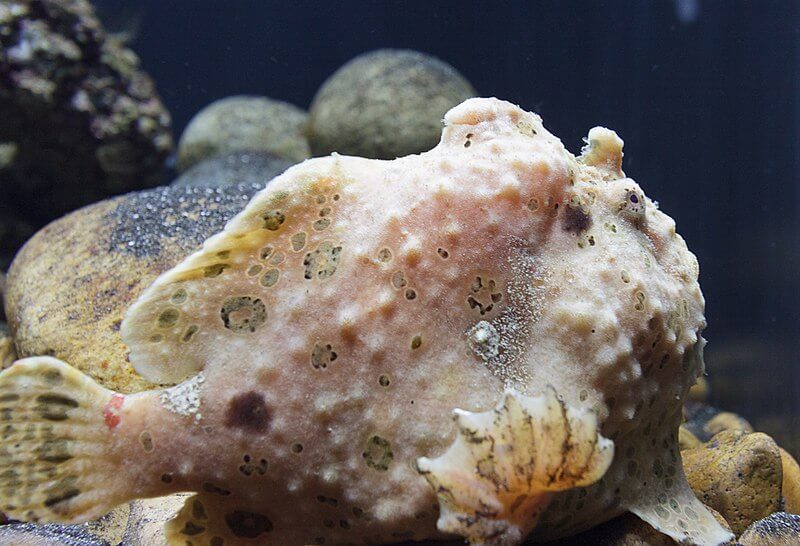
Frogfish belong to the anglerfish family and are covered in spinules and other appendages that act as camouflage. They have modified pectoral and pelvic fins that resemble legs. This allows the Frogfish to move slowly and deliberately along the seafloor.
Their fins are better suited for walking than swimming, and they also lack swim bladders, which most fish use to control their buoyancy. Furthermore, they have thick, bulky bodies not conducive to swimming.
This unusual mode of locomotion is perfectly suited to the Frogfish’s lifestyle. As ambush predators, they spend most of their time lying in wait. When prey comes close, they strike with lightning speed, using their powerful jaws to capture their meal.
Ocean Insights: Hear From Our Experts

By Dr. Rabiah Ryklief
Principal Scientist and Lecturer of Marine Science, with a PhD in Zoology
It's been traditionally believed that generating high pressure by pushing against the surrounding environment was the key to efficient locomotion. But scientists have uncovered a different story: some animals, like jellyfish and lampreys, actually pull themselves forward by creating low-pressure zones. This "suction" approach requires less energy than pushing against water or air. It's like gliding effortlessly through the water, not by pushing it back, but by drawing it in.
FAQs
Can ocean animals survive without swimming?
Several ocean animals, such as corals, can survive without swimming. Other animals, such as sea cucumbers and starfish, move slowly along the seabed. Rather than swimming, they crawl, glide, or remain stationary, relying on the ocean currents to bring food their way.
Do all animals know how to swim?
Not all animals instinctively know how to swim. Most mammals, excluding aquatic mammals like dolphins and whales, need to learn how to swim. Also, not all marine animals swim; some have adapted to live on the ocean floor. Additionally, newborn marine animals, like certain turtles, may have an innate ability to swim but still go through a learning phase to hone their skills.
What sea animals crawl on the sea?
Several sea animals, such as sea stars, crabs and lobsters, sea urchins, sea cucumbers, snails, and other mollusks, move along the sea floor by crawling. The sea stars, crabs, lobsters, and sea urchins use their tube feet, while crabs use their legs. Snails use a muscular foot.
How do animals that do not swim adapt to ocean life?
Animals that do not swim have developed various adaptations to thrive in their marine environment. They include burrowing, camouflage, symbiotic relationships, and using currents. These adaptations are key to survival for many species, allowing them to find food, avoid predators, and reproduce without the need to swim.
Which sea animal can walk on land?
Several sea animals, including crabs, octopuses, and sea lions, can walk on land. The most iconic of them, however, are the mudskippers. These amphibious fish use their pectoral fins to walk on land. They mainly inhabit intertidal zones and mangrove ecosystems.


